Most teams don’t have one big communication problem. They have forty small ones, spread across five apps.
Communication strategies are the shared habits a team uses to pass information: who talks to whom, on which channel, how fast, and where decisions live. The ones that work are simple. Hold one-on-ones, give each request one owner, match messages to channels, and write decisions down.
You’re not imagining the friction. Grammarly’s 2024 business communication report found every knowledge worker it surveyed hits a miscommunication at least weekly.
We read the top guides and checked their sources. You’ll get the four types, 10 tactics, a fix-it table, and a five-step plan.
Key Points
- Communication strategies are the shared rules for who says what, where, and how fast. The 10 tactics that matter most cover one-on-ones, meeting turns, channel choice, single owners, prep, feedback, tough talks, decision logs, reply times, and tone.
- Fix the symptom you see first. Missed handoffs need named owners, repeat questions need a decision log, and noisy chat needs a channel charter.
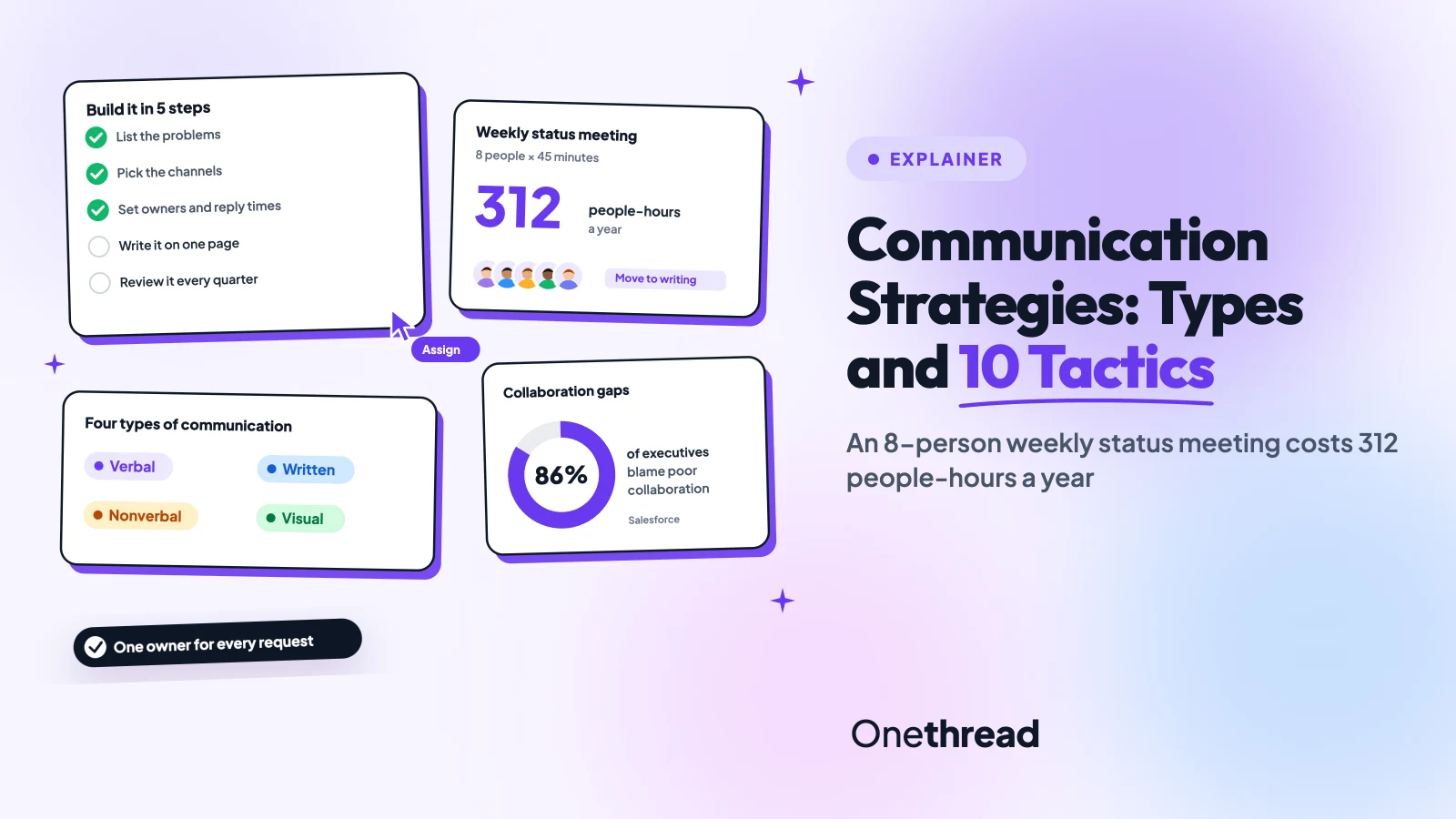
- Meetings are the priciest channel. An 8-person, 45-minute weekly status meeting costs 312 people-hours a year, so routine updates belong in writing.
- Build your own plan in five steps: list the problems, pick the channels, set owners and reply times, write it on one page, and review it every quarter.
What Are Communication Strategies?
Communication strategies are the planned methods a team uses to share information so the right people get the right message at the right time. They cover the channel, the timing, the owner, and the format. A good one fits on a single page and answers the question “where does this go?”
Here’s the thing: most teams already have a strategy. It just isn’t written down. So it lives in the heads of the two people who’ve been around longest.
A communication strategy differs from a communication plan. The strategy sets the standing rules for every day. A plan applies those rules to one project or event, with dates and named messages. You need the strategy first, because every plan borrows from it.
Three parts show up in almost every team strategy that works:
- Channels: which tool carries which kind of message, from quick chat to formal email.
- Owners: who answers, who decides, and who closes the loop when work changes hands.
- Timing: how fast each channel expects a reply, and when meetings happen.
And the strategy has two layers. One covers personal habits, such as listening and tone. The other covers team rules, such as decision logs and status updates.
You need both. Good listeners still lose work in a messy channel setup, and a tidy setup can’t save a rude meeting.
Why Do Communication Strategies Matter for Teams?
Communication strategies matter because unclear messages cost time, money, and trust long before anyone notices. The costs are rarely one big failure. They’re a slow leak of rework, missed handoffs, and meetings about meetings.
The numbers back this up. Salesforce has long cited a finding that 86% of executives blame ineffective collaboration and communication for workplace failures. Newer research points the same way.
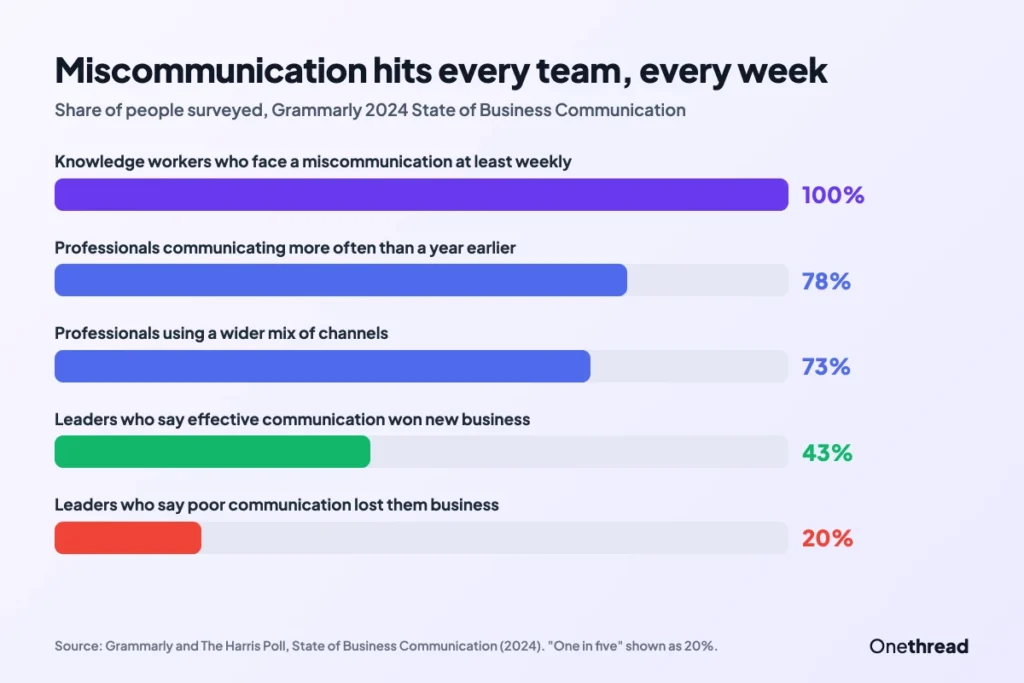
In its 2024 State of Business Communication report, Grammarly found that 78% of professionals communicate more often than a year earlier. And 73% now use a wider mix of channels. One in five business leaders said poor communication cost them business. On the bright side, 43% said effective communication won them new business.
The channel load is heavy too. Microsoft’s Work Trend Index reports that the average worker receives 117 emails a day and 153 Teams messages each weekday. It also found people get interrupted every two minutes during core hours.
That’s the real case for a written strategy. Not more messages. Fewer, better routed ones.
When people know where a message belongs, they stop checking six places for one answer. If your team keeps missing deadlines, our look at why projects fail shows how often poor communication sits underneath.
What Are the Four Types of Communication?
The four types of communication at work are verbal, written, nonverbal, and visual. Every communication strategy mixes them, so it helps to know what each does well and where each breaks. Pick the type that fits the message, and you avoid half the confusion before it starts.
Verbal Communication
Verbal communication is information shared through spoken words, in person, on calls, or in voice notes. It’s fast, and it carries tone, so it suits feedback, brainstorming, and anything with feelings attached.
But spoken words disappear. Nobody remembers the exact deadline from a hallway chat two weeks later. Clear speech, a steady pace, and plain word choice help a lot. So does good listening on the other side.
The fix is easy. After any verbal decision, one person writes a two-line summary where the team can find it. Talk first, then record.
Written Communication
Written communication covers email, chat, documents, task comments, and reports. Its big strength is a lasting record that people can check again and again. That makes it the right home for decisions, instructions, and anything with a date.
The catch is tone. Readers can’t hear your voice, so a short reply can read as cold or annoyed. Choose words with care, and front-load the ask in the first line.
Keep written messages scannable. Use one topic per message, short paragraphs, and a clear subject line. If the reply needs more than three back-and-forth rounds, switch to a quick call.
Nonverbal Communication
Nonverbal communication is everything you say without words: posture, facial expression, eye contact, gestures, and timing. Research on body language shows how much people read from these cues, often more than from the words.
That’s why nonverbal signals cause so many accidental misunderstandings. If someone avoids eye contact while you pitch an idea, you might read it as disagreement. They might just be tired.
On video calls, the cues shrink to a small box. Keep your camera on for important talks, nod when you agree, and say “I’m with you” out loud. It sounds odd at first. It works.
Visual Communication
Visual communication uses charts, diagrams, timelines, boards, and slides to carry a message. It works best for complex information, such as a project schedule or a process with many steps. One clear chart can replace three paragraphs of explanation.
Visuals pair well with speech and writing. In team meetings, a shared timeline on screen keeps everyone looking at the same facts. And it cuts the “wait, which version?” questions.
Keep visuals simple. One idea per chart, labeled axes, and a title that states the point. If people need you to explain the diagram, the diagram needs work, not more explanation.
Which Communication Strategies Work Best for Teams?
The communication strategies that work best for teams are small habits repeated every week, not big launches. These 10 effective communication strategies cover personal habits and team rules. Start with the two or three that match your biggest pain. Then add the rest over a quarter.
Hold Regular One-on-One Check-Ins
One-on-one conversations build the trust that group channels can’t. In a private chat, you learn how a teammate likes to communicate, what worries them, and what they won’t say in a group.
Keep them short and regular. Fifteen to thirty minutes every week or two beats an hour once a quarter. Let the other person set half the agenda.
One-on-ones are also the right place for sensitive topics. Confidential news, personal feedback, and career questions don’t belong in a team thread. If you lead a team, our guide to good communication skills covers how to listen and respond in these talks.
Give Every Voice Room in Meetings
Meetings fail when the same three people do all the talking. Others stop sharing ideas, and the team loses information it paid to bring into the room.
A structured meeting agenda fixes most of this. Send it a day early, list the decisions needed, and invite only the people directly involved.
Then run the room on purpose. Ask quieter members first, set a time limit per speaker, and don’t let anyone interrupt. The meeting lead owns this. A comfortable room gets better ideas than a loud one.
Match Each Message to the Right Channel
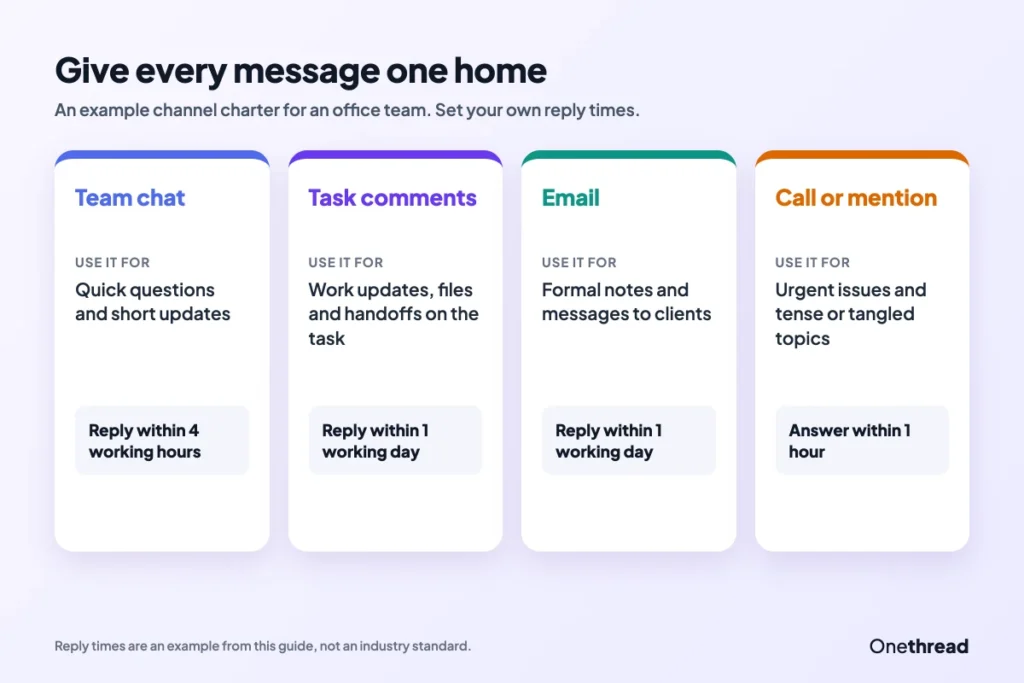
Every channel has a job. Chat suits quick questions, email suits formal or outside messages, task comments suit work updates, and calls suit anything tense or tangled. Trouble starts when the same message type lands in four places.
A channel charter solves this. It’s a one-page note that says which channel carries which message and how fast people should reply.
Tools help when they keep talk next to the work. In Onethread, the Discussion feature lets you open as many chats as you want inside each project. Project talk stays with the project instead of a general chat stream.
Assign One Owner to Every Request
A request with two owners has none. “Can someone check this?” is the most ignored sentence in team chat, because everyone assumes someone else will answer.
So give every ask one named owner and a due date. Write it as a task, not a chat message, when the work takes more than ten minutes. Then the owner knows it’s theirs, and everyone else knows they can stop worrying about it.
The same rule applies to handoffs. When work moves from design to development, the sender confirms the receiver has it. “Sent” isn’t the same as “received.” A short “got it” closes the loop.
Prepare Your Key Points Before You Talk
Winging an important conversation is how details go missing. Before a meeting, call, or update, write down the three points you need the other person to remember.
Then shape them for the listener. A client wants outcomes and dates. An engineer wants the problem and the limits. Same facts, different order.
Preparation also cuts meeting time. If you can’t state your goal in one sentence, you’re not ready to call the meeting. Write the sentence first, and send it with the invite so people arrive with answers instead of questions.
Ask for Feedback Both Ways
Communication that only flows down isn’t communication. It’s announcements. Two-way communication means you ask for questions, objections, and ideas, and you act on what you hear.
Make feedback a habit, not an event. End meetings with “what’s unclear?” rather than “any questions?” The first invites real answers. The second invites silence.
Ask for feedback on your own messages too. If people keep asking the same follow-up question, your first message left something out. Treat repeat questions as a signal to fix the source, not as a nuisance.
Plan Tough Conversations Ahead
Difficult conversations are the ones people avoid most. More than 80% of workers fear at least one scary conversation at work, according to a poll published by Forbes.
Avoiding them only makes them bigger. Plan instead. Write down the issue, the outcome you want, and one fact that supports your view.
During the talk, stay on the issue rather than the person. Use “I” statements, such as “I’m worried we’ll miss Friday,” instead of “you always miss deadlines.” Listen fully, sum up what you heard, and look for common ground. You’re solving a problem together, not winning an argument.
Write Down Decisions Where People Look
Teams make good decisions and then lose them. Three weeks later, someone asks why the launch moved, and nobody can find the thread.
A decision log fixes this. For each decision, record what was decided, who decided, when, and why. Keep it in one place the whole team can find in ten seconds, such as the project’s main page.
This habit also saves meeting time. Instead of re-arguing old choices, you point to the log. And new team members get context without a two-hour catch-up call. Write the entry the same day, while everyone still remembers the reasons.
Set Reply Times for Each Channel
Most chat stress comes from not knowing how fast you must reply. So people answer everything at once, and focus work never happens.
Set clear reply times per channel and write them in the channel charter. Here’s what that looks like for many office teams:
- Urgent issues: a phone call or a direct mention, answered within an hour.
- Team chat: a reply within four working hours.
- Email and task comments: a reply within one working day.
Your numbers can differ. What matters is that everyone uses the same ones, so a slow reply stops feeling like a snub.
Keep the Tone Positive and Fair
Tone decides whether people hear your message or just your mood. A calm, friendly tone keeps people open. A sharp one makes them defensive, even when you’re right.
Small things help. Research suggests smiling triggers the release of neurotransmitters linked to lower stress, for the speaker and the listener.
Fairness matters just as much. Treat every teammate with the same respect, no matter their role or seniority. And think before you speak. Once a harsh comment is out, you can’t take it back.
What Communication Mistakes Should Teams Avoid?
The communication mistakes teams should avoid are habits that feel harmless in the moment and cost trust later. Most of them come from rushing. Watch for these six:
- Assuming everyone hears it the same way: People learn and process differently. Check understanding with a quick recap instead of assuming the message landed.
- Listening only to reply: Poor listening causes most misunderstandings. Try to be a good listener first, and ask one question before you answer.
- Ignoring your tone: A harsh tone can start an argument over a small issue. Use a calm, confident voice that shows you’re open to the other view.
- Letting emotions decide: Choices made in anger often need undoing later. Pause, sleep on it if you can, and respond once you’ve thought it through.
- Staying silent: Holding back a concern doesn’t make it go away. Share your view early, with one fact to support it, while it’s still cheap to change course.
- Hearing only people who agree: Social media has made the echo chamber familiar, and the same thing happens at work. Ask the person who disagrees most to speak first.
Top Tip: Pick the one mistake your team makes most and name it in your next retro. Fixing one habit beats a poster listing six.
Which Communication Strategy Fixes Which Team Problem?
The right communication strategy depends on the symptom you see most. Start with the row that sounds like your week, then add the tactic it points to. These pairings are our suggestions, and they double as communication strategy examples you can copy.
| Symptom you notice | Strategy to start with | First step this week |
|---|---|---|
| Work falls through the cracks at handoffs | One owner per request | Turn open chat asks into tasks with names and dates |
| The same questions keep coming back | Decision log | Log the last five decisions on the project page |
| Chat is noisy and people feel always on | Channel charter and reply times | Agree on reply times per channel in one meeting |
| Meetings run long and few people speak | Structured agenda | Send agendas a day early with decisions listed |
| Feedback only flows top down | Two-way feedback | End every meeting with “what’s unclear?” |
| Conflict festers for weeks | Planned tough talks | Book the conversation and write your three points |
If two symptoms tie, start with the one that costs the most hours. Meetings usually win that contest.
How Do You Build a Communication Strategy in 5 Steps?
You build a communication strategy in five moves: name the pain, pick channels, set owners and reply times, write one page, and review it quarterly. The whole first draft takes about an hour with your team.
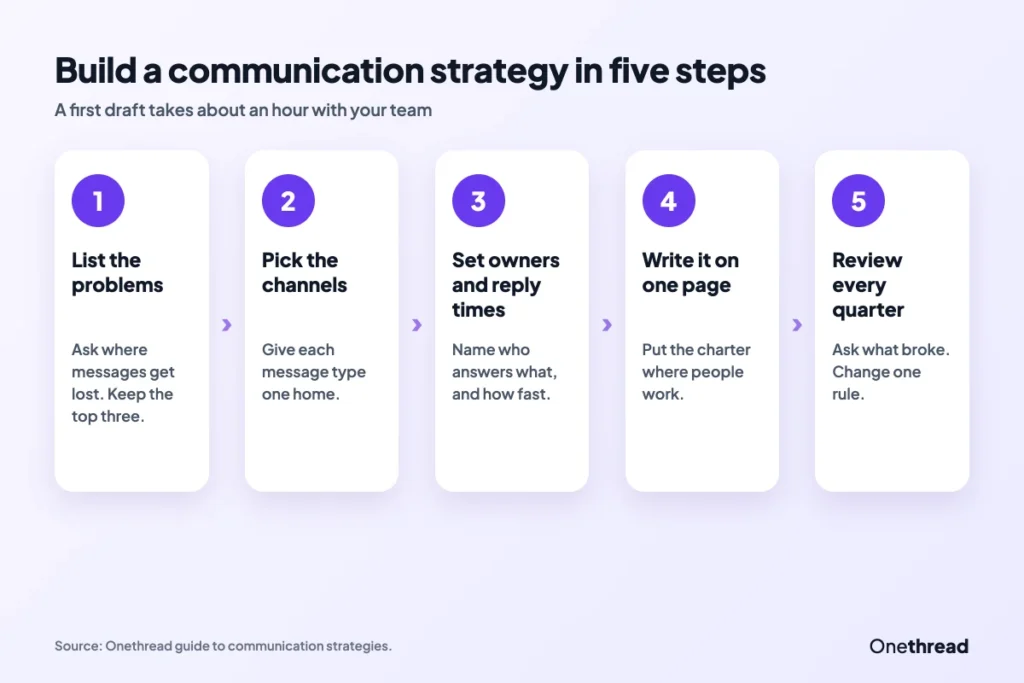
- List the problems: Ask the team where messages get lost. Write down the top three symptoms.
- Pick the channels: Give each message type one home. Retire channels nobody needs.
- Set owners and reply times: Name who answers what, and how fast each channel expects a reply.
- Write it on one page: Put the charter where everyone works, not in a forgotten folder.
- Review it every quarter: Ask what broke, then change one rule at a time.
Meetings are where a strategy pays off fastest, because they’re the most expensive channel.
Example: Say your 8-person team holds a 45-minute weekly status meeting. That’s 8 × 0.75 hours = 6 people-hours a week, and 6 × 52 = 312 people-hours a year.
Now swap it for a written update. An update that takes each person 20 minutes to write and read costs 8 × 20 minutes = 160 minutes, about 2.7 hours a week. You save about 3.3 hours every week, or roughly 172 hours a year.
Use your own team size and meeting length. The math usually makes the case for you. For more on how shared habits lift output, see our guide to the importance of team collaboration.
Top Tip: Keep one live meeting a week for discussion and decisions. Move pure status updates to writing, and protect the rest of the calendar for focus work.
What Should You Do Next?
You started with forty small communication issues and no map. Now you have four types to choose from, 10 tactics, and a table that points each symptom to a fix. Communication strategies work when they’re written down, kept short, owned by someone, and used every single week by the whole team.
This week, pick the one symptom that hurts most and run its first step from the table with your team. Then check the results in a month, because a strategy you actually test beats a perfect one that stays a plan.
FAQs About Communication Strategies
What Are the 7 C’s of Communication?
The 7 C’s of communication are clear, concise, concrete, correct, coherent, complete, and courteous. They work as a checklist for any message. Before you send an update, check that it states one point, uses specific facts, and stays polite. Many communication strategies use the 7 C’s as their writing standard.
What Is the Difference Between a Communication Strategy and a Communication Plan?
A communication strategy sets the standing rules for how a team shares information every day. A communication plan applies those rules to one project, launch, or event, with dates, audiences, and named messages. Teams usually need the strategy first, since every plan borrows its channels, owners, and reply times from it.
How Should Communication Strategies Change for Remote Teams?
Remote teams should write more down and rely less on hallway chats. Good communication strategies for remote teams set clear reply times, keep decisions in one shared place, and use video for sensitive talks. They also plan for time zones, so no one must reply at midnight to stay in the loop.
Who Should Own a Team Communication Strategy?
The team lead or project manager usually owns the communication strategy, but the whole team should help write it. The owner keeps the channel charter up to date, runs the quarterly review, and settles disputes about where messages belong. Shared input matters, because people follow rules they helped shape.
How Do You Know If a Communication Strategy Is Working?
A communication strategy is working when people ask fewer repeat questions, handoffs stop slipping, and meetings get shorter. Track two or three simple signals, such as missed deadlines or status meeting hours per week. If the numbers don’t move after a quarter, change one rule and measure again.