Jira and Smartsheet get compared all the time. They barely play the same sport.
Jira vs Smartsheet comes down to the kind of work your team does. Jira fits software teams that run sprints, backlogs and bug tracking, and it’s free for up to 10 users. Smartsheet fits business teams that plan in a spreadsheet grid with Gantt charts, from $9 per member a month.
Pick wrong and you’ll feel it. A marketing team fights Jira’s tickets, or a dev team tracks bugs in rows.
We compared both pricing pages, the help docs and the top-ranking reviews to build this guide.
You’ll get the prices, the feature gaps, a 10-person cost example and a clear pick for each team.
Jira wins on price for small software teams, and Smartsheet wins on ease for teams that live in spreadsheets. We built this table from each vendor’s pricing page.
| Feature | Jira | Smartsheet |
|---|---|---|
| Built for | Software and IT teams | Business and operations teams |
| $0 option | Yes, up to 10 users | No, 30-day free trial |
| First paid plan, per user a month | $8.48 (Standard) | $9 annual, $12 monthly (Pro) |
| 10 users for a year, first paid plan | $1,017.60 | $1,080 on annual billing |
| Main views | Board, backlog, list, timeline, calendar | Grid, Gantt, board, calendar |
| Automation on first paid plan | 400 runs per user a month | 250 a month |
| Best for (our pick) | Agile dev teams | Spreadsheet-first project teams |
The short version: Jira for code, Smartsheet for plans. The rest of this guide covers the details that change that call.
Jira is Atlassian’s work tracker for software teams. It runs Scrum and Kanban boards, a backlog, sprints and issue tracking in one place.
Every plan, the $0 one included, lists backlog, list, board, timeline, calendar and summary views. So a small dev team can plan a sprint, track bugs and see a rough roadmap without paying.
Say your team ships a mobile app. A bug report becomes a ticket, moves across the board, and links to the code change that fixed it. That’s the loop Jira is built around.
Paid plans add more as you grow. Standard adds user roles and permissions, 250 GB of storage and Atlassian’s Rovo AI tools. Premium adds cross-team planning, dependency management and a 99.9% uptime promise. If you’re also weighing a work platform for non-dev teams, our Jira vs monday.com comparison covers that pairing.
Pricing: $0 for up to 10 users. Standard $8.48 and Premium $15.56 per user a month. Enterprise is a custom quote.
Smartsheet is a work management tool built on a spreadsheet grid. If your team already plans in Excel or Google Sheets, it feels familiar on day one.
Each sheet can switch between grid, Gantt, board and calendar views. Rows become tasks, columns hold owners and dates, and the Gantt chart draws itself from those dates.
Say you run an office move. You list 60 tasks in rows, add start and end dates, and the Gantt view shows what slips when one task runs late. No ticket system needed.
The plan you pick matters more here. Pro covers 1 to 10 members, 20 GB of storage and 250 automations a month. Business removes the automation cap and adds timeline view, workload tracking and baselines. Resource Management is a separate add-on, so check our resource management software guide if staffing is your main need.
Pricing: No $0 tier. Pro $9 per member a month on annual billing, or $12 monthly. Business $19, or $24 monthly, with a 3-member minimum. Enterprise is a custom quote.
Jira and Smartsheet overlap on boards, calendars and automation. But they start from different places: Jira from the ticket, Smartsheet from the row. That shapes how each tool handles views, rules, reports, links to other apps and the first week of use. Here’s how the five areas compare.
Jira’s $0 tier already lists board, backlog, list, timeline and calendar views. The board and backlog do the heavy lifting, because sprints live there.
Smartsheet starts every project as a grid. You can flip the same sheet into a Gantt chart, board or calendar. Timeline view only arrives on Business.
The difference shows in planning style. Jira plans work in short cycles. Smartsheet plans work against dates. If Gantt charts are the deciding factor, our Gantt chart software roundup compares more tools that draw them.
Both tools run rules on a trigger, like “when status changes, notify the owner”. The limits differ a lot.
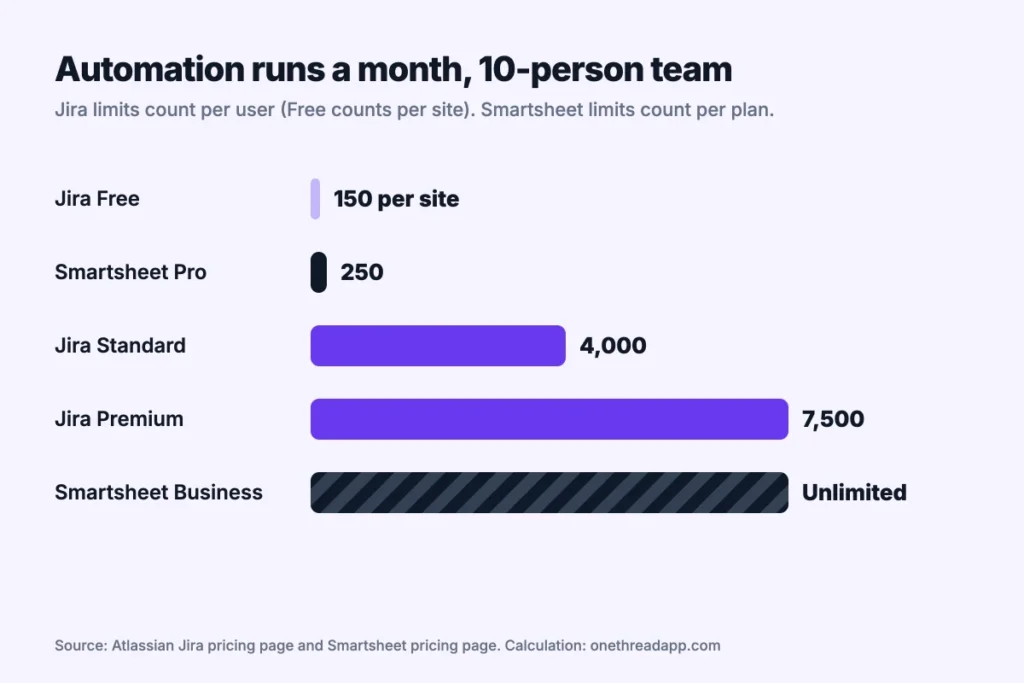
Jira Free allows 150 automation runs a month for the whole site. Standard allows 400 per user a month, and Premium 750. So 10 users on Standard get 4,000 runs a month.
Smartsheet Pro allows 250 automations a month. Business removes the cap.
Example: A 10-person team on Jira Standard gets 10 × 400 = 4,000 runs a month. The same team on Smartsheet Pro gets 250. If your rules fire on every task update, that gap matters fast.
Jira builds reports from issues. Its plans list AI-driven reports and dashboards, and the board shows what’s in progress at a glance.
Smartsheet builds reports from rows across sheets. You pick columns, filter by owner or date, and pin the result to a dashboard. Pro dashboards hold 10 widgets each.
In practice, Jira answers “what’s left in this sprint?” well. Smartsheet answers “which projects are late this month?” well. Neither answer is wrong. They’re just different questions, asked by different managers.
Jira lives at the center of the Atlassian stack, next to Confluence and Bitbucket. It links tickets to code and builds, which is what dev teams want from it.
Smartsheet connects to business apps, and it sells premium connectors for heavier jobs. Its Business plan adds API calls, and Enterprise adds SAML-based single sign-on (SSO).
One integration matters more than the rest here: the Smartsheet Jira Connector. It links the two tools directly, and we cover it in its own section further down, because it changes the “pick one” question.
Smartsheet scores higher on ease of use. On Capterra, reviewers rate it 4.3 for ease of use, against 4.1 for Jira.
That fits how each tool opens. Smartsheet shows you a grid, and most people know what to do with a grid. Jira shows you issue types, workflows and boards, which make sense once you’ve run a sprint.
For a non-technical team, that learning curve is the real cost. It doesn’t show up on the pricing page. It shows up in week two, when half the team has stopped updating tickets.
A 10-person team pays $0 to $1,867.20 a year for Jira and $1,080 to $2,880 a year for Smartsheet, before add-ons. We worked out each figure from the list prices on the two pricing pages.
| Plan | Price per user a month | 10 users for a year |
|---|---|---|
| Jira Free | $0 | $0 |
| Jira Standard | $8.48 | $1,017.60 |
| Jira Premium | $15.56 | $1,867.20 |
| Smartsheet Pro (annual) | $9 | $1,080 |
| Smartsheet Pro (monthly) | $12 | $1,440 |
| Smartsheet Business (annual) | $19 | $2,280 |
| Smartsheet Business (monthly) | $24 | $2,880 |
Example: Smartsheet Business on annual billing costs 10 × $19 × 12 = $2,280 a year. Jira Standard costs 10 × $8.48 × 12 = $1,017.60. That’s a gap of $1,262.40 for the same headcount.
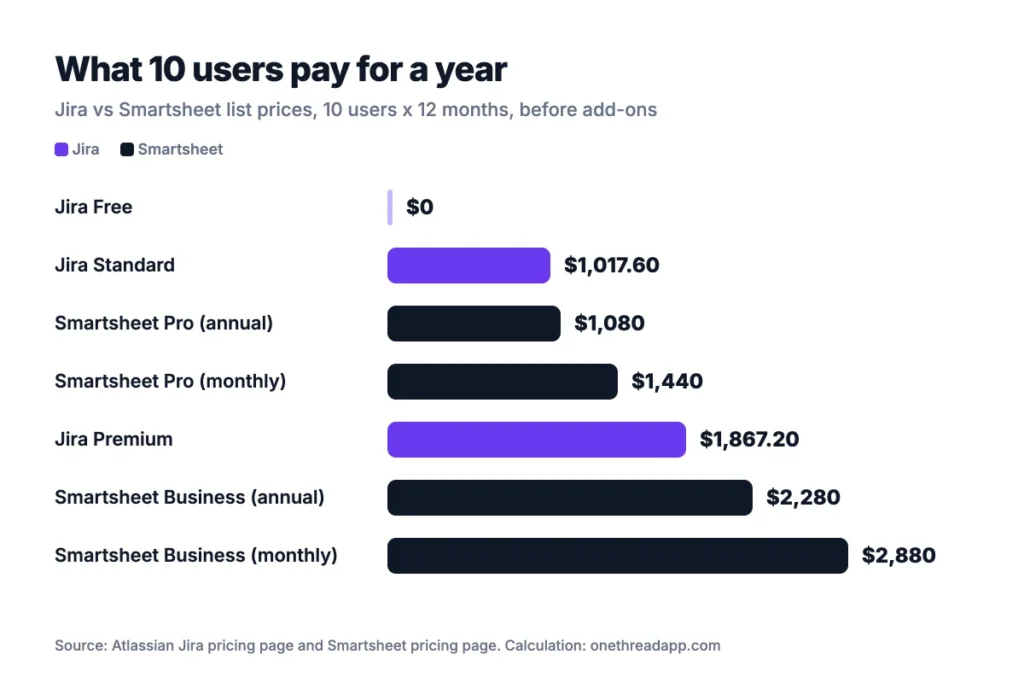
The headcount line matters. At 11 people, Jira’s $0 tier no longer fits, and Smartsheet Pro is out too, since it stops at 10 members. Both jumps happen at the same size.
Top Tip: Count your editors before you count your budget. Smartsheet bills members, but contributors on Pro are unlimited, so people who only update rows may not need a paid seat.
You connect them with the Smartsheet Jira Connector. It syncs issues between the two tools, so developers stay in Jira while managers plan in Smartsheet.
Smartsheet’s help center calls it “a paid premium offering”. It works on Business, Enterprise and Advanced Work Management plans, not on Pro. Pricing goes through Smartsheet’s sales team, so there’s no public number to plan around.
Setup has a few gates:
Once it runs, you choose per field whether the sync goes both ways or one way. That’s handy. A PMO can pull status from Jira into a portfolio sheet without letting sheet edits overwrite tickets.
So the hybrid setup works. It’s also the priciest path: Business seats for the planners, Jira seats for the developers, plus the connector fee. Most teams under 20 people won’t need it. Teams with a separate PMO and a separate dev group often do.
Top Tip: Ask Smartsheet sales for the connector price before you upgrade to Business for it. The add-on fee sits on top of the seat price.
Onethread is a simpler option if your team needs plain project and task tracking more than sprints or spreadsheets. It’s our own tool, so read this section with that in mind.
Onethread keeps projects, tasks, deadlines, discussion rooms and dashboards in one place. The Scale plan adds custom workflows, issue management, phases and milestones, so a mixed team of designers and developers can share one board.
Say you run a 10-person agency. Clients want dates, the dev side wants issues, and nobody wants two tools. That’s the gap Onethread is built for, with one tool and one bill for the whole team. For more side-by-side picks, our ClickUp vs Smartsheet comparison covers another option.
Pricing: Basic is free. Growth costs $3 per user a month on annual billing, or $3.60 monthly. Scale costs $5, or $6 monthly.
Pick Jira if your team writes code, and Smartsheet if your team plans by dates in a grid. Four checks settle most cases:
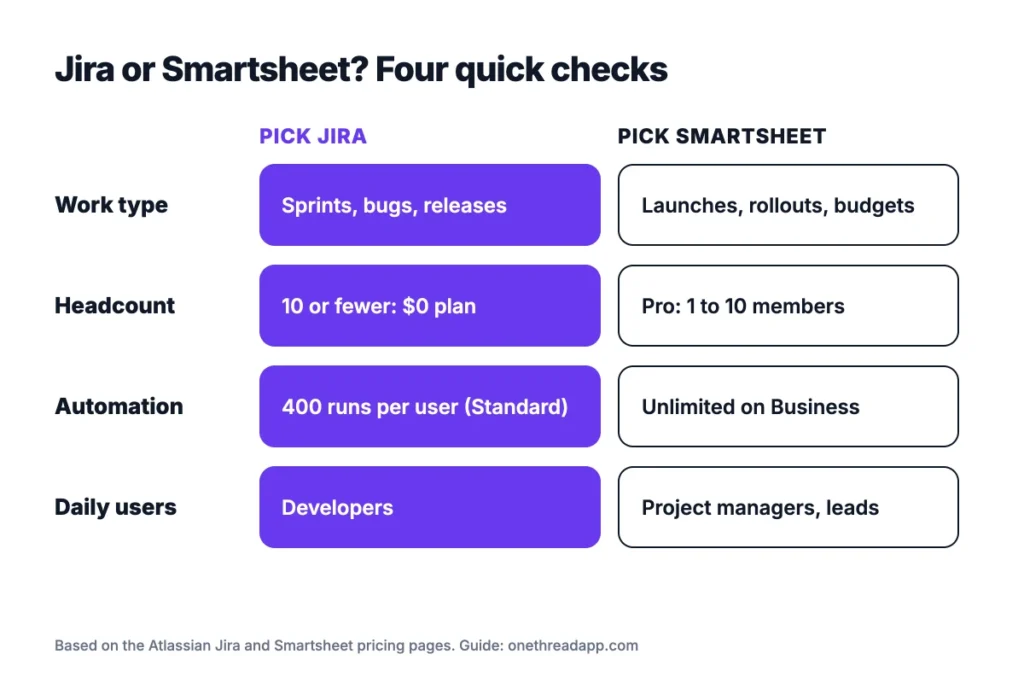
There’s one more test. Ask who will update the tool every day. If it’s developers, Jira wins, because they’ll live in tickets anyway. If it’s project managers and team leads, Smartsheet wins, because the grid asks less of them.
Still split? Run both trials side by side for two weeks. Jira’s free tier and Smartsheet’s 30-day trial let you test with your real team and real tasks, not a demo project. Then keep the tool your team opened without being reminded.
Sources: Jira pricing, Smartsheet pricing, Smartsheet Jira Connector FAQ, Onethread pricing.
Jira and Smartsheet solve different problems. Jira tracks work as tickets moving through sprints. Smartsheet tracks work as rows moving toward dates. Once you know which shape your team’s work takes, the choice gets simple. The price then follows from your headcount and how many rules you plan to automate.
This week, list the five tasks your team updates most often. If they read like tickets, open a free Jira site and run one sprint. If they read like rows with dates, start a Smartsheet trial and invite the people who’ll update it daily.
Yes. Jira’s Free plan covers up to 10 users, with board, backlog, list, timeline and calendar views. It includes 2 GB of storage and 150 automation runs a month for the whole site. In a Jira vs Smartsheet choice for a team of 10 or fewer, that Free plan is the biggest cost difference.
No. Smartsheet sells Pro, Business, Enterprise and Advanced Work Management plans, and none of them is free. You can try it for 30 days without a credit card. Pro then costs $9 per member a month on annual billing, or $12 billed monthly, for 1 to 10 members.
Smartsheet works for light agile work, since its board view can run a Kanban flow. But it has no built-in sprints, backlog or issue tracking. Teams that run Scrum with sprint planning usually find Jira the better fit, which is the main split in the Jira vs Smartsheet debate.
Jira shows work on a timeline view, which every plan lists, including Free. It works like a simple Gantt chart for epics and their dates. Cross-team planning and dependency management come with Premium. For dense date-driven plans with many dependencies, Smartsheet’s Gantt view is the stronger tool.
For most business users, yes. Capterra reviewers give Smartsheet 4.3 for ease of use and Jira 4.1. Smartsheet opens as a familiar grid, while Jira asks you to learn issue types, workflows and boards first. Developers usually pick it up fast, because it mirrors how they already work.