Team building is most useful when people have to work through a small challenge together, not when everyone is simply told to “bond.” A well-chosen activity can show how the group communicates, divides work, and reacts when the first plan does not work.
The activity itself is only the setup. The interesting part is what happens between people: who asks questions, who listens, who takes over, and whether the quieter members of the group get a real chance to contribute.
This list includes indoor, outdoor, and virtual options so you can choose something that fits the team’s size, schedule, and working environment. The best activity is usually the one that is easy to explain and easy to debrief afterward.
You do not need a large offsite budget to make team building worthwhile. A short exercise in a meeting room can reveal just as much as a complicated event if the purpose is clear and the team spends a few minutes discussing what they noticed.
Understanding the objective of team building
The goal should be practical: better communication, clearer delegation, stronger trust, or faster problem-solving. If the session is entertaining but teaches the team nothing about how they work together, the value tends to disappear quickly.
Here are some of the key goals of team building:
- Improve communication: Team building activities can help team members learn how to communicate more effectively, both verbally and non-verbally. This can help reduce misunderstandings, increase productivity, and foster a more positive work environment.
- Build trust: Trust is essential for any successful team. Fun team-building activities can help team members develop trust in each other by encouraging them to work together towards a common goal, share their thoughts and ideas, and learn to rely on each other.
- Increase collaboration: Team building activities can help team members learn how to collaborate more effectively by encouraging them to work together, share their skills and knowledge, and support each other to achieve a common goal.
- Boost morale: Engaging in fun and exciting team-building activities can help boost team morale by creating a more positive and enjoyable work environment. This can lead to increased job satisfaction, lower turnover rates, and better overall performance.
Choose the activity around the behavior you want to strengthen. New teammates may benefit from something that encourages conversation, while an experienced team may get more from a challenge involving decisions, handoffs, or shared problem-solving.
Indoor Team Building exercise

Indoor activities are convenient when time is limited or the weather is unreliable. Most of them can be run with a meeting room, a few basic materials, and a clear time limit.
Puzzles and small group challenges work because the objective is obvious. Keep the rules short, then let the group decide how to organize itself. That gives you a much better view of the team’s natural working style.
- develop stronger bonds,
- improve communication skills,
- and increase productivity.
The three ideas below are simple enough to organize without turning the preparation into a project of its own.
Activity 1: Group Puzzles
Time: 1 to 2 hours
Number of participants: 3 to 6 (the entire team)
Tools Needed: A set of puzzles for each group
Split the group into small teams and give each team a similar puzzle. Before starting, ask them to agree on how they will divide the work. Then let them solve it against the clock and watch how that plan changes once the pressure begins.
After the puzzle, spend a few minutes on the debrief. Ask what made the group faster, where information was lost, and whether everyone had a clear role. Those answers are usually more useful than who finished first.
Objective: Practice dividing work, sharing information, and solving a problem together under a small amount of time pressure.
Activity 2: Trivia Games
Time: 1 to 2 hours
Number of participants: Any number
Tools Needed: Trivia questions related to your industry or company
Run the trivia in short rounds and let teams discuss each answer before submitting it. A mix of company, industry, and general questions keeps the activity light while still encouraging people to pool what they know.
The objective is conversation, not proving who remembers the most facts. Keep the stakes low and let the group enjoy the differences in what people know.
Activity 3: Cooking Challenges
Time: 2 to 3 hours
Number of participants: 4 to 6 (the entire team)
Tools Needed: Cooking utensils, ingredients, and a kitchen
Give each group the same core ingredients and a clear time limit. Let them decide who prepares, cooks, plates, and keeps track of time, then finish with a tasting and a quick conversation about how the work was divided.
This activity is a practical exercise in delegation. People have to coordinate in real time, adjust when something goes wrong, and still deliver one shared result at the end.
Virtual Team Building Activities

Remote teams miss many of the casual interactions that happen naturally in an office. Virtual activities can create some shared experience, but they work better when they are short, easy to join, and not treated like another mandatory meeting.
Virtual Escape Rooms
Time: 1 to 2 hours
Number of participants: 4 to 10
Tools Needed: Video conferencing software (Zoom, Microsoft Teams, etc.), online escape room platform.
For a virtual escape room, split people into small groups and ask them to keep their discussion on the call. The value comes from hearing how different people interpret clues and how the group decides which idea to follow.
This is a good exercise for shared problem-solving because nobody has the full answer alone. Pay attention to whether people explain their reasoning, challenge assumptions, and bring quieter teammates into the discussion.
Online Games
Time: 30 minutes to an hour
Number of participants: Any number (the entire team)
Tools Needed: Video conferencing software (Zoom, Microsoft Teams, etc.), online team-building games platforms like Steam or Epic Games.
Choose a game that takes only a few minutes to explain. Trivia, drawing games, or a simple multiplayer option usually work better than something that requires a long setup or special skills.
The aim is simply to give remote coworkers something shared to react to. A short, low-pressure activity can create more natural conversation than a heavily structured “fun” session.
Virtual Team Building Challenges
Time: A few minutes to an hour
Number of participants: Any number (the entire team)
Tools Needed: Video conferencing software (Zoom, Microsoft Teams, etc.), collaboration platform.
Give each group one creative prompt, such as designing a team logo, writing a short motto, or building a mini pitch. Set a time limit, then ask each group to explain the choices behind what they created.
This works well because the team has to make several small decisions quickly. It gives people practice reaching agreement without requiring specialist software or much preparation.
Virtual Scavenger Hunt
Time: 1 to 2 hours
Number of participants: Any number (the entire team)
Tools Needed: Video conferencing software and internet connection
Running the Activity:
- Before the activity, divide participants into teams and provide them with a list of items they need to find. The items can be anything from common household objects to specific items related to your company culture or industry.
- Explain the rules of the game and set a time limit for finding all the items on the list.
- Each team will take turns searching for the items on the list while the rest of the team members watch via video conference.
- When a team finds an item, they need to hold it up to the camera or share their screen with the group to prove that they have found it.
- The first team to find all the items on the list or the team that finds the most items within the time limit wins the game.
Objective:
A virtual scavenger hunt can be kept simple: use a short list of ordinary household items, photos, or clues and give people a fixed amount of time. Add a few open-ended prompts so teams have to interpret the task rather than just race.
Because people bring a little of their own environment into the call, the activity often creates conversation that would not happen in a normal work meeting.
Outdoor Team Building Activities

Outdoor activities can change the energy of a team day, but they should fit the people taking part. Accessibility, comfort, weather, and the physical demands of the activity matter more than making the challenge look impressive.
Here are some outdoor team building events that you can organize for your team:
Relay Races
Time: 1 to 2 hours
Number of participants: Any number
Tools Needed: Cones, ropes, and other props for the relay course
Running the Activity:
- Before the activity, create a relay course that includes various challenges like running, jumping, crawling, and balancing.
- Divide participants into teams and provide them with the relay course instructions.
- Each team will take turns completing the relay course, with each team member completing one challenge before tagging the next team member to continue the course.
- The team that completes the relay course the fastest wins the game.
Objective:
Relay-style activities become more team-focused when success depends on handoffs and coordination rather than raw speed. Add a shared problem or paired section so people have to support one another to finish.
The lesson is in the handoff: clear communication, timing, and mutual support. Keep the rules easy to understand so the team spends its attention on working together.
Obstacle Course
Time: 1 to 2 hours
Number of participants: Any number
Tools Needed: Obstacle course equipment, such as ropes, tires, and hurdles
Running the Activity:
- Before the activity, create an obstacle course that includes various challenges, such as climbing, crawling, and jumping.
- Divide participants into teams and provide them with the obstacle course instructions.
- Each team will take turns completing the obstacle course, with each team member completing one challenge before tagging the next team member to continue the course.
- The team that completes the obstacle course the fastest wins the game.
Objective:
An obstacle-style challenge can work when the team has to plan the route and support one another. Keep the activity appropriate for the group and offer an alternative for anyone who does not want to take part physically.
Trust Fall
Time: 30 minutes
Number of participants: Any number
Tools Needed: A group of people and a safe landing spot
Running the Activity: Participants stand in a circle, with one participant standing in the middle. The person in the middle will fall backward, and the other participants will catch them. The person in the middle should keep their body straight and stiff, like a board.
Before starting the activity, the participants should discuss and agree on a safe landing spot.
Traditional trust activities are only useful when everyone is comfortable participating. Teams can get the same lesson—reliability and communication—from less physical exercises if that better suits the group.
Tug of War
Time: 30 minutes to 1 hour
Number of participants: At least 8 participants
Tools Needed: Rope
Running the Activity: Divide the team into two groups and have them stand on either side of the rope. The objective of the game is to pull the rope towards your team’s side.
The team that manages to pull the other team across the center line wins. It’s important to ensure that the teams are evenly matched in terms of strength and size.
To add an element of fun, you can add a water element by placing a kiddie pool filled with water in the center. The losing team will fall into the pool, adding a fun twist to the game.
Tug-of-war is mainly a coordination exercise when it is run as a light team challenge. Emphasize timing and teamwork, keep the environment appropriate, and avoid making strength the only measure of success.
Minefield
Time: 0.5 to 1 hour
Number of participants: 2 or more
Tools Needed: Blindfolds and small objects to be used as “mines” (e.g., cones, balls, water bottles)
Running the Activity: In this activity, participants will be divided into pairs, with one person wearing a blindfold and the other acting as a guide. The guide will stand at one end of the field, while the blindfolded person will stand at the other end. The field will be filled with the “mines” scattered throughout the field.
The guide will need to verbally instruct the blindfolded person on how to navigate through the minefield without touching any of the mines. The blindfolded person can only move forward, backward, left, and right. If they touch a mine, they will need to start over from the beginning. The pair that makes it through the minefield the fastest wins.
This exercise is really about communication. One person has to give clear directions, while the other has to listen carefully and ask questions when something is unclear. Use a simple, controlled setup that keeps the focus on the communication itself.
Outdoor Survival Challenge
Time: 3 to 4 hours
Number of Participants: 5 to 10
Tools Needed: Maps, compass, outdoor survival kits, and a designated outdoor area
Running the Activity: Participants will be divided into teams, and each team will be given a map and a compass to navigate through the designated outdoor area. Each team will be given a survival kit containing basic items necessary for outdoor survival, such as first aid supplies, matches, and a water filter.
The teams will be required to work together to overcome challenges and reach a designated endpoint within a specified time frame. The challenges may include building a shelter, finding food and water sources, starting a fire, and identifying edible plants.
The team that reaches the endpoint first with the most points from completing challenges wins.
A survival-themed challenge can reveal how people plan and divide responsibility when the situation is unfamiliar. Keep the scenario controlled and designed around teamwork rather than creating unnecessary physical risk.
Raft Building
Time: 2-3 hours
Number of participants: 5-15
Tools Needed: Wooden planks, ropes, barrels, life jackets, paddles, and other materials necessary for raft building.
Running the Activity: Divide the participants into teams of 5-7 members. Each team will be provided with wooden planks, ropes, barrels, life jackets, paddles, and other materials necessary for raft building. They have to construct a raft from scratch and test it on water.
The team that can successfully build the strongest and fastest raft wins the challenge.
Raft-building activities combine planning, delegation, and hands-on problem-solving. If the activity involves water, the setup should be professionally supervised and safety should come before competition.
Tools and Apps for Team Building – Power up your team-building game!
Tools can make remote team activities easier to run, but the software is not what creates teamwork. Use the simplest platform that supports the activity, especially if the team already knows it.
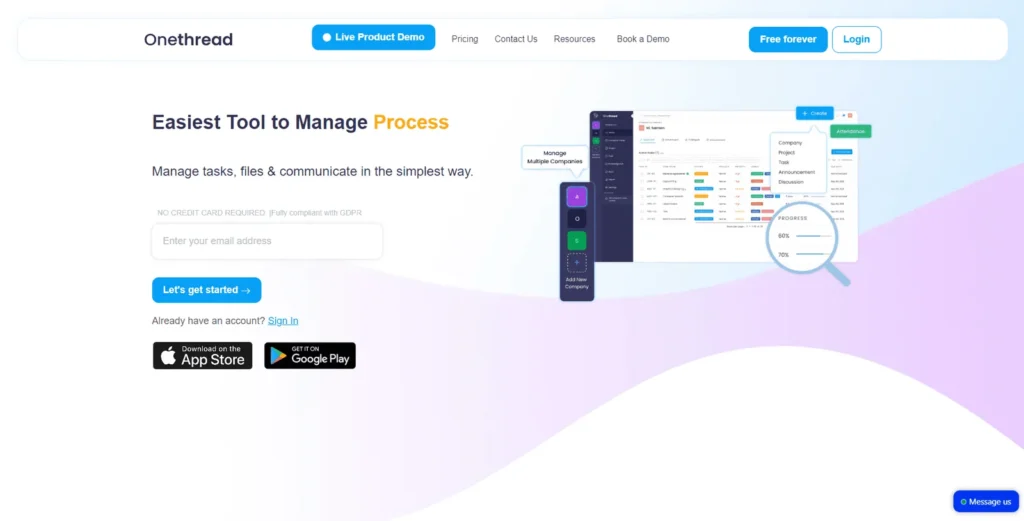
Onethread – The Ultimate Tool for Streamlined Team Communication and Collaboration
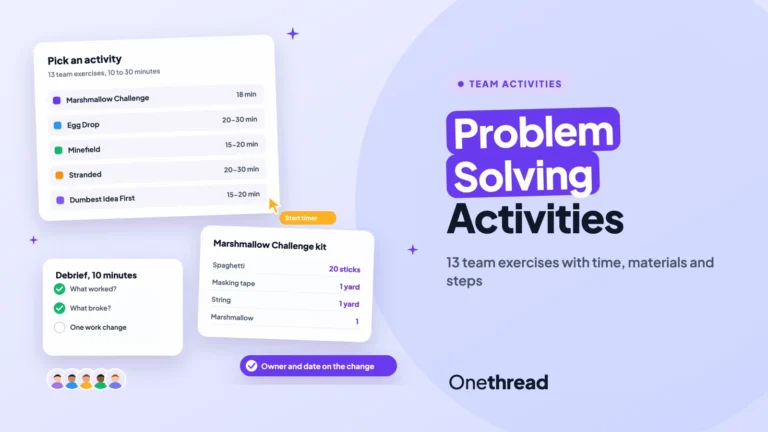
OneThread can help with the follow-up after an activity. If the group agrees on a new habit, task, or action, putting it into the normal project workspace makes it much more likely that the idea survives beyond the session.
Features of Onethread include:
- Easy task assignment and tracking
- Real-time updates and notifications
- Centralized document storage and sharing
- Customizable project templates
- Time tracking and reporting
The practical benefit is visibility. People can see the owner, due date, and progress of any follow-up action instead of relying on somebody to remember what was discussed during the activity.
Other familiar tools can support different parts of the experience:
Slack – Useful for quick team conversation, channels, file sharing, and coordinating virtual activities without adding a new communication app.
Trello – A simple visual board can be handy for organizing challenges, assigning small groups, or collecting follow-up actions after an activity.
Zoom – Video calls, breakout rooms, and screen sharing make it practical for remote activities that need face-to-face discussion or smaller team sessions.
Kahoot! – Useful when you want to run a quick quiz or game with very little setup and let everyone participate from their own device.
Choose the tool around the activity, not the other way around. Familiar software usually makes participation easier because people can focus on the exercise instead of learning a new interface. You can find more on this in our post about improving team productivity. You can find more on this in our post about ideas meeting.
Related reading: New team members, Team bonding, Fun at work and Running meetings.
Final thoughts
The best team-building activity is the one that fits the people in the room. A short exercise with a clear purpose is often more useful than a bigger event that looks impressive but does not connect to how the team actually works.
If the activity reveals a real coordination problem—unclear ownership, scattered updates, or weak follow-through—use that insight in the team’s normal workflow rather than leaving it behind when the session ends.
Team building is useful when it changes everyday behavior. A short debrief and one practical follow-up can make an hour-long activity more valuable than a much bigger event with no reflection afterward.