You can smell fake trust from a mile away. That’s the problem with most content marketing today. Readers have developed a sixth sense for when a brand is just nodding politely while reaching for their wallet.
The internet is a landfill of brands claiming to be transparent while hiding their intentions. Audiences are tired of that performance. They don’t want your carefully worded mission statement. Instead, they want to know why your product works the way it does, why your shipping isn’t always free, and whether you actually walk your talk.
Many companies work tirelessly on their content yet struggle to earn their audience’s confidence. That’s often because of weak positioning, shallow insights, or content that sounds similar to everything else online.
This piece skips the polished platitudes. We’ll dig into what actually moves the needle when nobody’s looking.
1. Display Clear Trust Signals
Most brands earn credibility and then hide it, buried in an “About” page nobody reads or tucked into a footer that gets ignored. If you’ve got proof that backs up your claims, it needs to be front and center, not three clicks deep.
Trust signals work because they shift the burden of proof. Instead of asking readers to take your word for it, you’re showing them external validation (certifications, partnerships, or third-party affiliations) that confirms what you’re saying is legitimate.
Brands can implement this tactic with a few focused steps:
- Audit what you already have. Industry certifications, sustainability credentials, media mentions, and data privacy compliance badges all count.
- Then, ask yourself where your visitors are most skeptical. That’s where your trust signals belong.
- Your homepage is the obvious starting point, but don’t stop there. Product pages, landing pages, and even blog posts can carry trust signals relevant to the content around them.
- Pair every badge or logo with a short explanation. A symbol alone doesn’t tell readers why it matters. One or two sentences of context turn a visual element into an actual argument.
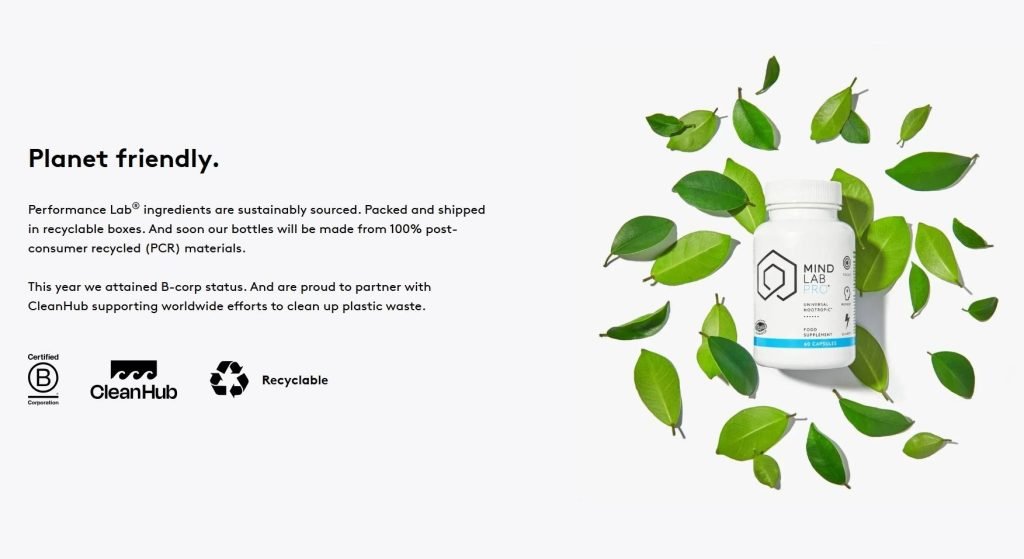
An example of a company that uses this practice is Performance Lab, a nutritional supplement brand focused on clean-label sports nutrition and nootropics.
Instead of just claiming sustainability, they display three distinct trust badges prominently: Certified B Corporation status, a recyclable packaging indicator, and a CleanHub partnership badge.
The accompanying copy explains that their ingredients are sustainably sourced, their boxes are recyclable, and their partnership supports global plastic cleanup efforts. The B Corp badge in particular signals that a third party has audited their environmental practices, worker treatment, and governance structure. This is a far cry from a brand simply typing “eco-friendly” into their own headline.
This approach transforms abstract virtue signaling into something a skeptical supplement buyer can actually verify.
2. Feature Real Customer Voices in Your Content
Your marketing copy will always have a ceiling. No matter how well it’s written, readers know you wrote it about yourself. That creates automatic skepticism. What cuts through that skepticism is hearing from people who have no stake in the sale.
That’s why consumers actively seek out user-generated content before making decisions. A stranger’s honest account of their experience carries more weight than a brand’s polished message, because it comes without an agenda.
Simply put, UGC is significantly more authentic and trustworthy than traditional brand content.
Brands can integrate this type of content into their strategy with a structured approach:
- Start collecting UGC deliberately. Encourage customers to share their experiences through post-purchase emails, social media prompts, or incentivized review requests. The more specific the feedback you invite, the more useful the responses you’ll get.
- Once you have it, use it strategically. Don’t limit UGC to a dedicated reviews page. Bring it onto your homepage, your product pages, and anywhere a potential customer might be weighing their options. Real quotes from real people work best when they appear at the exact moment doubt creeps in.
- Keep it unpolished. Overly edited testimonials start to read like brand copy. Authentic language, even when it’s imperfect, is what makes UGC believable in the first place.
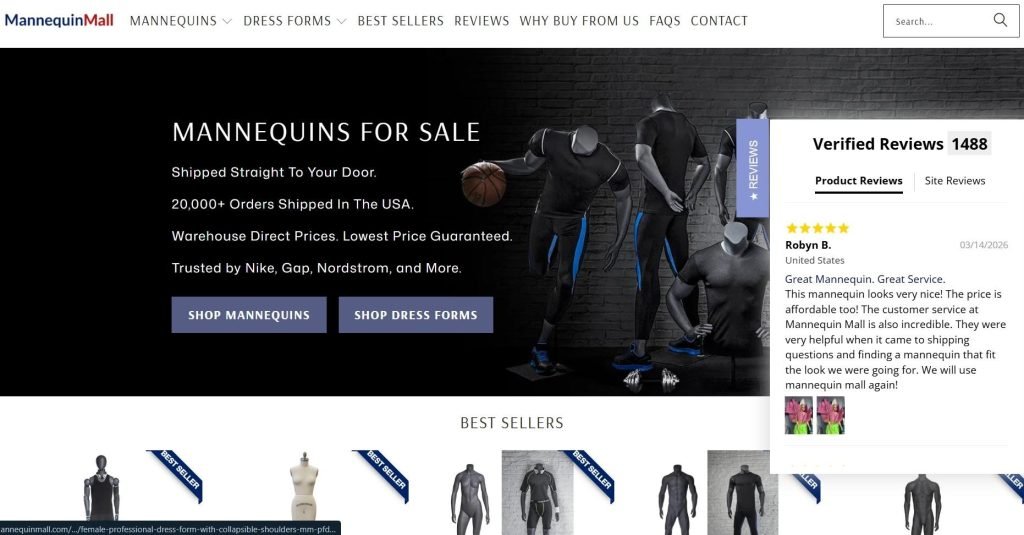
Mannequin Mall, a retailer specializing in fashion mannequins and visual merchandising supplies, executes this tactic through a floating side button permanently anchored to the right edge of their website.
The button reads “Reviews” and remains accessible regardless of where the visitor scrolls. Clicking it opens a compact side panel displaying verified customer testimonials, complete with star ratings and, notably, images of mannequins in actual store settings submitted by buyers.
The reviews address specific product qualities (durability, finish, or realism of posing), using the customer’s own language.
The persistent accessibility of this feedback means trust signals are always within reach, never buried.
3. Use Video to Show What Written Content Can’t
Text tells. Video shows. That difference matters more than most brands realize.
When a reader encounters a written claim (“premium quality,” “expertly crafted,” “trusted by thousands”), they process it skeptically. When they watch someone demonstrate it, the dynamic shifts. They’re seeing rather than being told, and that’s a harder thing to dismiss.
It’s no surprise that 82% of people say video is the most memorable form of content they consume.
For building trust specifically, video has an edge because it’s harder to fake. A well-produced article can come from anywhere. A video that shows real people, real processes, and real expertise is a different kind of proof.
Here’s how brands can introduce video into their content strategy:
- Think about what your brand does that customers never get to see. Product creation, service workflows, and expert insights work well because viewers can see details that written descriptions cannot fully capture.
- Keep the focus on substance over production value. A straightforward video that actually shows something real will outperform a glossy brand film that says nothing. Authenticity matters more than polish here.
- Distribute your videos where your audience already is, such as your homepage, product pages, YouTube, and social media. A video that lives only on one platform is leaving trust-building opportunities on the table.
Icecartel, a brand selling men’s moissanite jewelry, features a behind-the-scenes video that takes viewers directly into their manufacturing process.
An expert jeweler leads the video, sharing the story behind the brand and offering a genuine look at daily life inside their jewelry store.
This is the kind of content that written copy struggles to replicate. Watching a craftsperson talk about their work communicates expertise and care in a way that a product description simply can’t match.

4. Walk Readers Through Exactly How Your Process Works
Uncertainty kills conversions. When a potential customer can’t picture what working with you actually looks like, hesitation fills that gap. That hesitation rarely resolves in your favor.
Explaining your process clearly removes that barrier. It shows you have nothing to hide, that you’ve thought about the customer experience, and that getting started is straightforward. That combination does quiet but meaningful trust-building work before a single purchase is made.
Brands can apply this approach by mapping out their core workflow:
- Break your process down to its essential steps, ideally between three and five. More than that, and it starts to feel complicated. On the other hand, having fewer can make it feel vague.
- Write each step in plain language that focuses on what the customer does or gets, not on your internal mechanics.
- Visuals sharpen the message significantly. If your product or service has an interface, showing it in action at each step answers questions before they’re asked. Screenshots, animations, or interactive previews all work. The goal is to make the abstract concrete.
- Place this content where skepticism is highest. For most brands, that’s the homepage or a dedicated “How it works” section. Anywhere a visitor is weighing whether to commit is the right place for process clarity.
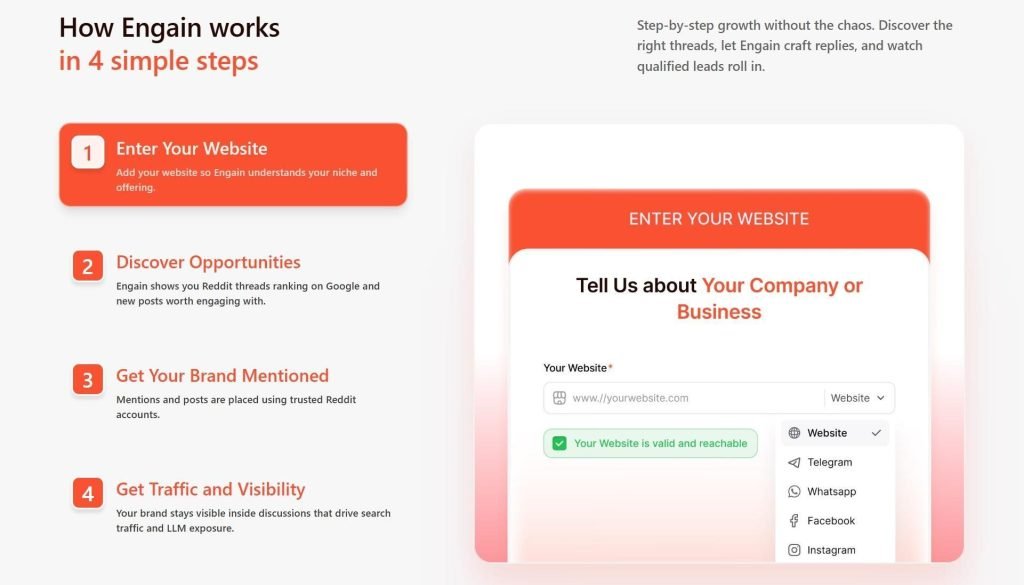
Engain, a software platform that helps businesses grow their presence and generate leads through Reddit marketing, lays out their entire process in four steps directly on their homepage. Each step is written concisely. Only what’s necessary is included, nothing extra.
What makes it particularly effective is the interactivity. Clicking each step triggers a live visual of how it looks inside the actual platform, displayed alongside the text.
This is a smart execution that instantly answers the inevitable “but what does that actually mean?” This way, there’s no need for a demo or a sales call to find out.
5. Add Interactive Content That Makes the Experience Feel Personal
Static content delivers the same message to everyone. That’s efficient, but it has a trust problem. It doesn’t account for the reader sitting in front of it, and most people can tell.
Interactive content changes that dynamic. When someone engages with a quiz, a calculator, or a personalized recommendation tool, the experience shifts from passive to active. They’re no longer being spoken at. They’re participating.
When you combine that interactivity with personalization, something more significant happens. It triggers a sense of authenticity and digital trust that generic content rarely achieves. The brand stops feeling like a broadcast and starts feeling like a conversation.
Brands can introduce interactive elements without building complex systems:
- Think about the most common question your customers ask before buying. “Which product is right for me?” is the obvious one, and a quiz is the most direct way to answer it.
- Three to five focused questions that lead to a tailored recommendation is the sweet spot. That’s enough to feel personalized and not overloaded, so that people don’t abandon halfway through.
- Calculators and assessments work well too, particularly for brands where outcomes vary by individual circumstance, like finance, health, fitness, and similar categories.
- Keep the tool genuinely useful. If the result feels arbitrary or steers everyone toward the same answer regardless of input, it destroys the trust it was meant to build. The recommendations need to actually fit the responses.
Baratza, a brand that makes precision coffee grinding equipment, features a quiz prompt directly on their homepage.
The invitation is straightforward: answer three quick questions and find out which grinder suits you best. That’s a low-commitment entry point that immediately signals customer focus.
This way, Baratza lets individual needs lead the way instead of pushing visitors toward a bestseller. That’s a small but effective trust-builder from the first interaction.

Final Thoughts
Trust isn’t a campaign. It’s also not a landing page optimization or a quarterly initiative you assign to the content team and then forget.
Trust is accumulated in the small, unglamorous moments when your brand chooses honesty over polish and usefulness over conversion tactics.
The five strategies outlined here share a common thread. They all require stepping out from behind the curtain and letting the audience see something real – a third-party certification, a stranger’s review, a workshop floor, a comparison you might lose, and a quiz that actually helps. None of them are complicated, but they all require effort to be seen clearly, which is harder than it sounds.
Consistent improvements like these shape how audiences evaluate your brand. So start refining your content now, and each new piece will contribute to stronger credibility and lasting trust.