Most agencies run on five apps that never talk to each other.
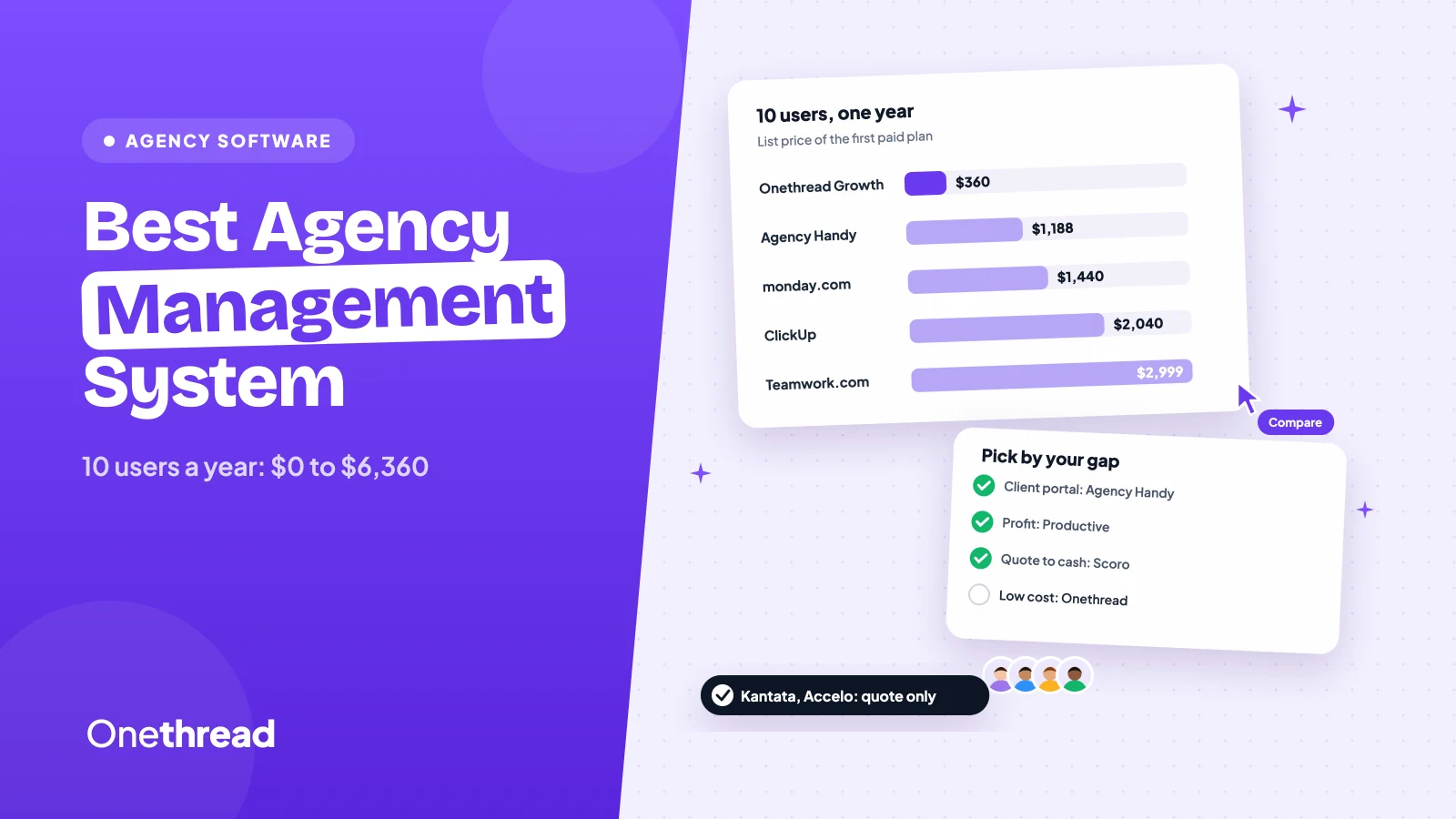
The best agency management system for most small agencies is one that joins client work, time and billing in one place. Agency Handy fits client portals and billing, Productive fits profit tracking, and Scoro fits quote-to-cash work. ClickUp, monday.com and Onethread are the low-cost picks for task tracking.
You don’t need every feature. Your agency needs the three that fix the leaks in its week.
We checked the pricing page of all 10 tools for this guide. You will get a side-by-side table, a cost example for a 10-person team, and picks for insurance agencies too.
Key Points
- The best agency management system depends on where your agency loses time or money. Agency Handy suits client portals and invoicing from $29 a month, Productive suits profitability tracking, and Scoro suits teams that quote, plan and bill in one tool.
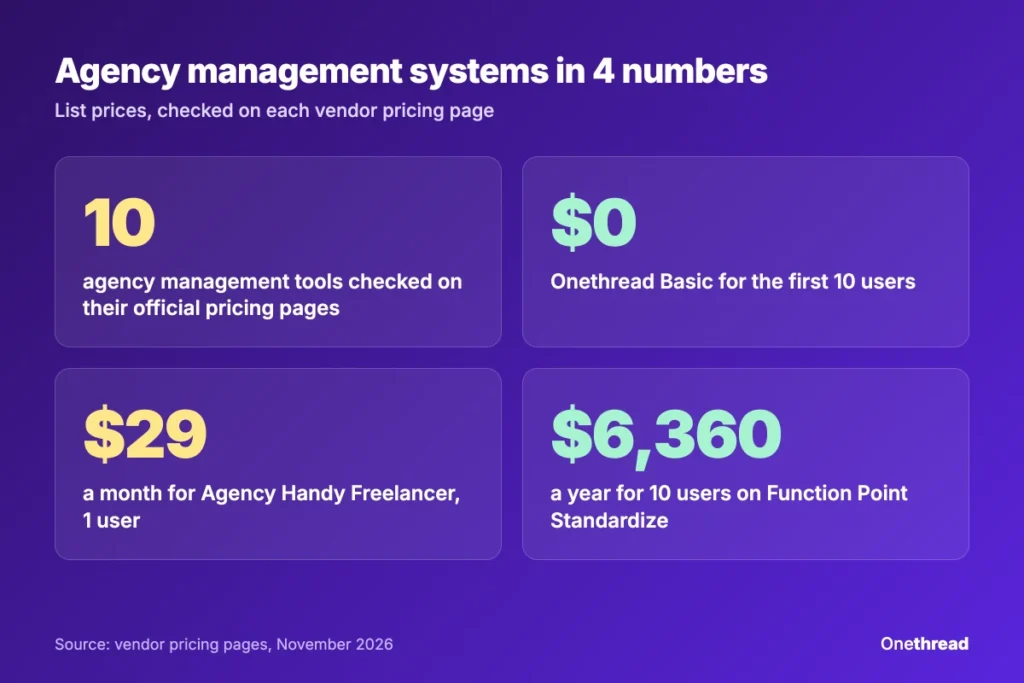
- For a 10-person team, list prices run from $0 on Onethread Basic to about $6,360 a year on Function Point. Kantata and Accelo quote on request.
- Pick the tool that covers your biggest gap first: client communication, time and billing, or resource planning. Then test it on one live client project during the free trial.
- Insurance agencies need a different kind of system. Applied Epic, AMS360, EZLynx, QQCatalyst, AgencyBloc and HawkSoft handle policies, commissions and carrier data.
Which Agency Management System Fits Your Agency?
The right agency management system matches your agency’s size and the work that hurts most today. The table lists the starting paid price, the free option and the main strength of each tool. Prices are list prices per month, checked on each vendor’s pricing page.
| Tool | Best for | Starting paid price | Free plan or trial | Client portal |
|---|---|---|---|---|
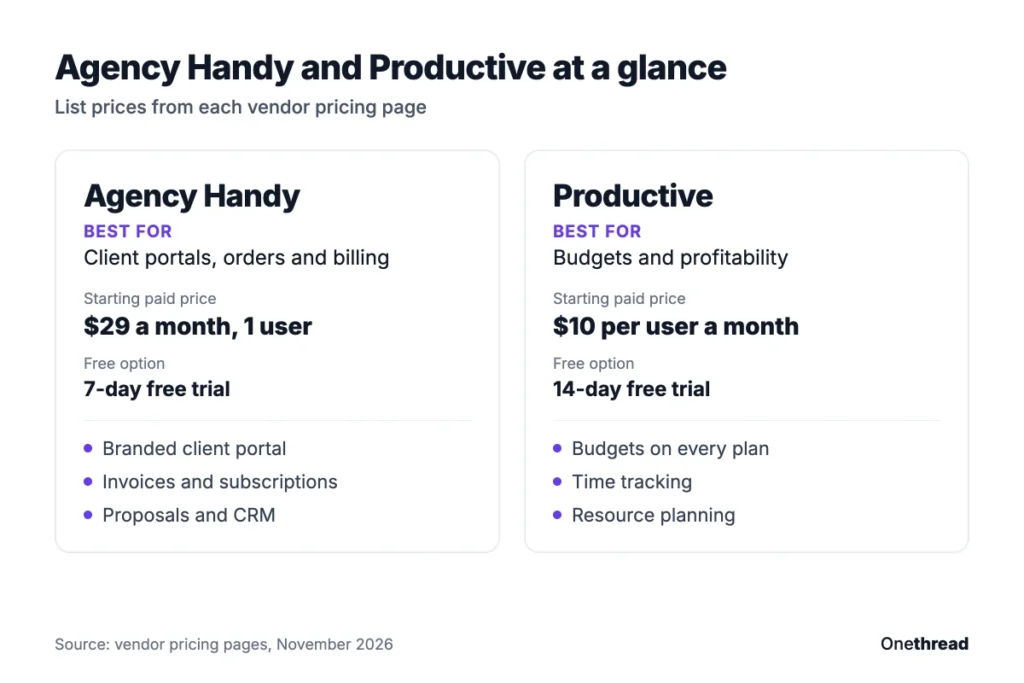
| Agency Handy | Client portals, orders and billing | $29 a month for 1 user, $99 for 10 users | 7-day free trial | Yes |
| Productive | Budgets and profitability | $10 per user a month | 14-day free trial | Client access to budgets |
| Scoro | Quote-to-cash work | $17 per user a month, 5-seat minimum | 14-day free trial | Paid add-on |
| Teamwork.com | Client projects and retainers | $9.99 per user a month, billed yearly | Free for up to 5 users | Client users |
| Kantata | Large services firms | Custom quote | Demo only | Not stated |
| Accelo | Retainers and client work | Custom quote | Demo only | Client Workspace |
| Function Point | Creative agency estimates | $53 per user a month, billed yearly | Demo only | Not stated |
| monday.com | Visual workflows | $9 per seat a month, billed yearly | Free for 2 seats | Guest access |
| ClickUp | Low-cost all-in-one work | $9 per user a month, billed yearly | Free Forever plan | Guest accounts |
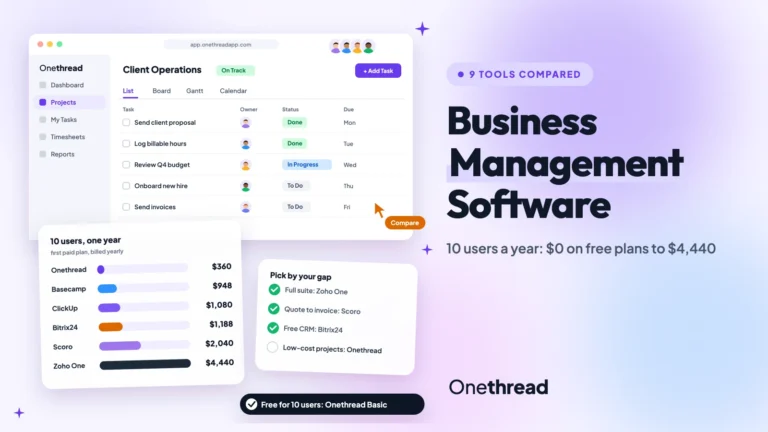
| Onethread | Simple project tracking | $3 per user a month, billed yearly | Free for the first 10 users | Not listed |
Sources: the official pricing pages of all 10 tools, checked in November 2026. Prices can change, so confirm them on each vendor’s site.
What Is an Agency Management System?
An agency management system is software that runs the business side of a service agency in one place. It joins clients, projects, time, budgets and invoices, so you can see which work makes money. A plain project tool tracks tasks. An agency system also tracks hours, rates and billing.
Agencies use it to replace a stack of single tools. A typical stack holds a CRM, a task board, a timer, a proposal tool and an accounting app. Each handoff between them adds manual work and room for error.
The term also has a second meaning. In insurance, an agency management system (AMS) is the system of record for policies, clients and commissions. We cover those tools in their own section.
The pay-off is clear time and cash. When hours, budgets and invoices sit in one tool, you bill faster and spot unprofitable clients sooner. You also stop typing the same data into three apps. A good system also gives managers one place to check workload, margins and overdue invoices each week.
If your main need is task and project planning, our guide to the best agency project management software compares tools built for that job. Ad shops can also read our picks of the best project management software for advertising agencies.
How Did We Pick These Agency Management Tools?
We picked tools that cover at least three of the six jobs agencies ask for most. Those jobs are project tracking, time tracking, budgets, billing, resource planning and client access.
For each tool, we read the official pricing page and product pages in November 2026. We noted the plan names, prices, billing terms, trials and seat rules. Where a page was unclear, we say so instead of guessing.
We left out tools that only cover one job, such as a stand-alone timer or a booking app. We also skipped tools whose pricing or features we could not check on the vendor’s own site.
We then sorted the picks by the gap they close. Client portals and billing come first, then profit and quote-to-cash tools, then larger PSA suites. Low-cost task tools close the list. Each review ends with who the tool suits, its pros and its cons.
You can read more about how we test and score software in our review methodology. No vendor paid for a place on this list or for its position.
The order is not a score. Each tool earns its place for one clear job. Read the “Best For” notes first, then skip the tools that do not match your gap.
Why Pick Agency Handy for Client Portals and Billing?
Agency Handy is an all-in-one client portal and agency management system for service businesses. It puts leads, clients, orders, tasks, files, proposals and invoices behind one branded login.
Clients sign in, place orders, upload files, approve work and pay invoices in the same portal. Your team tracks tasks and time in the back end. Plans include CRM, proposals, tickets, time tracking and file feedback.
Agency Handy prices by plan, not by seat. The comparison table on its pricing page lists $29 a month for 1 user, $99 for 10 users and $199 for 30 users. Yearly and multi-year billing come with a discount. Detailed pricing plans show the limits on leads, storage and AI credits.
Pricing: Freelancer costs $29 a month for 1 user. Team Starter costs $99 for 10 users, and Business Pro costs $199 for 30 users. The free trial lasts 7 days, with no card needed. If your team sells packaged services, try Agency Handy on one client first.
Best For
- Productized and retainer agencies that want clients to order, approve and pay in one portal.
Pros
- Flat team pricing, so 10 users cost the same as 3 users on Team Starter.
- White-label portal with custom domain and email on Team Starter and above.
- Invoicing, subscriptions and proposals come in every plan.
Cons
- Resource planning and capacity views are lighter than in Productive or Kantata.
- The pricing page shows several billing options, so check which one a quote uses.
- Freelancer covers 1 user and 1 workspace only.
Why Pick Productive for Agency Profitability?
Productive is an agency management system built around budgets and profit. It joins projects, time tracking, resource planning and billing, then shows margin per client and per project.
Every plan includes time tracking, budgeting and resource planning. Higher plans add more automation, reporting depth and integrations. Clients can get access to their budgets, but Productive does not sell a full client portal like Agency Handy.
Productive suits agencies that bill by the hour or by retainer and want to see early when a project burns through its budget. The trade-off is setup time. You get the most value after you enter rates, roles and budgets for each project.
Pricing: Essential starts at $10 per user a month. Professional lists at $25 to $29 per user a month, based on billing. Ultimate is on request, and the free trial lasts 14 days.
Best For
- Agencies of 10 to 100 people that bill by time or retainer and track margin per client.
Pros
- Budgets, time tracking and resource planning are in every plan.
- Profit reports show which clients and services lose money.
- Strong fit for agencies that already think in rates and roles.
Cons
- The pricing page shows different prices under different toggles, so confirm your quote.
- Setup takes longer than in a simple task tool.
- No branded client portal for orders and payments.
Why Pick Scoro for Quote-to-Cash Work?
Scoro is an end-to-end work management system for agencies and consultancies. It joins quotes, projects, resource planning, time tracking and invoices, so one record runs from the first quote to the final bill.
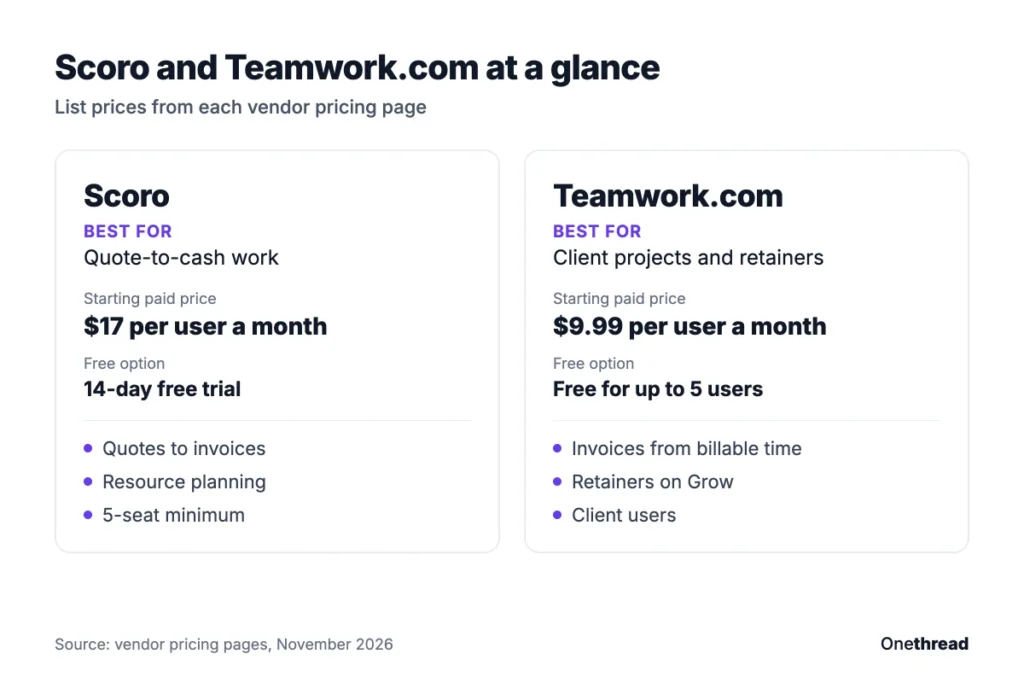
Scoro sells its plans as bundles. Time-billing starts at $17 per user a month, while Projects & Resources and Quote to Cash each start at $29.
End-to-end starts at $57 and adds the CRM. Every plan has a 5-seat minimum.
Scoro is a strong pick if your quotes often change during a project. A quote becomes the project budget. You track hours against it and bill from the same data. The client portal is a paid extra.
Pricing: $17 to $57 per user a month by bundle, 5-seat minimum, 14-day free trial with no card. Annual billing saves 13% to 17%, according to the pricing page.
Scoro also shows planned and actual hours side by side for each person. That view helps you spot overbooked staff before a deadline slips.
Best For
- Agencies of 15 people or more that quote, plan and invoice every project.
Pros
- Quotes, budgets and invoices share one data set.
- Bundles let you pay only for the parts you use.
- Clear resource planning across teams.
Cons
- The 5-seat minimum makes it costly for teams of 2 or 3.
- CRM sits only in the End-to-end bundle.
- The client portal costs extra.
Why Pick Teamwork.com for Client Projects and Retainers?
Teamwork.com is project management software made for client work. It mixes task lists, boards and Gantt views with time tracking, budgets and invoicing for billable hours.
The free plan covers up to 5 users. Deliver costs $9.99 per user a month, billed yearly. Grow costs $24.99 and adds invoices from billable time, resource planning, capacity views, time budgets and retainers. Profitability reports start on Scale.
Teamwork.com works well for agencies that run fixed-scope projects and retainers side by side. You can invite clients as users, so they see the tasks you choose to share. If you are weighing it against general project tools, our comparison of how monday.com stacks up against Asana shows the trade-offs in plain task tools.
Pricing: Free for up to 5 users. Deliver costs $9.99 and Grow $24.99 per user a month, billed yearly. Scale and Enterprise are on request, with a 14-day free trial.
Best For
- Agencies of 5 to 50 people that bill hours against retainers and fixed projects.
Pros
- Free plan for small teams.
- Invoices built from tracked billable time on Grow.
- Retainer and time budget tools made for client work.
Cons
- Profitability insights need the Scale plan.
- Seat minimums apply on paid plans, so check them before you buy.
- Many features sit on Grow, not Deliver.
Why Pick Kantata for Large Services Teams?
Kantata is professional services automation (PSA) software for larger agencies and consultancies. It focuses on resource management, forecasting and financial control across many projects and offices.
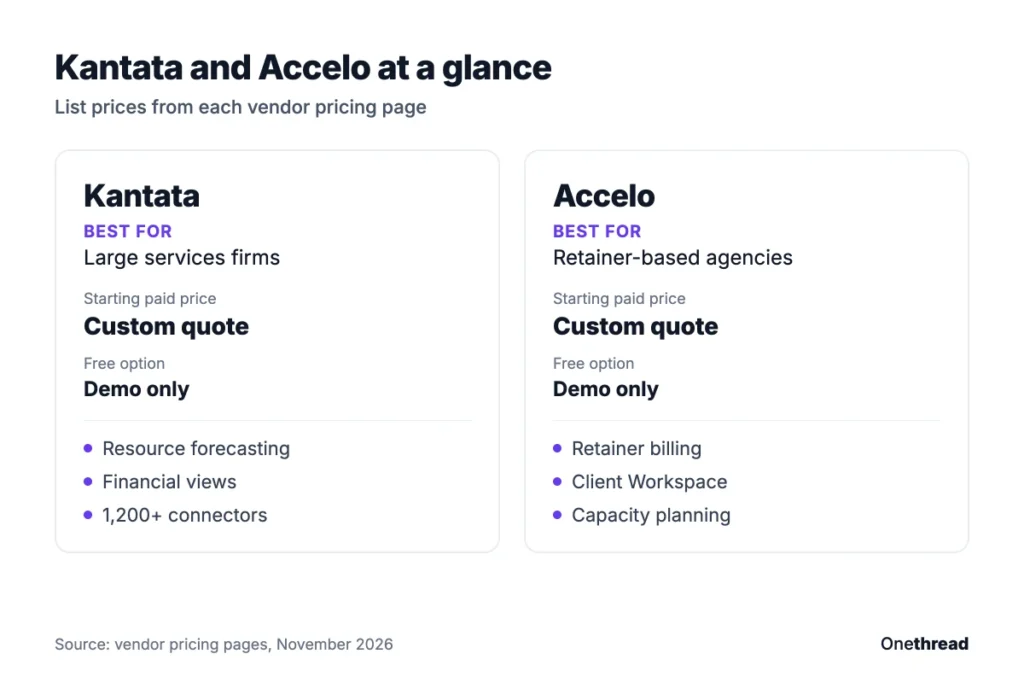
Kantata’s strength is planning people. You can forecast demand by role, see who is free next month, and track project costs against revenue. It also lists more than 1,200 connectors for other business apps.
Kantata does not publish prices. Its pricing page asks you to contact sales for a plan built around your team. That fits a firm with a finance team and a long buying cycle, not a five-person studio.
Kantata used to be called Mavenlink, and many older reviews still use that name. If you are a small team that only needs resource views, check lighter picks first. Productive and Teamwork.com both cover resource planning at a public price, with a free trial.
Pricing: Custom quote. No public trial or seat minimum is stated on the pricing page.
Best For
- Agencies and consultancies with 50 or more billable people across several teams.
Pros
- Deep resource forecasting by role and skill.
- Financial views for cost, revenue and margin.
- Large set of integrations.
Cons
- No public pricing.
- Setup and training take time.
- Too heavy for small agencies with simple projects.
Why Pick Accelo for Retainer-Based Agencies?
Accelo is client work management software for service businesses. It joins sales, quotes, projects, retainers, time and billing, with a Client Workspace where clients can see their work.
Accelo is known for retainer tools. You can set up recurring work, track hours against each period, and bill on time. Resourcing and capacity planning show who has room for more work. The homepage frames its goal as predictable profit.
Accelo does not list prices. The pricing page asks for a quote based on team size, and there is no public trial.
Accelo fits agencies where the same client buys again every month. It is less of a fit for one-off projects with fixed fees. Book the demo with one real retainer in mind, so you can see how its billing handles rollover hours, overages and renewals.
Pricing: Custom quote based on team size. Demo on request.
Best For
- Agencies where most revenue comes from monthly retainers.
Pros
- Retainer tracking and recurring billing are core features.
- Client Workspace gives clients a clear view of their work.
- Sales, projects and billing share one record.
Cons
- No public pricing or self-serve trial.
- The interface packs many modules, so training matters.
- Smaller teams may pay for modules they never use.
Why Pick Function Point for Creative Agency Estimates?
Function Point is agency management software made for creative and marketing agencies. It covers estimates, proposals, job tracking, time tracking, resource forecasts and batch invoicing.
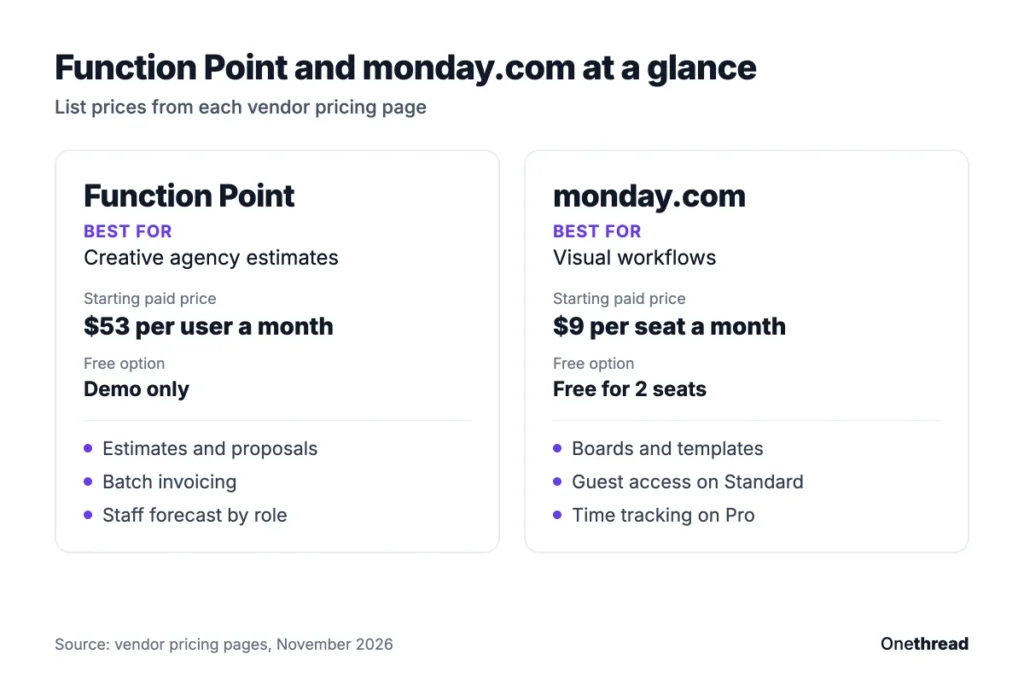
Pricing is per user. Standardize costs $53 per user a month and Optimize costs $62, on a one-year term with annual billing. Monthly billing costs more, and new customers pay an onboarding fee. Non-profits get $2 off per seat.
Function Point suits agencies that live on estimates and job numbers. You build an estimate and approve it as a job. Then you forecast staff by role and invoice in batches at month end.
Ask about the onboarding fee before the demo ends, since the pricing page does not state the amount. Also ask how long setup takes for a team of your size.
Pricing: $53 (Standardize) or $62 (Optimize) per user a month on annual billing, plus a one-time onboarding fee. No free trial is listed.
Best For
- Creative and marketing agencies that work from estimates and job tickets.
Pros
- Built only for agencies, with agency terms.
- Estimates, jobs and invoices share one flow.
- Resource forecast by role and person.
Cons
- The highest per-user list price on this list.
- One-year term and an onboarding fee.
- No client portal is mentioned.
Why Pick monday.com for Visual Agency Workflows?
monday.com is a visual work management platform. Agencies use its boards for content calendars, client requests, campaign plans and approvals.
The Free plan covers 2 seats and 3 boards. Basic costs $9, Standard $12 and Pro $19 per seat a month, billed yearly. Paid plans start at 3 seats. Time tracking needs Pro, guest access starts on Standard, and resource management sits on Enterprise.
monday.com is easy to set up and simple for clients to read. It is not a billing tool, so most agencies pair it with an invoicing app. Our Jira vs monday comparison shows how its seat buckets add up for growing teams.
Top Tip: Count your people before you pick a plan. Seats come in buckets, so 6 people may pay for more seats than they use.
Pricing: Free for 2 seats, then $9 to $19 per seat a month billed yearly, Enterprise on request, 14-day Pro trial.
Best For
- Creative and content teams that want clear boards and simple client views.
Pros
- Fast setup with many ready templates.
- Guests can view and comment on Standard and above.
- Clean boards that clients understand.
Cons
- No built-in invoicing.
- Time tracking needs the Pro plan.
- Seats are sold in buckets, so you may pay for empty seats.
Why Pick ClickUp for Agencies on a Budget?
ClickUp is an all-in-one work app with tasks, docs, goals, whiteboards and time tracking. Many small agencies use it as a low-cost base and add billing elsewhere.
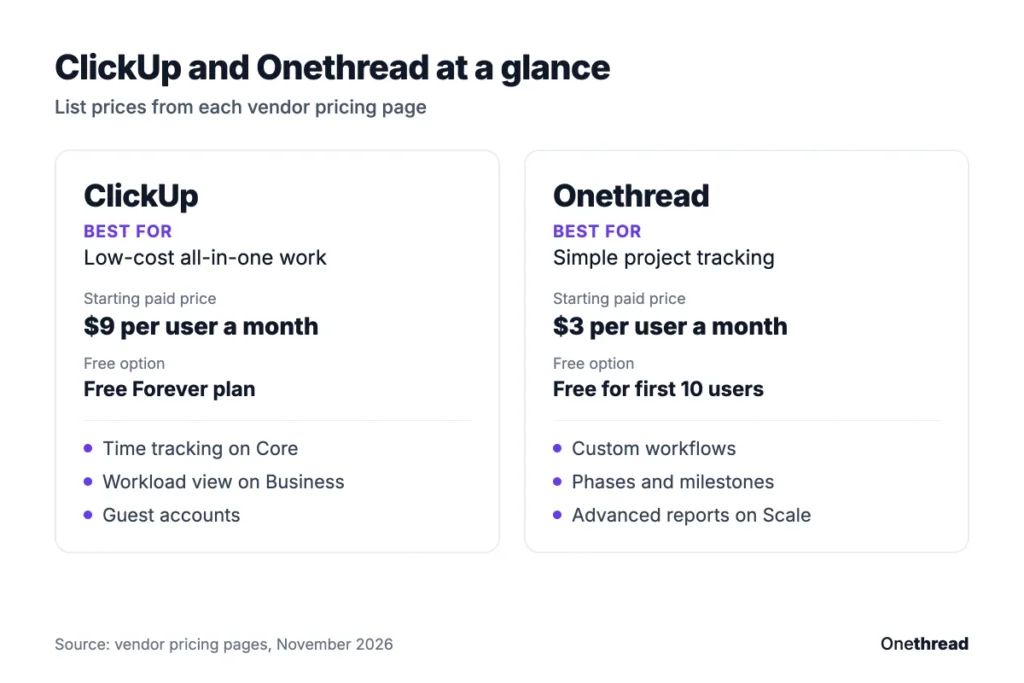
The Free Forever plan has guest accounts. Core costs $9 per user a month billed yearly and adds time tracking. Business costs $17 and adds timesheets, the Workload view and resource management. Max costs $100, and Enterprise is on request.
ClickUp gives you a lot for the price, but it takes work to set up well. Plan one space per client and one list per project, then add views as you need them.
Keep invoicing in a separate app, such as your accounting tool. Agencies that like to build their own system get the most from it. Teams that want ready agency workflows may prefer Productive or Teamwork.com.
Pricing: Free Forever, then Core $9, Business $17 and Max $100 per user a month billed yearly, Enterprise on request.
Best For
- Small agencies that want many tools in one app at a low price.
Pros
- Generous free plan with guest accounts.
- Time tracking from the Core plan.
- Workload view for capacity on Business.
Cons
- No native invoicing.
- Many settings, so setup takes time.
- Resource management needs Business or higher.
Why Pick Onethread for Simple Agency Project Tracking?
Onethread is our own project management software. It fits small agencies that want clear projects, phases and milestones without a long setup. We list it last on purpose, so you can weigh it against the others.
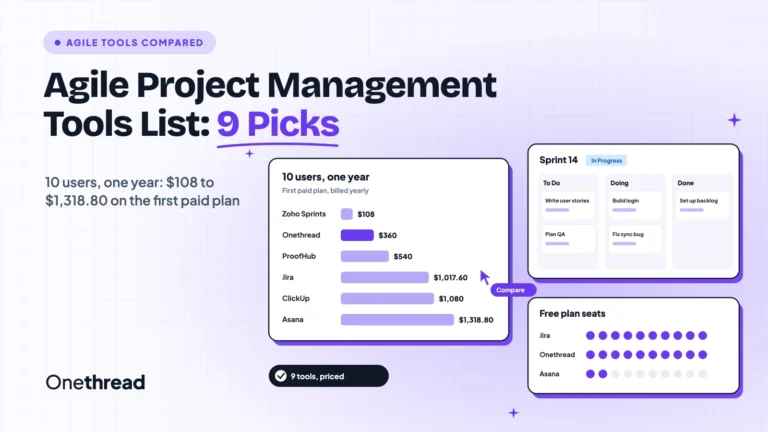
The Basic plan is free for the first 10 users and includes up to 3 workflows. Growth costs $3 per user a month and Scale costs $5, billed yearly. Monthly billing costs $3.60 and $6. Scale adds advanced reports.
Onethread does not include invoicing or a client portal today, and we would rather say so up front. If billing or client orders are your main gap, pick Agency Handy, Productive or Scoro.
If your gap is planning and tracking client projects, Onethread keeps it simple. You can see the full list of Onethread project management features before you sign up.
Pricing: Free for the first 10 users, then $3 (Growth) or $5 (Scale) per user a month billed yearly.
Best For
- Small agencies that need simple project, phase and milestone tracking at low cost.
Pros
- Free for teams of up to 10 users.
- Low per-user price on paid plans.
- Custom workflows, phases and milestones.
Cons
- No invoicing or client portal.
- Budgeting is listed as upcoming on Scale.
- Lighter reporting than PSA tools such as Kantata.
Which Insurance Agency Management Systems Lead on Reporting?
Insurance agency management systems lead on reporting when they show policy, premium and commission data in ready dashboards. Applied Epic, Vertafore AMS360 and EZLynx offer the deepest built-in reporting. QQCatalyst, AgencyBloc and HawkSoft fit smaller agencies.
An insurance AMS is not the same as an agency CRM. A CRM tracks customer relationships and sales. An AMS also runs policies, billing and the back office across the full customer lifecycle.
| System | Best for | Reporting tools | Pricing |
|---|---|---|---|
| Applied Epic | P&C and benefits brokers, 10 to 500+ staff | Epic Dashboards, role views by branch, premium or commission | Contact sales |
| Vertafore AMS360 | Independent agencies of most sizes | Business intelligence, trend and KPI reports | Contact sales |
| EZLynx | Growing and multi-location agencies | Agency Pulse monthly benchmark report, summary reports | Priced by users and products |
| QQCatalyst | Small and growing independent agencies | 50+ pre-built and custom reports | Contact sales |
| AgencyBloc | Life, health and benefits agencies | Commissions+ custom commission reports | From $109 a month |
| HawkSoft | Independent P&C agencies | Agency Intelligence KPIs for retention and cross-sell | Base fee plus per-user fee |
Top insurance agency teams also compare carriers for every line they sell. This list of the Top insurance agency picks for umbrella cover shows the product research an AMS should support. Applied Epic and AMS360 also handle invoicing, billing and commission tracking, and AMS360 calculates commission splits on statements.
Sources: the official product and pricing pages of all six systems, plus the EZLynx guide on CRM vs AMS. We checked them in November 2026.
What Features Should an Agency Management System Include?
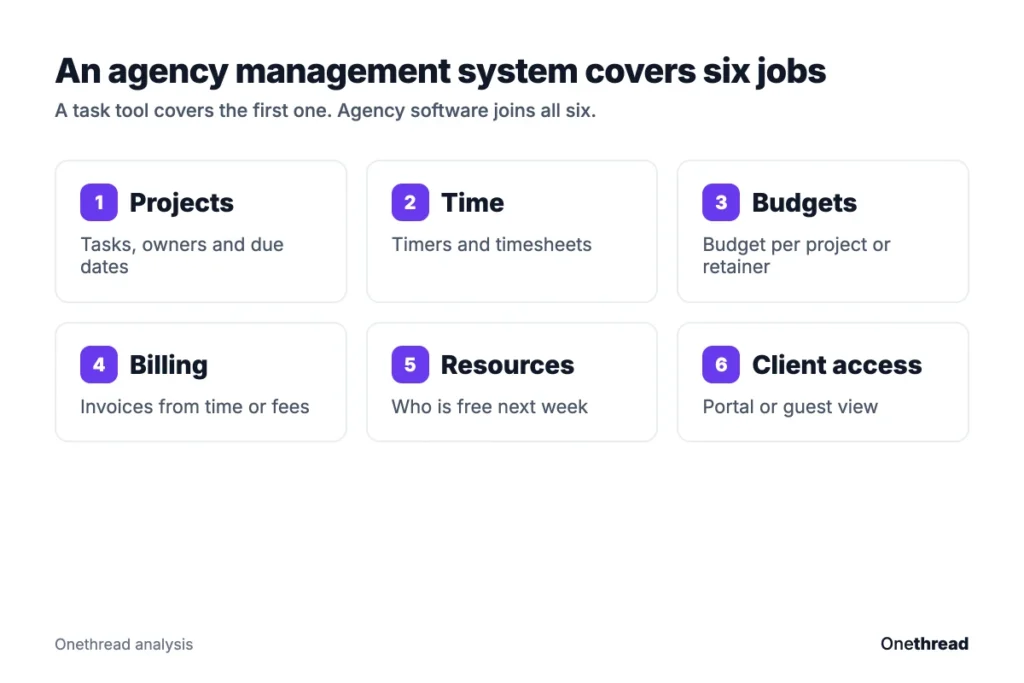
A good agency management system covers six jobs: projects, time, budgets, billing, resources and client access. You don’t need all six on day one, but your system should not block any of them later.
Use this checklist when you compare tools:
- Project and task tracking. Boards, lists or Gantt views, with owners and due dates on every task.
- Time tracking. A timer and timesheets tied to tasks, so hours flow into budgets and invoices.
- Budgets and profitability. Budget per project or retainer, with alerts before you go over.
- Billing and invoicing. Invoices built from time, fixed fees or subscriptions.
- Resource planning. A view of who is busy and who has room next week. Our guide to agency resource management software covers this job in depth.
- Client access. A portal or guest view where clients approve work and see progress.
Pick the jobs you need now, then check which plan includes each one. Many tools hide time tracking, resource views or the client portal on higher plans.
Marketing agencies often add one more layer: client reporting. Monitor rankings with an affordable SEO tool, then share the results in the client portal.
Top Tip: Write down your three worst weekly leaks before any demo. Ask each vendor to show you how its tool fixes those three, not its full feature tour.
How Much Does an Agency Management System Cost?
An agency management system costs from $0 to about $60 per user a month at list price. Flat-price tools such as Agency Handy charge per plan, while most others charge per user. Kantata and Accelo quote on request, so budget time for a sales call.
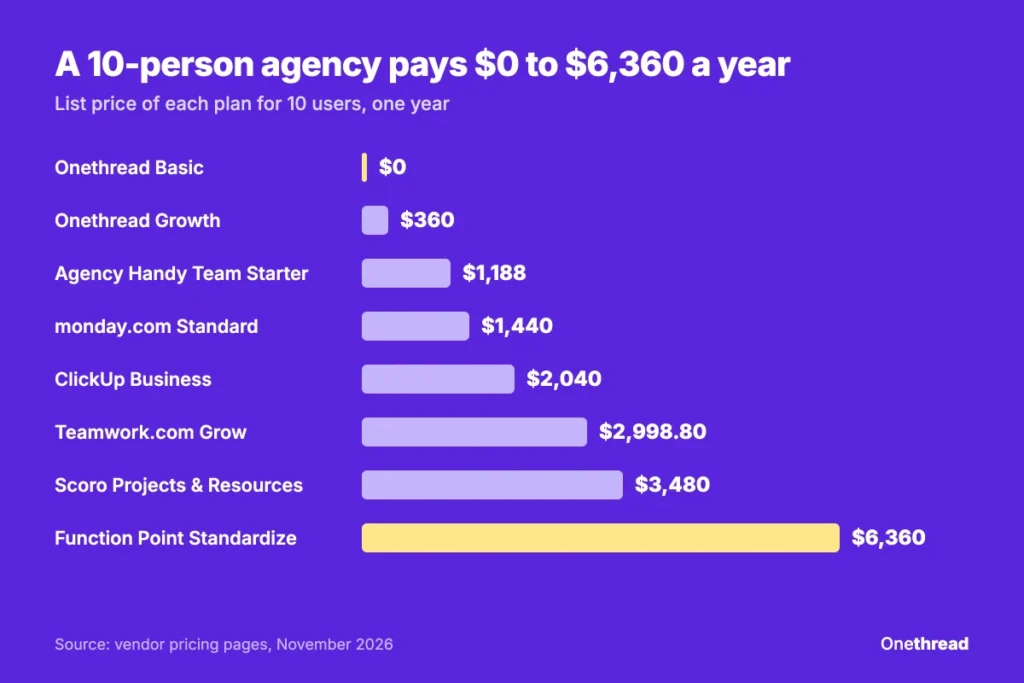
Seat rules change the real cost. monday.com sells seats in buckets. Scoro needs at least 5 seats. Onethread is free for the first 10 users.
Example: We priced one year for a 10-person agency at list price. Onethread Basic costs $0, and Onethread Growth costs 10 × $3 × 12 = $360. Agency Handy Team Starter costs $99 × 12 = $1,188 on monthly billing.
monday.com Standard costs 10 × $12 × 12 = $1,440. ClickUp Business costs 10 × $17 × 12 = $2,040. Teamwork.com Grow costs 10 × $24.99 × 12 = $2,998.80.
Scoro Projects & Resources costs 10 × $29 × 12 = $3,480. Function Point Standardize costs 10 × $53 × 12 = $6,360, plus its onboarding fee. The gap between the cheapest and the dearest paid pick is $6,000 a year.
Price is only half the sum. If a tool saves each person 30 minutes a week, a 10-person team gets back about 260 hours a year. At a billable rate of $100 an hour, that is $26,000 of time. To price your own services against those hours, try our free agency pricing calculator.
How Do You Choose the Best Agency Management System?
You choose the best agency management system in five steps. Start with your biggest gap, not with the longest feature list you can find.
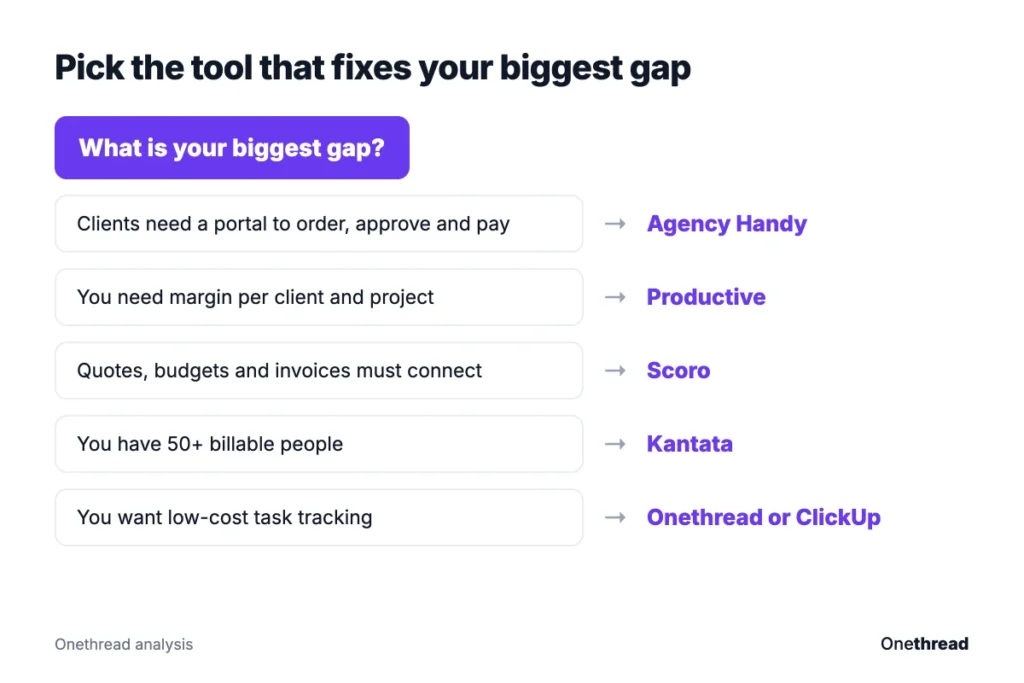
- Name your biggest gap. Pick one: client communication, time and billing, profit tracking, or resource planning.
- Shortlist two or three tools. Use the table at the top. Agency Handy covers client portals, Productive covers profit, Scoro covers quotes to invoices, and ClickUp or Onethread cover low-cost tracking.
- Check seat rules and billing terms. Look for minimum seats, seat buckets, one-year terms and onboarding fees.
- Run one live client project in the trial. Add real tasks, log real hours and send a test invoice.
- Ask your team and one client. Keep the tool only if both find it easier and faster than the old way.
Most trials last 7 to 14 days, so plan the test project before you start the clock.
Keep a short scorecard during the trial. Note how long setup took, how many clicks a timesheet needs, and whether the invoice looked right.
Ask one client to log in and approve a task. Their reaction is often the clearest signal you will get. Drop any tool that needs a workaround for your most common daily task.
What Should You Do Next?
The best agency management system is the one that closes your biggest gap at a price your team size supports. Client portals point to Agency Handy, profit tracking to Productive, and quote-to-cash work to Scoro. Low-cost task tracking points to ClickUp or Onethread, and large firms should look at Kantata.
Write down your top gap today, pick two tools from the table, and start both free trials on the same client project. The tool your team still opens without a reminder after one week is your answer, whatever the feature list says.
FAQs
What Is the Best Agency Management System for Small Agencies?
The best agency management system for a small agency depends on its main gap. Agency Handy suits small teams that need a client portal and billing, with 10 users for $99 a month. ClickUp and Onethread suit small teams that mostly need task tracking, and both have free plans.
Is an Agency Management System the Same as Project Management Software?
No. Project management software tracks tasks, owners and dates. An agency management system adds the business side: time tracking, budgets, invoices, resource planning and often a client portal. Many agencies start with a project tool and move to an agency management system once billing and margins get hard to track.
How Long Does It Take to Set Up Agency Management Software?
A small agency can set up simple agency management software in one to two weeks. That covers clients, projects, rates and a first invoice. Larger PSA tools such as Kantata or Accelo often take several weeks, because you also map roles, budgets and integrations with your finance tools.
Which Insurance Agency Management System Has the Best Reporting?
Applied Epic has the deepest built-in reporting of the insurance agency management systems we checked. Its Epic Dashboards show role views by branch, department, premium or commission, with scheduled exports. Vertafore AMS360 and EZLynx follow closely, with trend reports and a monthly benchmark report called Agency Pulse.
Is There a Free Agency Management System?
Yes, a few tools have free plans, but none covers full billing for free. Onethread is free for the first 10 users, Teamwork.com is free for up to 5 users, and ClickUp has a Free Forever plan. Agency Handy, Productive and Scoro offer free trials of 7 to 14 days instead.