A calendar app should save you time, not eat it.
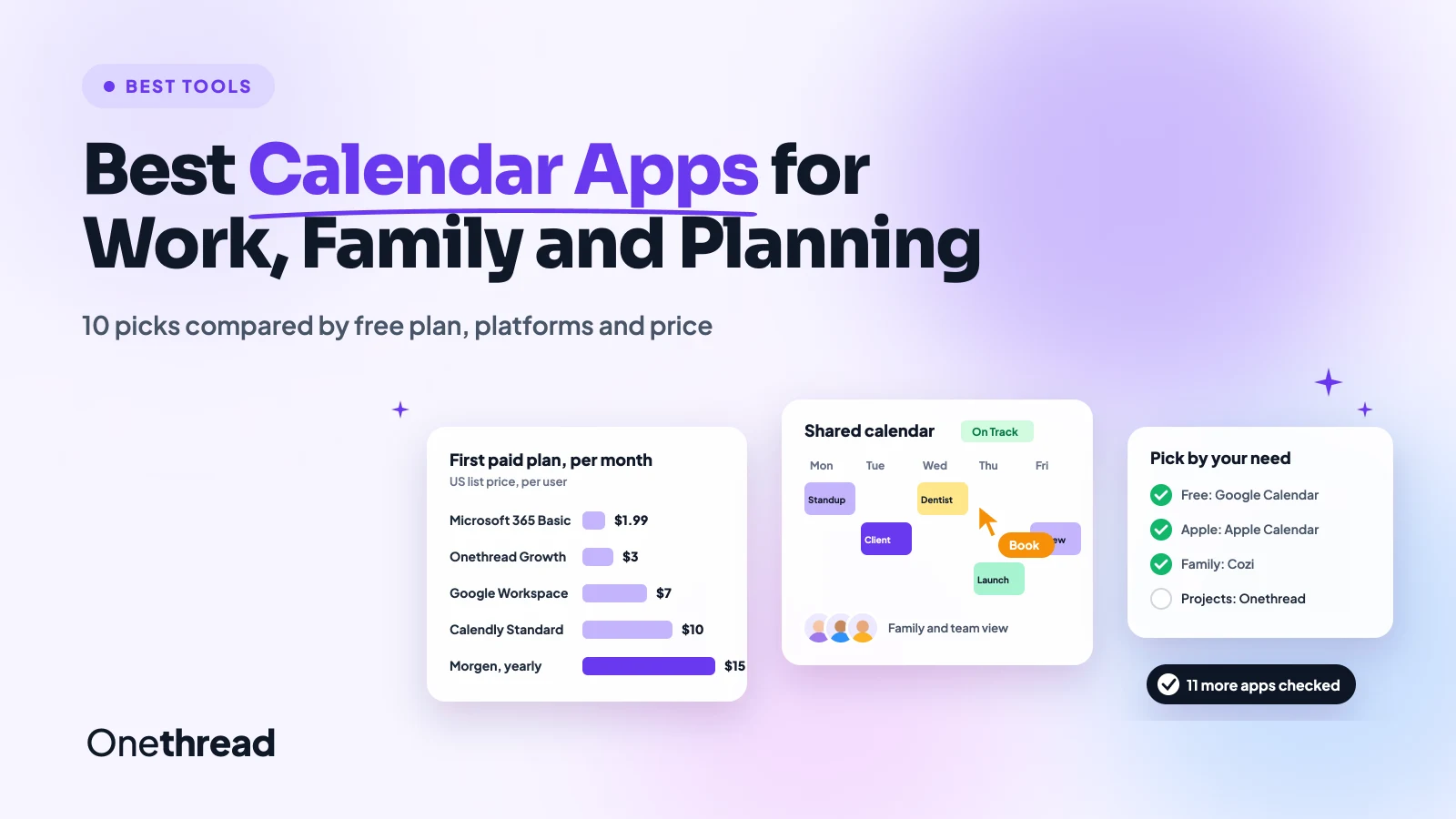
The best calendar apps for most people are Google Calendar, Outlook and Apple Calendar, because all three are free and sync across devices. Fantastical, Notion Calendar and Morgen add better planning tools. Calendly handles booking, and TimeTree and Cozi suit families.
The right pick depends on your devices and on who shares your week. A team needs shared views. A family needs one list everyone can read.
We checked the free plans, platforms and prices of 21 apps on their own pages in November 2026.
You get a comparison table, 10 detailed picks and a short guide to choosing.
Key Points
- The best calendar apps for most people are Google Calendar, Outlook and Apple Calendar. All three are free, and the right one is the one built into the email and phone you already use.
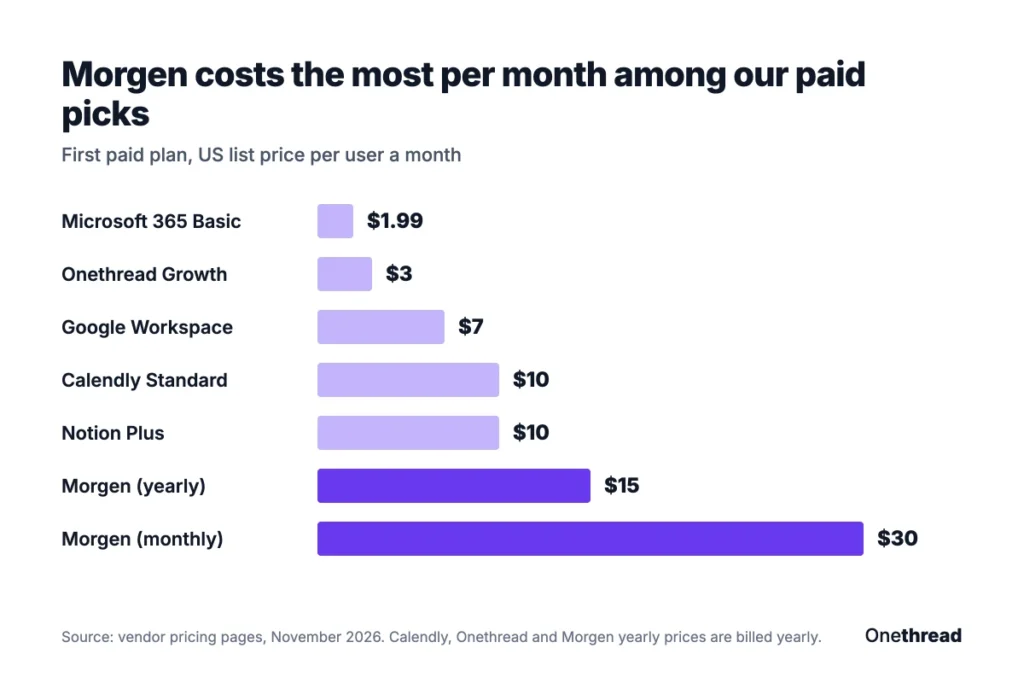
- Pay only when a feature saves you time: Fantastical for natural language input, Morgen for AI time blocking, and Calendly Standard for client booking at $10 a seat a month, billed yearly.
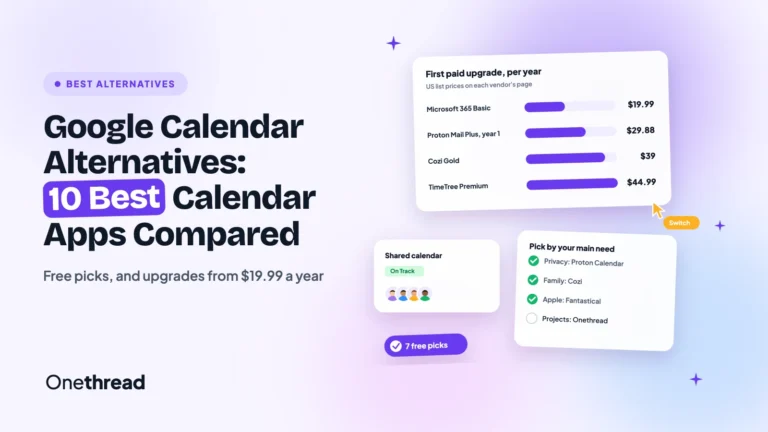
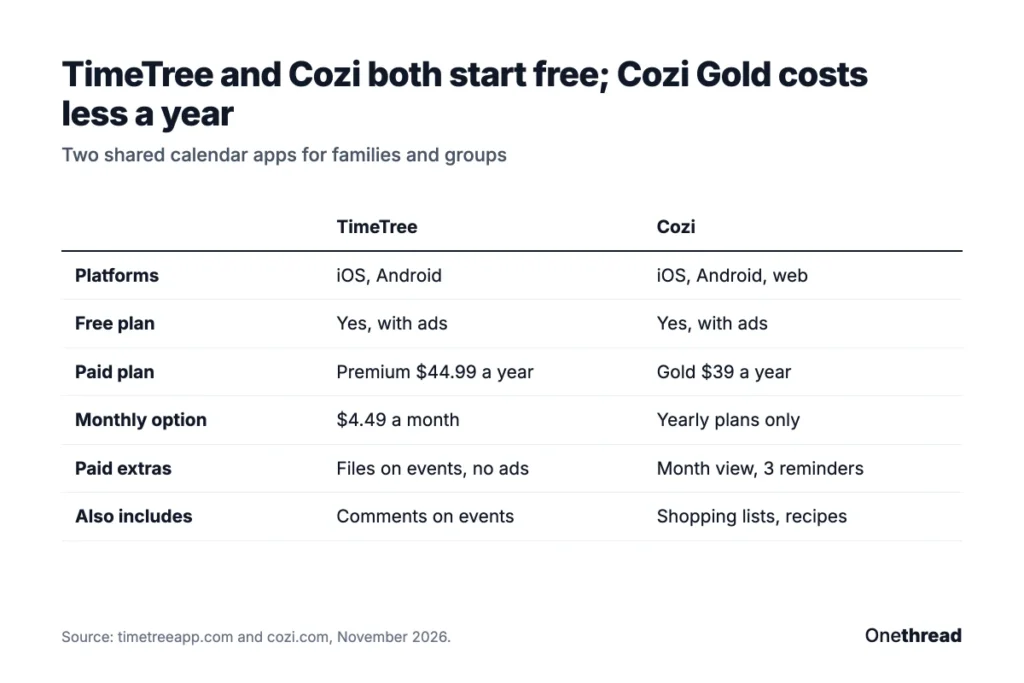
- Families should pick a shared app such as TimeTree or Cozi. Both are free with ads, and Cozi Gold costs $39 a year.
- Teams that plan projects on dates can use Onethread’s calendar view, which is free for the first 10 users.
Which Calendar Apps Are Best at a Glance?
| App | Best for | Platforms | Free plan | First paid plan (USD) |
|---|---|---|---|---|
| Google Calendar | Free team scheduling | Web, Android, iOS | Yes | Workspace Business Starter $7 a user a month |
| Microsoft Outlook | Microsoft 365 users | Windows, Mac, web, iOS, Android | Yes | Microsoft 365 Basic $19.99 a year |
| Apple Calendar | iPhone and Mac users | iPhone, iPad, Mac, iCloud.com | Yes | iCloud+ from $0.99 a month (storage) |
| Fantastical | Fast natural language entry | Mac, iPhone, iPad, Windows | Yes, 1 calendar set | Flexibits Premium, priced at checkout |
| Notion Calendar | Notion users | Mac, Windows, iPhone, Android | Yes | Notion Plus $10 a seat a month |
| Morgen | AI time blocking | Mac, Windows, Linux, mobile, web | No, 14-day trial | $15 a month billed yearly |
| Calendly | Client booking links | Web, mobile | Yes, 1 event type | Standard $10 a seat a month billed yearly |
| TimeTree | Shared calendars for groups | iOS, Android | Yes, with ads | Premium $44.99 a year |
| Cozi | Family schedules and lists | iOS, Android, web | Yes, with ads | Cozi Gold $39 a year |
| Onethread | Project dates and deadlines | Web | Yes, first 10 users | Growth $3 a user a month billed yearly |
Sources: each vendor’s pricing page or app store listing, checked November 2026.
How Did We Pick the Best Calendar Apps?
We picked the best calendar apps by checking 21 apps against five tests. Each app had to sync across devices, show day, week and month views, share calendars, send reminders and state its price in public.
We read each vendor’s pricing page and app store listing in November 2026. We also compared the apps that the top 10 Google results for this search recommend.
Prices on this page are list prices in US dollars for one person or one seat. Some apps show a lower first-year rate, and app store prices can change by country.
We dropped apps that have shut down or stopped getting updates. Those are listed near the end, so you know why they are missing.
We did not sign in to paid plans or run long trials. The notes on each app come from vendor pages, app store listings and help docs, and the prices are what a new buyer sees.
Calendars that also track work earned a place only when their calendar view is part of the plan you would buy. A task app with a locked calendar view is a task app first, so those apps sit in a shorter list near the end.
What Makes a Good Calendar App?
A good calendar app syncs on every device you own, lets you add an event in seconds, and shares your schedule with the right people. Everything else is a bonus.
Start with sync. An app that works on your phone but not your laptop will fail the first time you plan away from your desk. Check that it reads the accounts you already use, such as Google, Outlook or iCloud.
Next, look at input speed. Natural language entry lets you type “lunch with Sam Friday at 1” and get a filled event. Fantastical and Zoho Calendar both support it.
Sharing matters for teams and families. You want view and edit rights, so a partner can add a dentist visit without changing your work blocks.
Finally, check reminders and views. A three-day or agenda view helps on a phone. A month view helps you plan travel and school breaks, and a year view helps with long projects.
Example: a two-person household on Cozi Gold pays $39 a year, which is $3.25 a month for the pair. Two people on Morgen’s yearly plan pay $15 each a month, or $360 a year. The gap is a choice between shared lists and AI planning.
Why Pick Google Calendar for Free Team Scheduling?
Google Calendar is the best free pick for most people and small teams. It runs in any browser and on Android and iOS.
You can share each calendar with view or edit rights, so a teammate sees your free time without reading every event.
Focus time blocks off hours, mutes notifications and can decline meetings for you. Time Insights shows how you spend your week and with whom. A personal Google account can also publish one booking page.
If your team already uses Gmail, the calendar is in place. Meet links attach to events on their own, and Gmail can add flights and bookings to your schedule. Our list of Google Calendar alternatives covers what to try if it does not fit.
Pricing: free with a Google account. Google Workspace Business Starter costs $7 a user a month, and its pricing page notes that it does not include appointment booking pages.
Best For
- People and small teams that already use Gmail or Android.
- Students who need a free calendar on any device.
Pros
- Free, fast and available in any browser.
- Easy sharing with view or edit rights for each person.
- Focus time and Time Insights help you protect deep work.
- Meet links attach to new events on their own.
Cons
- Paid booking features need a higher Workspace plan.
- Few views beyond day, week, month and schedule.
- No natural language entry on the web app.
Why Pick Microsoft Outlook If You Use Microsoft 365?
Microsoft Outlook puts email, calendar, tasks and contacts in one place. It is the natural pick if your company runs on Microsoft 365.
The calendar works on Windows, Mac, the web, iOS and Android. You can open several calendars side by side, schedule Teams meetings from an event and see coworkers’ free time when you plan a meeting.
A free Outlook.com account covers personal use. Microsoft 365 Basic removes ads and adds storage, and Personal adds the desktop Office apps.
Outlook also reads Google and iCloud calendars, so you can keep a personal Gmail calendar next to your work one. Note that calendar items count toward your mailbox storage.
Pricing: free with Outlook.com. Microsoft 365 Basic is $1.99 a month or $19.99 a year, and Microsoft 365 Personal is $9.99 a month or $99.99 a year.
Best For
- Teams that already use Microsoft 365, Teams and Exchange.
- Anyone who wants email and calendar in a single desktop app.
Pros
- Email and calendar live in one app.
- Strong meeting tools for shared workplace calendars.
- Works on every major desktop and phone system.
- Reads Google and iCloud calendars next to work ones.
Cons
- The interface feels busy next to lighter calendar apps.
- Calendar items use up mailbox storage.
- Personal use beyond Basic needs a $99.99 yearly plan.
Why Pick Apple Calendar for iPhone and Mac?
Apple Calendar is the best free calendar app for people who live on an iPhone, iPad and Mac. It ships with the device and syncs through iCloud with no setup.
You can share a calendar with view or edit rights, and changes show up for everyone in real time. Public calendars let anyone with the link subscribe, which suits a club or a class.
Siri can add events by voice, and the calendar also reads Google and Exchange accounts.
Windows users can reach the same calendar through iCloud.com or the iCloud app. Android has no official app, which is the main gap for mixed households. A partner on Android can still subscribe through a public calendar link, but only to read.
Pricing: free. iCloud includes 5 GB of storage, and iCloud+ plans start at $0.99 a month for 50 GB if you need more space.
Best For
- People who use only Apple devices.
- Families on iCloud who share one or two calendars.
Pros
- Free and built into every Apple device.
- Live shared calendars with view or edit rights.
- Reads Google, Exchange and other accounts too.
- Siri adds events by voice on every Apple device.
Cons
- No Android app.
- Fewer planning features than Fantastical or Morgen.
- The web version on iCloud.com is basic.
Why Pick Fantastical for Fast Event Entry?
Fantastical is the best calendar app for people who want to type an event in plain words. Write “team call Tuesday 3pm every week” and it fills in the date, time and repeat rule.
It runs on Mac, iPhone, iPad, Apple Watch and Windows. You get day, week, month, quarter and year views, plus calendar sets that switch between work and home with one tap.
Fantastical also reads Google, Exchange and iCloud calendars, so you keep your accounts and change only the view on top of them.
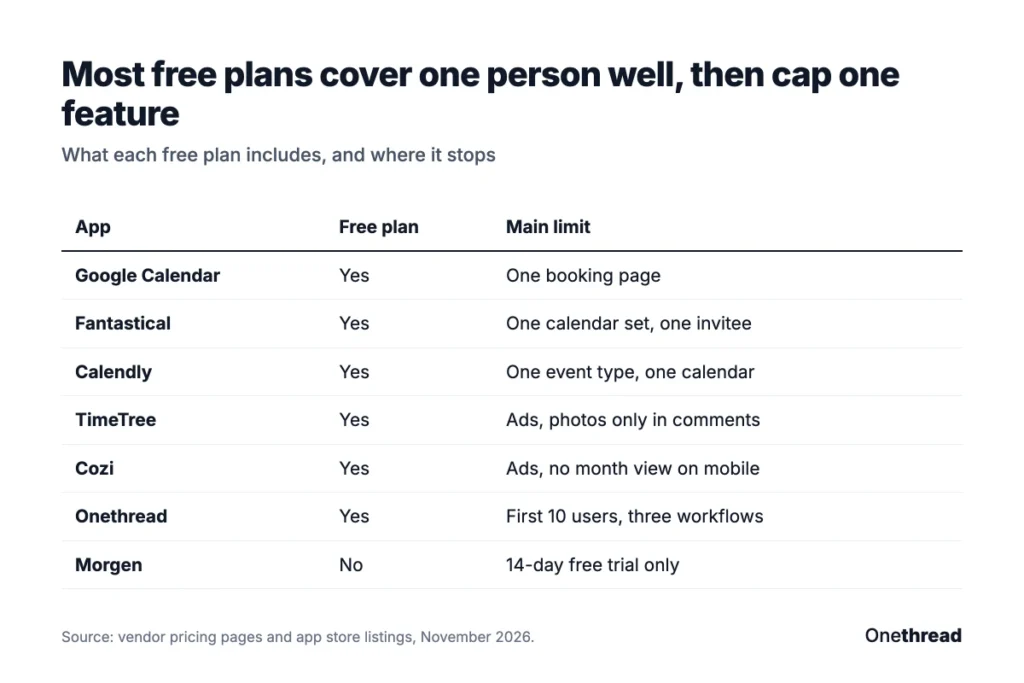
The free plan covers one calendar set and one invitee per event. Flexibits Premium adds travel time, time-to-leave alerts, calendar mirroring and unlimited Meet With scheduling.
Pricing: free plan available. Flexibits shows the Premium price at checkout, and the App Store lists in-app purchases of $6.99 and $56.99.
Best For
- Apple and Windows users who add many events by typing.
- People who switch between work and home calendar sets.
Pros
- Fast typed input that fills in dates and repeats.
- Calendar sets keep work and home apart.
- Quarter and year views help with long plans.
- Reads your Google, Exchange and iCloud accounts as they are.
Cons
- No Android phone app.
- The useful extras sit behind a subscription.
- Pricing is not listed on the vendor’s site.
Why Pick Notion Calendar If You Plan in Notion?
Notion offers Notion Calendar as a free app that links your schedule to your Notion pages and databases. It is the best pick if your notes, docs and tasks already live there.
Database items with dates show up on the calendar, and you can drag them to new days. A built-in scheduling link shares your free times, and a time zone view helps when your team spans countries.
The app runs on Mac, Windows, iPhone, iPad and Android, and it syncs Google, Outlook and iCloud calendars. The calendar itself is free on every Notion plan.
Keyboard shortcuts let you create, move and join meetings without the mouse, which suits people who live in Notion all day.
Pricing: Notion Calendar is free. Notion Plus costs $10 a seat a month if your team needs more workspace features.
Best For
- Teams and students who already plan their work in Notion.
- People who want a free, keyboard-first calendar.
Pros
- Free, with a clean, keyboard-friendly design.
- Notion database items appear on the calendar.
- Built-in scheduling link and time zone view.
- Syncs Google, Outlook and iCloud calendars.
Cons
- Less useful if you do not use Notion.
- No web app listed on its product page.
- Team workspace features cost extra on Notion Plus.
Why Pick Morgen for AI Time Blocking?
Morgen is a calendar and task planner that pulls every calendar into one view and uses an AI Planner to block time for your tasks. It is the best pick if your to-do list never fits your week.
It connects Google, Outlook and iCloud calendars, plus task apps, with no limit on integrations. You also get a booking page, scheduling links and rules that move or tag events for you.
The AI Planner works from your task list. You set how long each task takes, and Morgen places it in the open gaps of your week.
Morgen runs on Windows, Mac, Linux, mobile and the web. There is no free plan, but a 14-day trial needs no card.
Pricing: $30 a month billed monthly, or $15 a month billed yearly. Team seats cost $10 a seat a month billed yearly, with a two-seat minimum.
Best For
- Busy people who plan tasks and meetings in one place.
- Linux users who need a full calendar app.
Pros
- AI Planner turns tasks into time blocks.
- Unlimited calendar and task integrations.
- Runs on every desktop system, including Linux.
- Booking page and scheduling links included.
Cons
- No free plan after the trial.
- Monthly billing costs twice the yearly rate.
- More setup than a simple calendar.
Why Pick Calendly for Client Booking?
Calendly is the best tool for letting clients book time with you. You share a link, people pick an open slot, and the meeting lands on your calendar with no back and forth.
The free plan gives you one event type and one connected calendar. Standard adds unlimited event types, up to six connected calendars, automated reminders and payments through Stripe or PayPal.
Calendly checks every connected calendar before it offers a slot, so you never get double booked across work and personal accounts.
Calendly sits on top of your main calendar, so most people pair it with Google Calendar or Outlook. Our Calendly pricing guide breaks down every plan, including team seats and the yearly discount.
Pricing: free plan available. Standard costs $10 a seat a month billed yearly.
Best For
- Consultants, sales teams and anyone who books calls with outsiders.
- Freelancers who take paid calls through a link.
Pros
- Booking links end email ping-pong.
- Works with the calendar you already use.
- Reminders and payments on paid plans.
- Checks every connected calendar to stop double booking.
Cons
- Not a full calendar on its own, so you still need Google or Outlook.
- Free plan allows only one event type.
- Team routing features need higher plans.
Why Pick TimeTree for Shared Group Calendars?
TimeTree is a free shared calendar built for couples, families and small groups. Everyone in the group can add events, comment on them and see changes as they happen.
The free version shows ads and allows photos only in comments. Premium removes ads, lets you attach PDFs and files to events, adds a three-day hour-by-hour view and lets you pin key events. The first month of Premium is free, so you can test it with your group.
TimeTree runs on iOS and Android, which makes it a good bridge for households that mix iPhones and Android phones.
You can keep several shared calendars, for example one for the family and one for a sports team, and switch between them in one tap.
Pricing: free with ads. TimeTree Premium costs $4.49 a month or $44.99 a year, and prices can vary by region.
Best For
- Couples, clubs and groups that share one schedule.
- Mixed iPhone and Android households.
Pros
- Free shared calendars with comments on each event.
- Works across iPhone and Android.
- Premium adds file attachments to events.
- Several shared calendars, one tap apart.
Cons
- Ads on the free plan.
- No desktop app listed on its Premium page.
- Less suited to work calendars and client meetings.
Why Pick Cozi for Family Schedules?
Cozi is a family organizer that combines a shared calendar with to-do lists, shopping lists and recipes. Each family member gets a color, so one glance shows who is busy.
The free plan covers the shared calendar and lists with ads. Cozi Gold adds the month view on mobile, up to three reminders per event and alerts to every family member when something changes.
Cozi works on phones and in a browser, so parents can plan at work and kids can check the week from a tablet at home.
The shopping list updates for everyone at once, so whoever passes the store can pick up what is missing.
Pricing: free with ads. Cozi Gold costs $39 a year, and Cozi Max costs $79 a year.
Best For
- Families that juggle school, sports and chores.
- Parents who plan meals and shopping with the week.
Pros
- Calendar, lists and recipes in one app.
- A color for each family member in the calendar view.
- Low yearly price that covers the whole family on one account.
- Shared shopping list updates for everyone at once.
Cons
- Ads on the free plan, which can feel busy on a small phone screen.
- Month view on mobile needs Gold.
- Not built for work schedules or client meetings.
Why Pick Onethread for Project Calendars?
Onethread is project management software with a calendar view, a Gantt chart and task lists in one place. It suits teams that plan work around deadlines rather than meetings.
Each task with a date appears on the calendar, so you can see who delivers what this week. You can drag a task to a new day when plans change.
Teams can also log time on tasks and share progress with clients, which keeps deadlines and workload in one view. The Gantt chart shows how tasks depend on each other across the month.
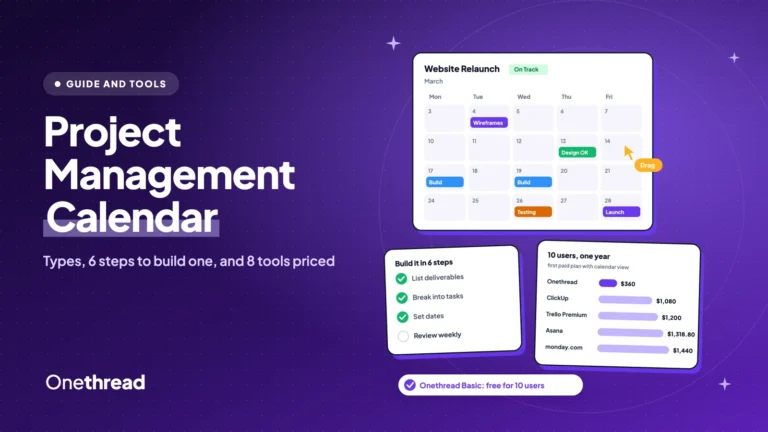
If you want the bigger picture, our guide to the project management calendar shows how to build one step by step.
Pricing: the Basic plan is free for the first 10 users, with up to three workflows. Growth costs $3 a user a month billed yearly.
Best For
- Small teams and agencies that track project deadlines.
- Agencies that share deadlines and progress with clients.
Pros
- Calendar view, Gantt chart and tasks together.
- Free for the first 10 users.
- Low per-user price on paid plans.
- Drag tasks to new days when plans change.
Cons
- Not a personal calendar for appointments.
- Free plan limits workflows to three.
- Web first, so it is not built for quick phone entry.
Which Other Calendar Apps Are Worth a Look?
Eleven more apps came up in our research. Some are task apps with a calendar view, some fill gaps on Android or in time blocking, and two are no longer worth installing. Each group says what the apps do and what they cost.
Task Apps With a Calendar View
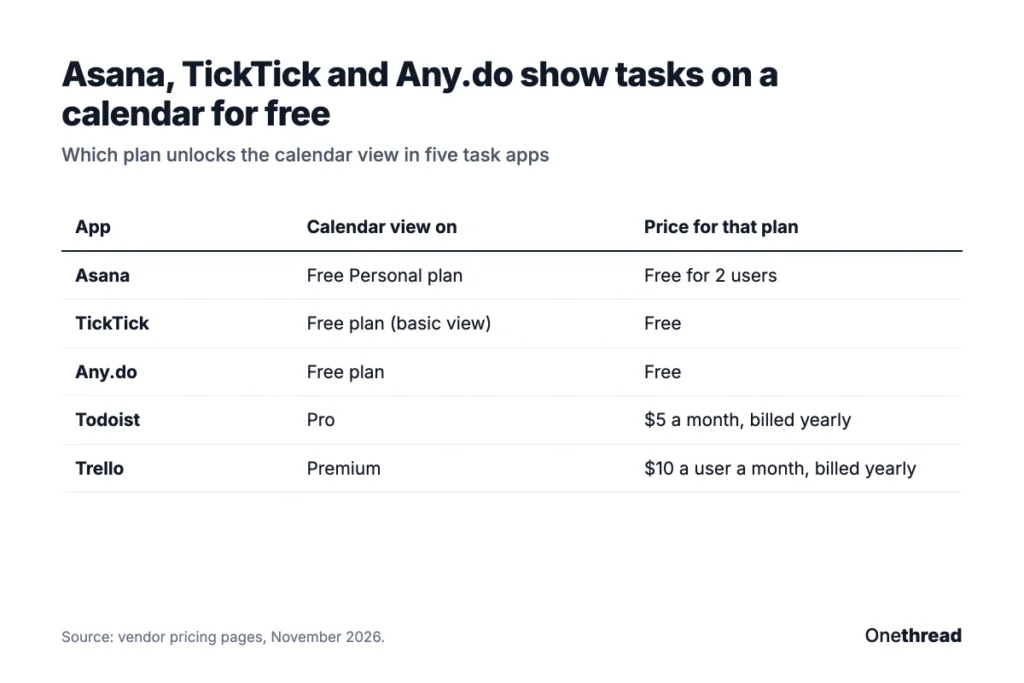
Todoist shows tasks on a calendar layout, but only on Pro, which costs $5 a month billed yearly. TickTick includes a basic calendar view on its free plan, and Premium costs $49.99 a year.
Any.do pairs a calendar with a daily planner on its free plan, and Premium costs $4.99 a month billed yearly. Trello puts its calendar view on Premium at $10 a user a month billed yearly. Asana includes a calendar view on every plan, even the free Personal plan for two users.
Calendars for Android and Many Accounts
Business Calendar 2 is a free Android calendar with ads, seven widget types and sync with Google, Outlook, Exchange and CalDAV. A separate Pro app adds templates, weather and PDF printing.
CalenGoo is a paid calendar that runs on iOS, Android, Windows, Mac and Linux. It syncs Google, iCloud, CalDAV and Exchange, and keeps working offline. The iOS app costs $6.99 once.
Both suit people who want dense views, many accounts and widgets on one screen, which the default phone calendars rarely offer.
Planners for Time Blocking and Reminders
Timepage began at Moleskine and now comes from Bonobo in the App Store. It offers a timeline, a month heat map and travel time for $19.99 a year, and it turns read-only without a membership.
TimeBloc lays out your day as time blocks on iPhone and adds routines on its own. 24me mixes a calendar, tasks and time-to-leave alerts, and its Premium plan costs $47.99 a year.
For a broader list of planning tools, see our picks of daily planner apps.
Apps We Left Off the List
Woven was a popular scheduling calendar, but its own FAQ says the service shut down in May 2021 after the team joined Slack. Old lists still recommend it, so we name it here to save you a search. Reclaim or Morgen cover the same idea of smart scheduling today.
AnyTime Organizer is a Windows desktop planner. Its newest Steam release dates from 2018, so we treat it as legacy software rather than a modern pick. If you want a printable planner on Windows, Outlook covers most of the same ground.
How Do You Choose the Best Calendar App for You?
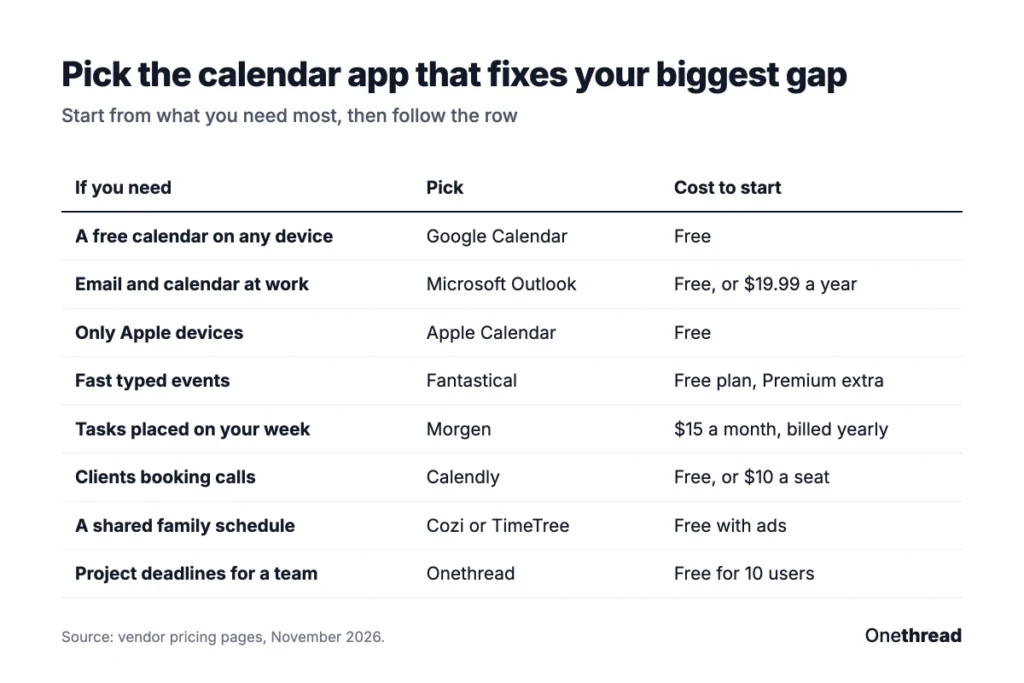
The best calendar app for you is the one that matches your devices, your sharing needs and your budget. Answer three questions, and the list shrinks to one or two apps.
First, which devices do you use? An all-Apple setup points to Apple Calendar or Fantastical. A mix of phones points to Google Calendar, Outlook or TimeTree.
Second, who shares your calendar? Families do best with Cozi or TimeTree. Clients need a booking link from Calendly. Project teams need dates tied to tasks, which a tool like Onethread handles.
Third, what problem are you paying to fix? Pay for Morgen if your tasks never fit your week. Pay for Fantastical if adding events by hand is slow.
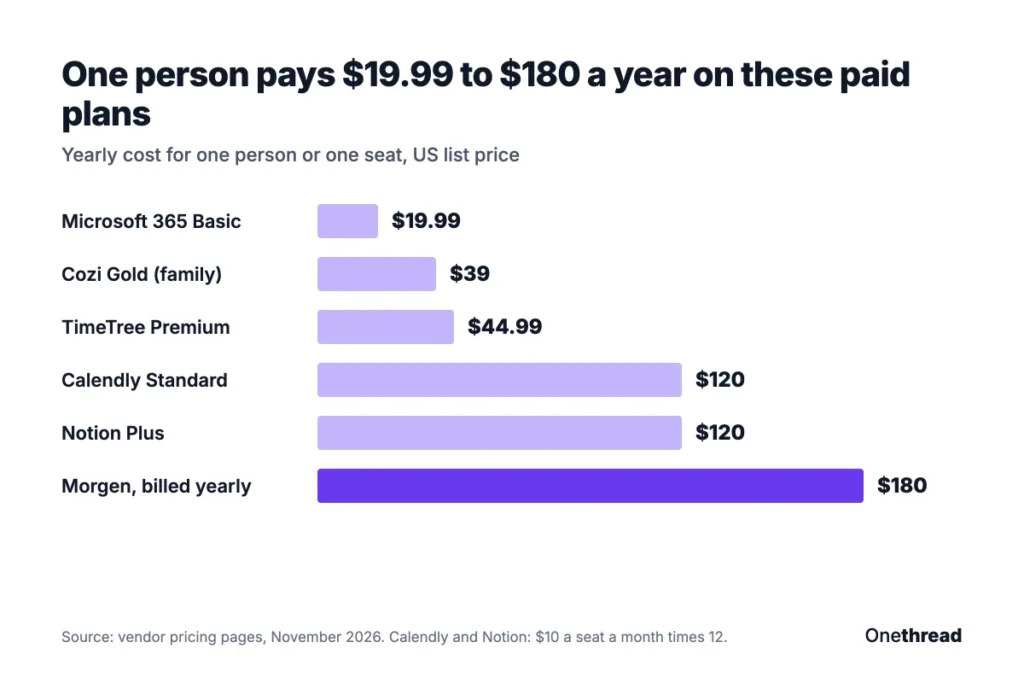
Fourth, check the price for the whole year, not the month. A $15 plan billed yearly still costs $180, and Calendly Standard or Notion Plus comes to $120 a year for one seat.
Calendar apps work best next to a good task list and notes. Our guide to the best productivity apps covers both, and our list of note taking apps helps you pick where meeting notes go. Android users can also check our productivity apps for Android.
Top Tip: try one app for two full weeks before you move every calendar into it. A week with no missed events tells you more than any feature list.
What Should You Do Next?
The best calendar apps are the ones that fit the devices and people already in your week. Most readers can stay free with Google Calendar, Outlook or Apple Calendar, and pay only when a gap costs them real time each week.
Open the calendar you use now and write down the last three things that slipped. If they were shared events, try TimeTree or Cozi for a week. If they were tasks, start Morgen’s 14-day trial and let it plan your days. The fix is rarely a new app, and often one missing habit.
FAQs
What Is the Best Free Calendar App?
Google Calendar is the best free calendar app for most people. It runs in any browser and on Android and iOS, shares calendars with view or edit rights, and includes Focus time. Apple users can stay with the free Apple Calendar, and Outlook.com suits people who already use Microsoft email.
What Are the Best Apps for Time Management?
The best apps for time management pair a calendar with a task list. Morgen and Fantastical plan tasks and events together, Todoist and TickTick add calendar views to task lists, and Google Calendar’s Focus time protects deep work. Pick one calendar and one task app rather than five tools.
Should You Pay for a Calendar App?
Most people do not need to pay for a calendar app. Free plans from Google, Microsoft and Apple cover sync, sharing and reminders. Paying makes sense when a feature saves real time. Good examples are Calendly booking links, Morgen’s AI time blocking or Cozi Gold’s alerts.
Which Calendar App Works on Both iPhone and Android?
Google Calendar works on both iPhone and Android, and so do Outlook, TimeTree and Cozi. Apple Calendar has no Android app, and Fantastical has no Android phone app. For a mixed family or team, choose one of the cross-platform best calendar apps and share calendars from there.
What Is the Difference Between a Calendar App and a Scheduling App?
A calendar app stores and shows your events, while a scheduling app lets other people book time on it. Google Calendar and Outlook are calendar apps. Calendly is a scheduling app that reads your calendar, finds open slots and adds booked meetings to it.