A Mac can run almost any project tool, but not every tool runs well on a Mac.
The best project management software for Mac is OmniPlan or Merlin Project for detailed schedules, and Asana, ClickUp or monday.com for team work. Each of these has a native Mac app. Onethread and Trello are the cheapest picks for small teams, and both have free plans.
So the right pick depends on how you plan and who you share plans with.
We compared 11 tools against 8 top-ranking guides and checked each vendor’s Mac app and pricing pages.
You’ll get the Mac app status, the price and the best fit for each.
Key Points
- Native Mac planners: OmniPlan, from $199.99 one-time for Standard, and Merlin Project, at $229.99 a year, are built for macOS and suit Gantt-heavy plans with critical paths.
- Team tools with Mac apps: Asana, ClickUp, monday.com, Wrike, Trello, Basecamp and Notion all offer a Mac desktop app next to the web app.
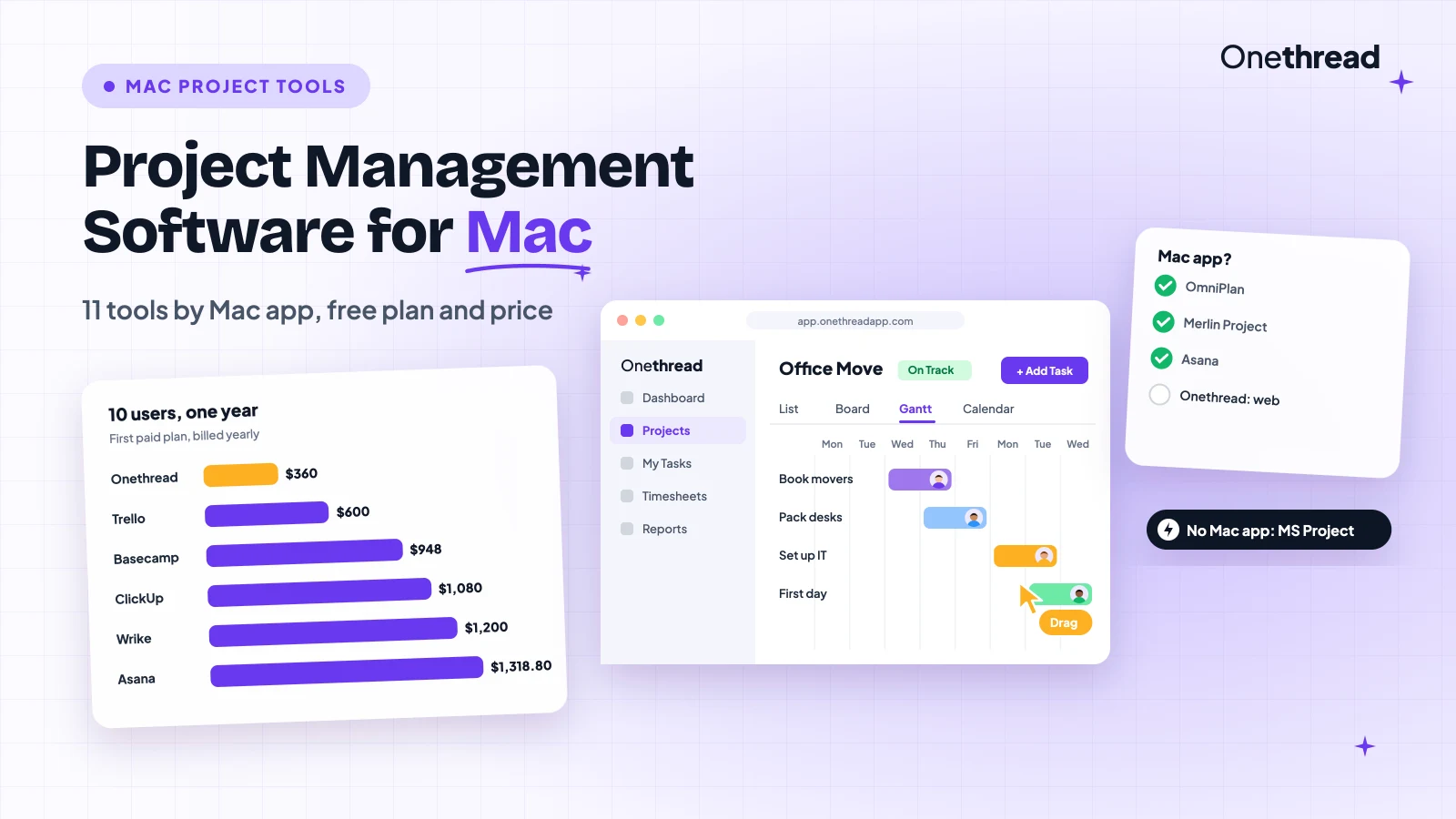
- Cheapest for a team of 10: Onethread Growth costs $360 a year and Trello Standard $600, against $1,318.80 for Asana Starter, all billed yearly.
- Microsoft Project has no Mac app: Mac users run it in a Windows virtual machine, use the web-based Planner, or open the files in Merlin Project.
Which Project Management Software for Mac Is Best?
OmniPlan and Merlin Project are best for detailed Mac-native schedules. Asana and ClickUp are best for team work, and Onethread is best for a low-cost team plan. The table lists each tool’s Mac app status, free option and first paid price.
| Tool | Native Mac app | Free option | Paid plan from | Best for |
|---|---|---|---|---|
| OmniPlan | Yes, Mac only | 14-day trial | $199.99 one-time | Critical path schedules |
| Merlin Project | Yes, Mac only | 30-day trial | $229.99 a year | Replacing MS Project |
| Asana | Yes | Free for 2 users | $10.99 per user a month | Cross-team work |
| ClickUp | Yes | Free Forever plan | $9 per user a month | All-in-one teams |
| monday.com | Yes | Free for 2 seats | $9 per seat a month, 3-seat minimum | Visual boards |
| Wrike | Yes | Free plan | $10 per user a month | Growing teams |
| Trello | Yes | Free for 10 collaborators | $5 per user a month | Simple Kanban |
| Basecamp | Yes | 1 project, 3 users | $29 a month flat | Client projects |
| Notion | Yes | Free plan | $10 per member a month | Docs plus tasks |
| Smartsheet | Being retired | 30-day trial | $9 per member a month | Spreadsheet planning |
| Onethread | Web app in any Mac browser | Free for 10 users | $3 per user a month | Small teams on a budget |
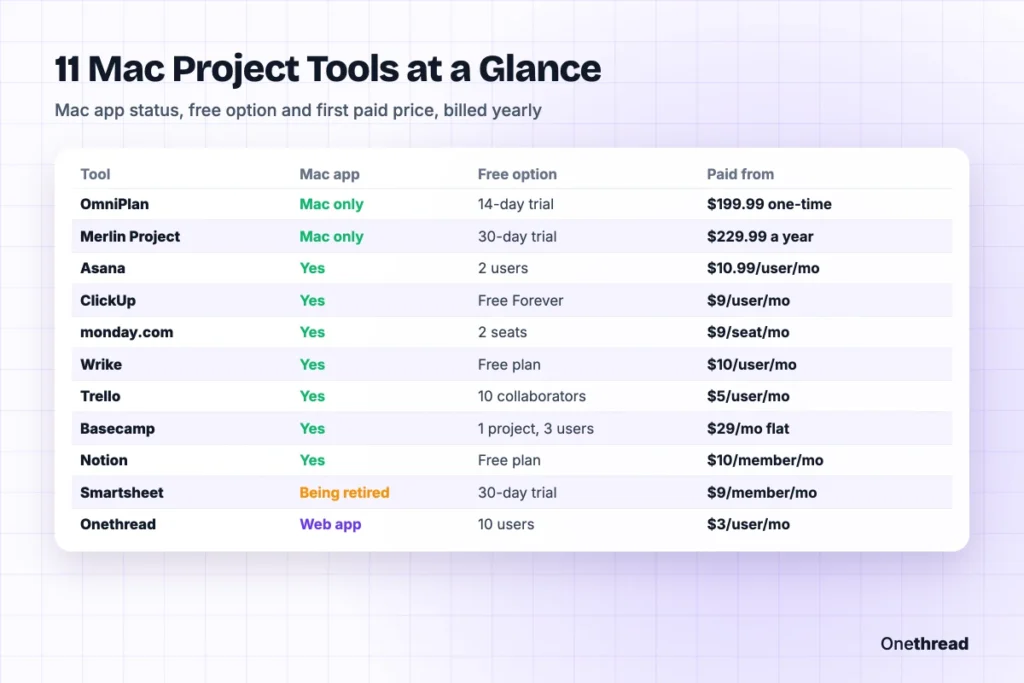
Prices are for yearly billing unless the table says otherwise. Check each vendor’s site before you buy.
How Did We Pick These Mac Project Tools?
We started with the tools that appear most in the top-ranking guides for this keyword. Asana, ClickUp, monday.com and Wrike appear in almost all of them, and Merlin Project and OmniPlan in about half.
Then we checked each vendor’s download page for a Mac app and read its full pricing page. We followed the steps in our review methodology.
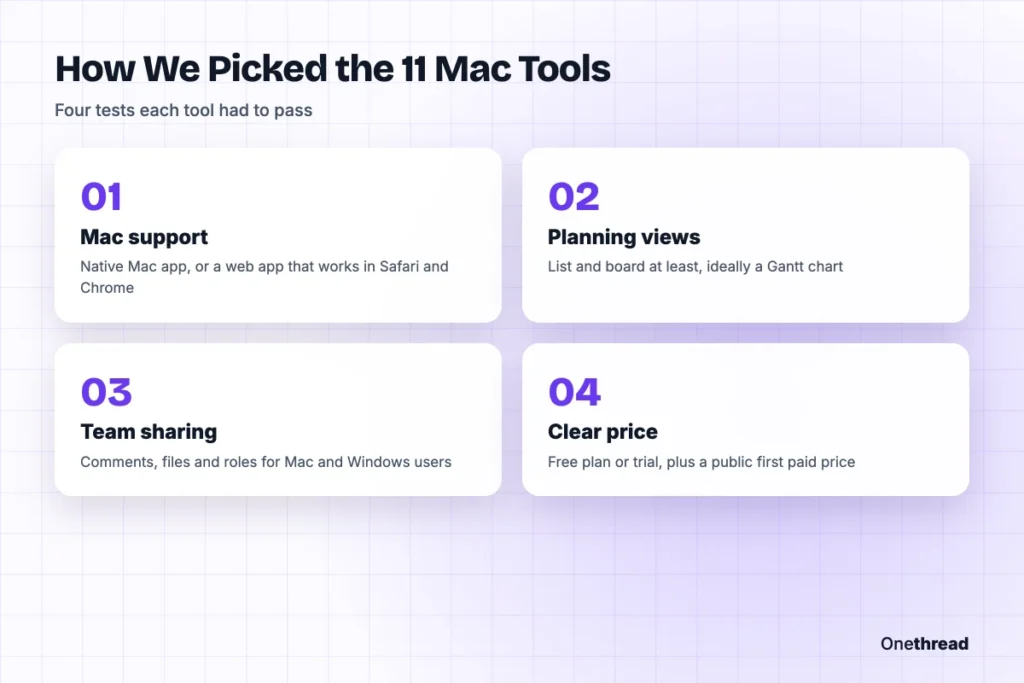
Four tests decided the list:
- Mac support: a native Mac app, or a web app that works well in Safari and Chrome.
- Planning views: at least a list and a board, and ideally a Gantt chart or timeline.
- Team sharing: comments, file sharing and roles, so Mac and Windows users can work on the same plan.
- Clear price: a free plan or trial, plus a public price for the first paid plan.
We dropped Microsoft Project from the main list because it has no native Mac app. It gets its own section, since many Mac users search for it first.
We also checked how each Mac app is offered to buyers. Some come from the Mac App Store, and others are a direct download from the vendor. Smartsheet’s Mac app is being retired, so we note that clearly in its review.
Which Mac-Native Apps Are Best for Detailed Project Schedules?
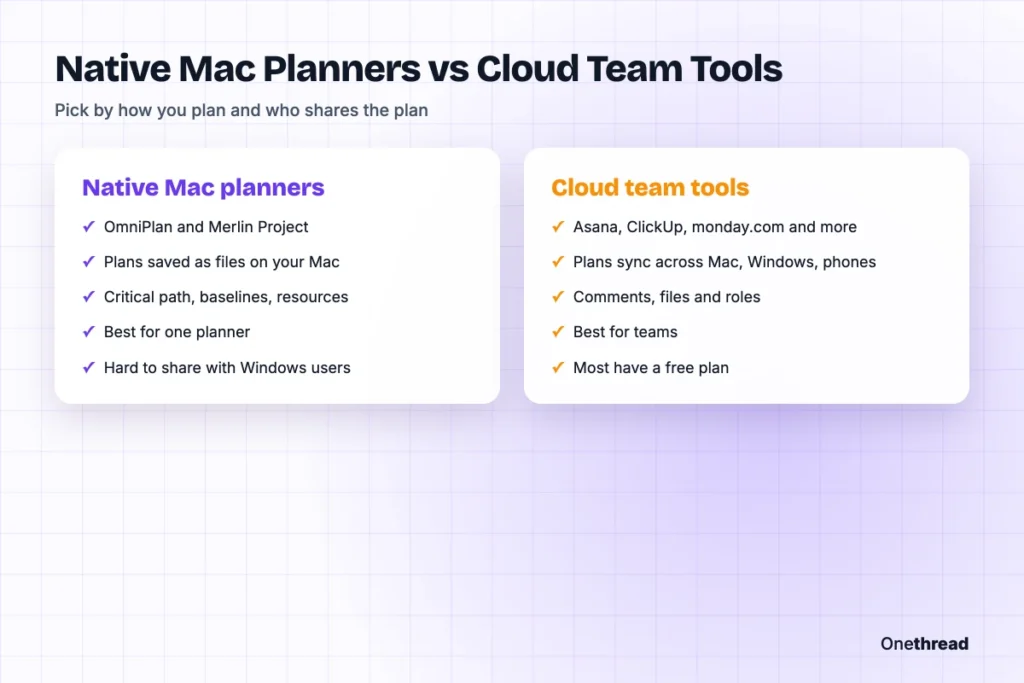
These two apps run only on Apple devices and work like a desktop version of Microsoft Project. They suit planners who build long schedules with dependencies, resources and baselines. Both store plans as files on your Mac, so you can keep working on a flight.
OmniPlan
OmniPlan from The Omni Group is a Mac and iPad planner built around Gantt charts. It handles critical paths, multiple baselines, Monte Carlo simulation and earned value analysis.
Say you run a six-month office move with 200 tasks. OmniPlan shows which tasks push the end date and how the plan changed since the last baseline.
Pricing: Standard costs $199.99 one-time and Pro $399.99 one-time, or Pro at $199.99 a year. There is a 14-day free trial.
Best For
- Project managers who build detailed schedules on a Mac or iPad.
Pros
- One-time licence option, with no monthly fee.
- Critical path, baselines and Monte Carlo simulation.
- Runs on Mac, iPad, iPhone and Vision Pro.
Cons
- No Windows version for mixed teams.
- Pro features cost twice as much.
- Built for one planner more than a live team.
Merlin Project
Merlin Project from ProjectWizards is a Mac planner with Gantt charts, Kanban boards and mind maps. It handles resources, costs and budgets, and it opens Microsoft Project files.
Say a client sends you a schedule as an MPP file. Merlin Project opens it on your Mac, and its blog says it works offline too.
Pricing: $22.99 a month or $229.99 a year. The lighter Express edition costs $6.99 a month or $69.99 a year. There is a 30-day free trial.
Best For
- Mac teams that need to open and edit Microsoft Project files.
Pros
- Opens and imports MPP and XML files.
- Gantt, Kanban and mind maps in one app.
- Resource levelling, costs and budgets.
Cons
- Subscription only.
- Mac and Apple devices only.
- More setup than a simple task tool.
Which Team Project Tools Have the Best Mac Apps?
These tools run in the cloud and add a Mac desktop app on top. Your plan syncs across Mac, Windows and phones, so mixed teams can share one workspace. Most have a free plan, which makes them easy to test before you pay.
Asana
Asana organises work into projects with list, board, timeline and calendar views. Its Mac app is a direct download from Asana’s site.
Say your marketing and product teams share a launch plan. Asana links their tasks, so each team sees what blocks them.
Pricing: The Personal plan is free for one or two people. Starter costs $10.99 per user a month billed yearly, or $13.49 monthly.
Best For
- Teams that run work across several departments.
Pros
- Clear timeline and portfolio views.
- Native Mac app.
- Many integrations.
Cons
- Free plan now covers only 2 users.
- Highest entry price in our cost table.
- Advanced features start at $24.99 per user a month.
ClickUp
ClickUp packs tasks, docs, goals and whiteboards into one app. Its Mac app is a direct download, not a Mac App Store app.
Say you want one tool to replace a task app, a wiki and a whiteboard. ClickUp covers all three in the same workspace.
Pricing: Free Forever includes 60 MB of storage and 5 Spaces. Core costs $9 per user a month billed yearly.
Best For
- Teams that want many tools in one place.
Pros
- Free plan with no member cap.
- Docs, goals and whiteboards built in.
- Native Mac app.
Cons
- Many settings to learn.
- Free storage is only 60 MB.
- Monthly prices are higher than yearly ones.
monday.com
monday.com builds boards from colourful columns and turns them into timelines and dashboards. Its Mac app sits in the Mac App Store, and monday says it works online or offline.
Say your agency tracks client requests on a whiteboard today. monday.com turns that board into a shared view with owners and dates.
Pricing: Free for 2 seats. Basic costs $9 per seat a month billed yearly, with a 3-seat minimum. There is a 14-day Pro trial.
Best For
- Teams that like visual boards and dashboards.
Pros
- Mac App Store app.
- Easy, visual setup.
- Many templates.
Cons
- Paid plans start at 3 seats.
- Free plan covers only 2 seats.
- No monthly discount, since yearly billing saves 18%.
Wrike
Wrike suits growing teams that need request forms, approvals and reports. You download its Mac app from inside your Wrike account.
Say your design team gets requests by email and chat. Wrike’s request forms put every request into one queue.
Pricing: Free plan available. Team costs $10 per user a month billed yearly, for 2 to 15 users. There is a 14-day trial.
Best For
- Growing teams that need forms, approvals and reports.
Pros
- Request forms and approvals.
- Free plan to start.
- Native Mac app.
Cons
- Seats sold in groups of 5 on Team.
- Business plan is yearly only.
- Mac app download is hidden inside the account.
Trello
Trello is a simple Kanban board app. Its Mac app is in the Mac App Store.
Say your team of eight just needs To Do, Doing and Done. Trello’s free plan covers that with room to spare.
Pricing: Free for up to 10 collaborators. Standard costs $5 per user a month billed yearly, or $6 monthly.
Best For
- Small teams that want simple Kanban boards.
Pros
- Free plan for up to 10 collaborators.
- Low paid price.
- Mac App Store app.
Cons
- Free plan limits each Workspace to 10 boards.
- Light on reports.
- Premium costs $10 per user a month.
Basecamp
Basecamp keeps each project in one place: to-dos, a message board, schedules, docs and chat. It offers separate Mac downloads for Apple silicon and Intel.
Say your agency invites clients into each project. Basecamp’s flat price means you don’t pay per guest.
Pricing: Free for 1 project and 3 users. Paid plans are flat: Freelancer costs $29 a month for up to 5 users, and Pro $79 a month for up to 10 users. There is a 30-day trial with no card.
Best For
- Agencies and client teams that want a flat price.
Pros
- Flat monthly price.
- Native Mac apps for Apple silicon and Intel.
- Clients fit inside each project.
Cons
- Pro Unlimited costs $199 a month billed yearly.
- Flat tiers jump at 5, 10 and 15 users.
- Fewer views than other tools.
Notion
Notion mixes docs, wikis and databases, and many teams use its databases as task boards. Its Mac app comes as a Universal, Apple silicon or Intel download.
Say your team writes specs and tracks the tasks behind them. Notion keeps both on the same page.
Pricing: Free plan available. Plus costs $10 per member a month, and Business $20.
Best For
- Teams that want docs and tasks in one place.
Pros
- Docs, wikis and tasks together.
- Offline access to pages you download.
- Native Mac app.
Cons
- Task features are lighter than in a full project tool.
- Setup takes time.
- Yearly prices are not shown clearly on the pricing page.
Smartsheet
Smartsheet looks like a spreadsheet but adds Gantt charts, forms and automations. Its Mac app is being retired on or after January 6, 2027, and Smartsheet now points users to the web app.
Say your finance team plans in Excel today. Smartsheet keeps the grid and adds owners, dates and alerts.
Pricing: No free plan. Pro costs $9 per member a month billed yearly, for 1 to 10 members. There is a 30-day trial.
Best For
- Teams that think in spreadsheets.
Pros
- Familiar grid layout.
- Gantt charts and forms.
- Works in Safari and Chrome on a Mac.
Cons
- Mac desktop app is being retired.
- No free plan.
- Pro stops at 10 members.
What If You Want a Low-Cost Web Tool on Your Mac?
Onethread is a web-based project management tool, so it runs in Safari, Chrome or any Mac browser with nothing to install. We include it because many Mac teams want a simple shared tool more than a desktop app.
Its Basic plan is free for the first ten users in your company. It includes unlimited projects and tasks and 15 GB of file sharing. The Onethread features page lists the rest.
Say a 10-person team on Macs and Windows laptops wants boards and timelines in one place. Onethread covers that on the free plan, and nobody needs to install an app.
A web tool also skips the update cycle. There is no app to patch on each Mac, and every teammate sees the same version of the tool on the same day.
Pricing: Basic is free for the first ten users. Growth costs $3 and Scale $5 per user a month on yearly billing.
Best For
- Small teams that want a free or low-cost shared tool on any Mac.
Pros
- Free for the first ten users.
- Nothing to install or update.
- Paid plans from $3 per user a month.
Cons
- No native Mac desktop app.
- The free plan allows up to three workflows.
- Needs an internet connection.
How Can You Use Microsoft Project on a Mac?
You can’t install Microsoft Project on a Mac directly. It has no native Mac version, and a Microsoft moderator confirmed this on Microsoft Q&A. Mac users have three common options.
- Run Windows in a virtual machine: Parallels can run the Windows version of Project on a Mac.
- Use the web: Microsoft Planner runs in a browser. Planner Plan 1 costs $10 per user a month, and Plan 3 with the Project desktop app costs $30, both paid yearly.
- Open the files elsewhere: Merlin Project opens MPP and XML files on a Mac.
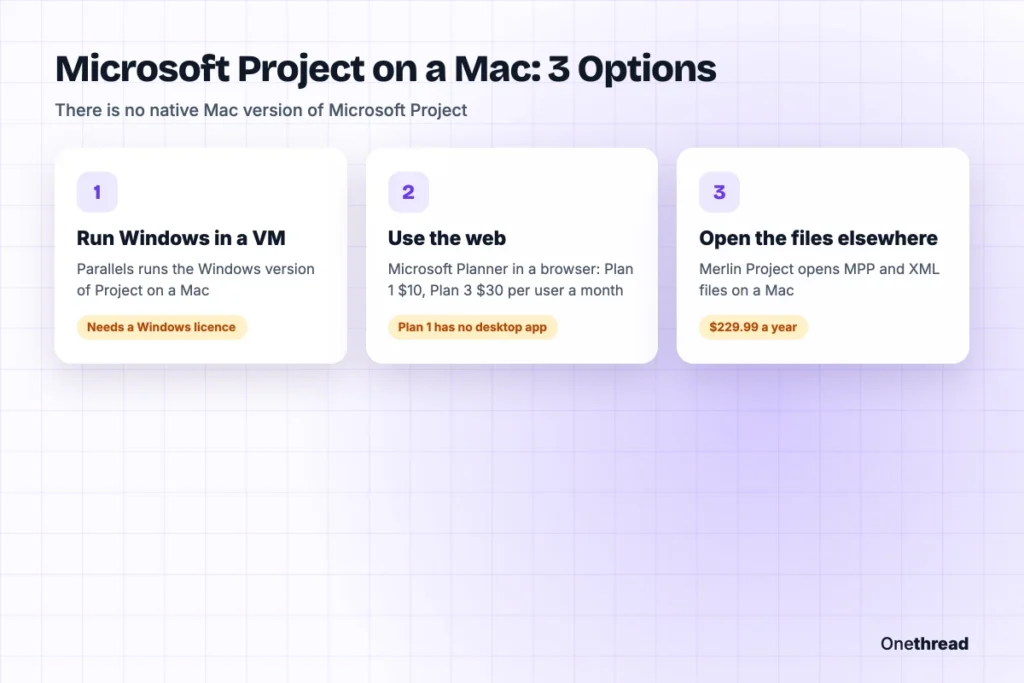
Each option has a trade-off. A virtual machine needs a Windows licence and a fast Mac, and you still work in a Windows app. The web route is the easiest, but Planner Plan 1 does not include the full Project desktop app.
For most Mac teams, a native planner or a cloud tool is simpler. Merlin Project suits people who must swap files with Microsoft Project users. OmniPlan suits people who only need strong schedules on a Mac.
Read our full guide to Microsoft Project on Mac for setup steps. If a free Mac tool is your goal, our list of project management software for solopreneurs covers solo picks.
How Much Does Project Management Software for Mac Cost?
Project management software for Mac costs from $0 on free plans to about $11 per user a month on entry paid plans. Desktop planners differ: OmniPlan sells a one-time licence, and Merlin Project sells a yearly one.
The table shows the first paid plan for a team of 10, billed yearly.
| Tool and plan | Price used | 10 users, one year |
|---|---|---|
| Onethread Growth | $3 per user a month | $360 |
| Trello Standard | $5 per user a month | $600 |
| Basecamp Pro | $79 a month flat, up to 10 users | $948 |
| ClickUp Core | $9 per user a month | $1,080 |
| monday.com Basic | $9 per seat a month | $1,080 |
| Smartsheet Pro | $9 per member a month | $1,080 |
| Wrike Team | $10 per user a month | $1,200 |
| Asana Starter | $10.99 per user a month | $1,318.80 |
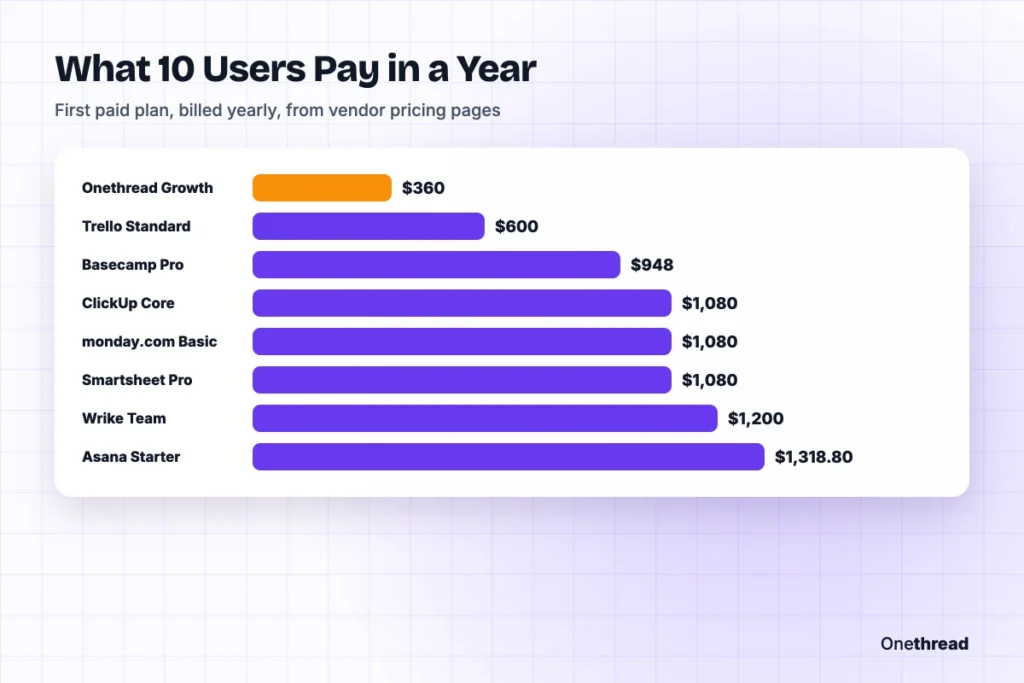
Example: Asana Starter for 10 users costs $10.99 × 10 × 12 = $1,318.80 a year. Onethread Growth for the same team costs $3 × 10 × 12 = $360.
Top Tip: Check seat rules before you compare prices. monday.com sells at least 3 seats, and Wrike sells Team seats in groups of 5.
What Features Should Project Management Software for Mac Have?
Good project management software for Mac should feel at home on macOS and still work for teammates on other systems. These features matter most.
- Visual planning tools: boards, timelines and Gantt charts show the whole plan at a single glance.
- Collaboration tools: comments, mentions and file sharing keep talk next to the task.
- Integration options: links to Apple Calendar, Google Workspace, Slack or Microsoft 365 cut copy and paste.
- Offline access: desktop planners such as OmniPlan and Merlin Project keep plans on your Mac.
- Custom workflows: statuses, fields and automations that match how your team works.
Before you buy, test the tool on the Macs your team uses every day. Check that it runs well on both older Intel Macs and newer Apple silicon Macs. Try it in Safari as well as Chrome, since some web apps work best in one browser over another.
Also check the mobile apps before you decide. Many Mac users plan on a laptop and update tasks from an iPhone or iPad, so a good iOS app matters a lot too.
Keep macOS up to date so desktop apps run as expected. If you have trouble with your Macbook not updating, fix that first before you install a new tool.
How Do You Choose Project Management Software for Mac?
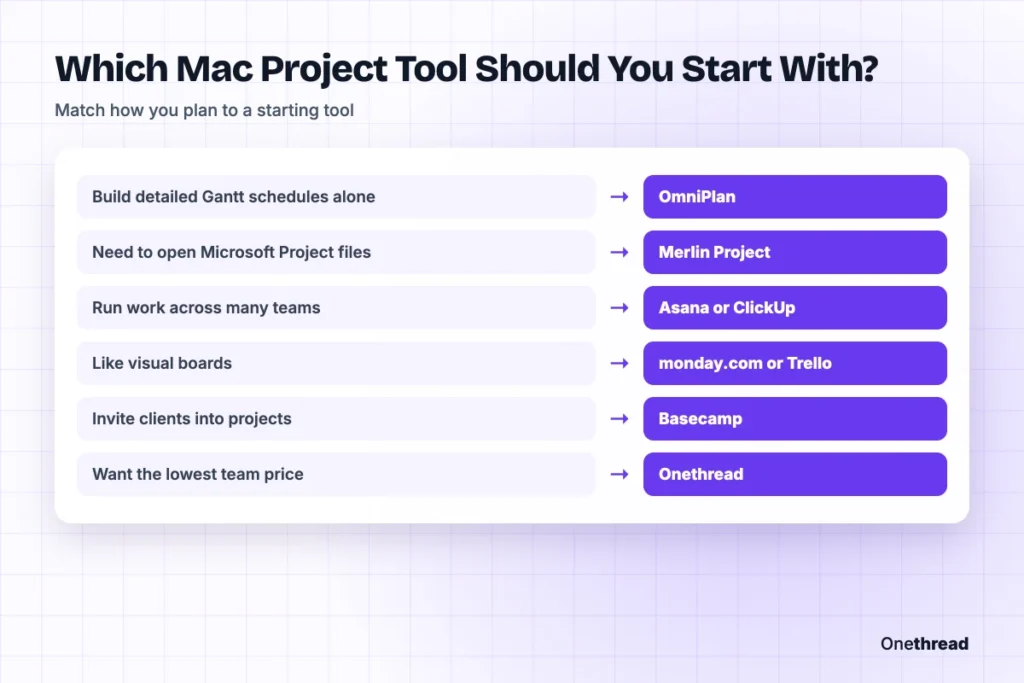
Pick by how you plan first, then by who shares the plan with you.
- Solo schedules or team work: a solo planner suits OmniPlan or Merlin Project, and a team suits a cloud tool.
- Mixed devices: if teammates use Windows, pick a cloud tool with apps for both.
- Microsoft Project files: if clients send MPP files, test Merlin Project first.
- Budget: count seats, minimums and yearly versus monthly prices.
| If you… | Start with |
|---|---|
| Build detailed Gantt schedules alone | OmniPlan |
| Need to open Microsoft Project files | Merlin Project |
| Run work across many teams | Asana or ClickUp |
| Like visual boards | monday.com or Trello |
| Invite clients into projects | Basecamp |
| Want the lowest team price | Onethread |
Our guide to project management software for small teams compares hosted tools by seat price. For more Mac picks, see our roundup of the best Mac project management apps. For head-to-head views, read Jira vs monday.com and Asana vs Smartsheet.
Sources: OmniPlan, Merlin Project, Asana, ClickUp, monday.com, Wrike. More: Trello, Basecamp, Notion, Smartsheet, Microsoft Planner.
What Should You Do Next With Project Management Software for Mac?
Project management software for Mac comes in two kinds. Native planners suit detailed schedules, and cloud tools suit teams that share one plan. OmniPlan and Merlin Project lead for Gantt-heavy plans. Asana, ClickUp and monday.com lead for teams, and Onethread costs the least for a team of ten.
This week, pick one native planner and one team tool from the decision table. Run the same small project in both for five working days with real tasks. Keep the one your team opens most often, without any reminders from you or the boss.
FAQs
What Is the Best Project Management Software for Mac?
The best project management software for Mac depends on your work. OmniPlan and Merlin Project are best for detailed schedules built on a Mac. Asana, ClickUp and monday.com are best for teams, and all three have native Mac apps. Onethread and Trello are the cheapest picks for small teams.
Is There Free Project Management Software for Mac?
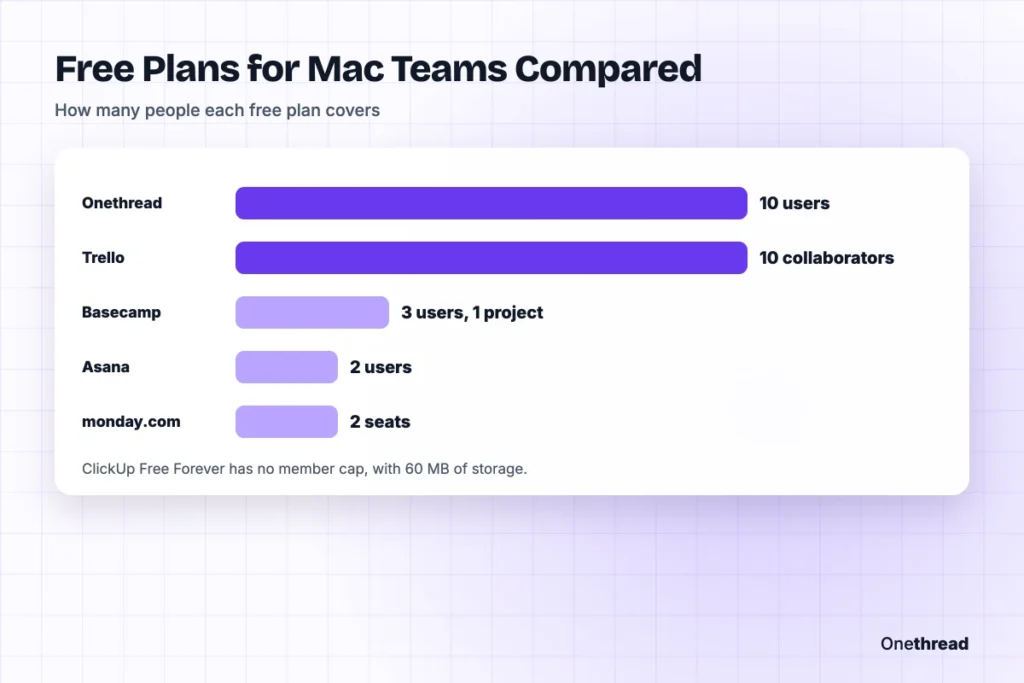
Yes, and project management software for Mac often starts free. Onethread is free for ten users, Trello for 10 collaborators, and ClickUp has a Free Forever plan. Asana and monday.com also have free plans, but they cover only 2 users or seats. OmniPlan and Merlin Project offer free trials, not free plans.
What Is the Mac Equivalent of Microsoft Project?
Merlin Project and OmniPlan are the closest Mac equivalents to Microsoft Project. Both handle Gantt charts, dependencies, resources and baselines. Merlin Project also opens and imports MPP and XML files, which helps when clients or partners still send plans built in Microsoft Project.
Do I Need a Native Mac App or a Web App?
A web app is enough for most teams, because it runs in any Mac browser and syncs with Windows users. A native Mac app helps if you work offline, want keyboard shortcuts and Mac menus, or build long schedules alone. Several tools, such as Asana and ClickUp, offer both.
Can Mac and Windows Users Share One Project Tool?
Yes, if you pick a cloud tool. Asana, ClickUp, monday.com, Wrike, Trello, Basecamp, Notion and Onethread all sync the same workspace across Mac, Windows and phones. Mac-only planners such as OmniPlan and Merlin Project are harder to share with teammates who use Windows.