Understanding the Follow-the-Sun Model in IT
In today’s interconnected global economy, businesses increasingly rely on the follow-the-sun (FTS) model to maintain continuous project momentum and customer support around the clock. The FTS approach involves handing off work and support activities to teams located in different time zones, enabling 24-hour productivity without overburdening any single region’s workforce. This model is especially prevalent in IT projects where seamless collaboration and rapid issue resolution are critical.
The follow-the-sun model leverages geographically distributed teams to achieve continuous progress. For example, a development team in Asia works during their daytime hours and hands off completed work to a team in Europe as their day begins, which then passes tasks to a team in America. This cyclical handoff accelerates project timelines, reduces time-to-market, and maintains constant customer support. Consequently, organizations can respond faster to market demands and provide uninterrupted service, increasingly expected by global clients.
However, success depends on more than geographic coverage. Robust IT infrastructure, strategic planning, and continuous access to critical tools and support personnel regardless of the hour are essential. Without these, the model can lead to delays, miscommunication, and frustration. Coordinating seamless handoffs and real-time collaboration presents unique challenges, addressed through technology and process optimization.
The Challenge of Planning Tool Access Across Time Zones
One significant hurdle in follow-the-sun IT operations is ensuring uninterrupted access to planning tools. Project management platforms, version control systems, and communication apps must be available to disparate teams without downtime or latency. Interruptions can stall progress and disrupt handoffs, compromising delivery timelines.
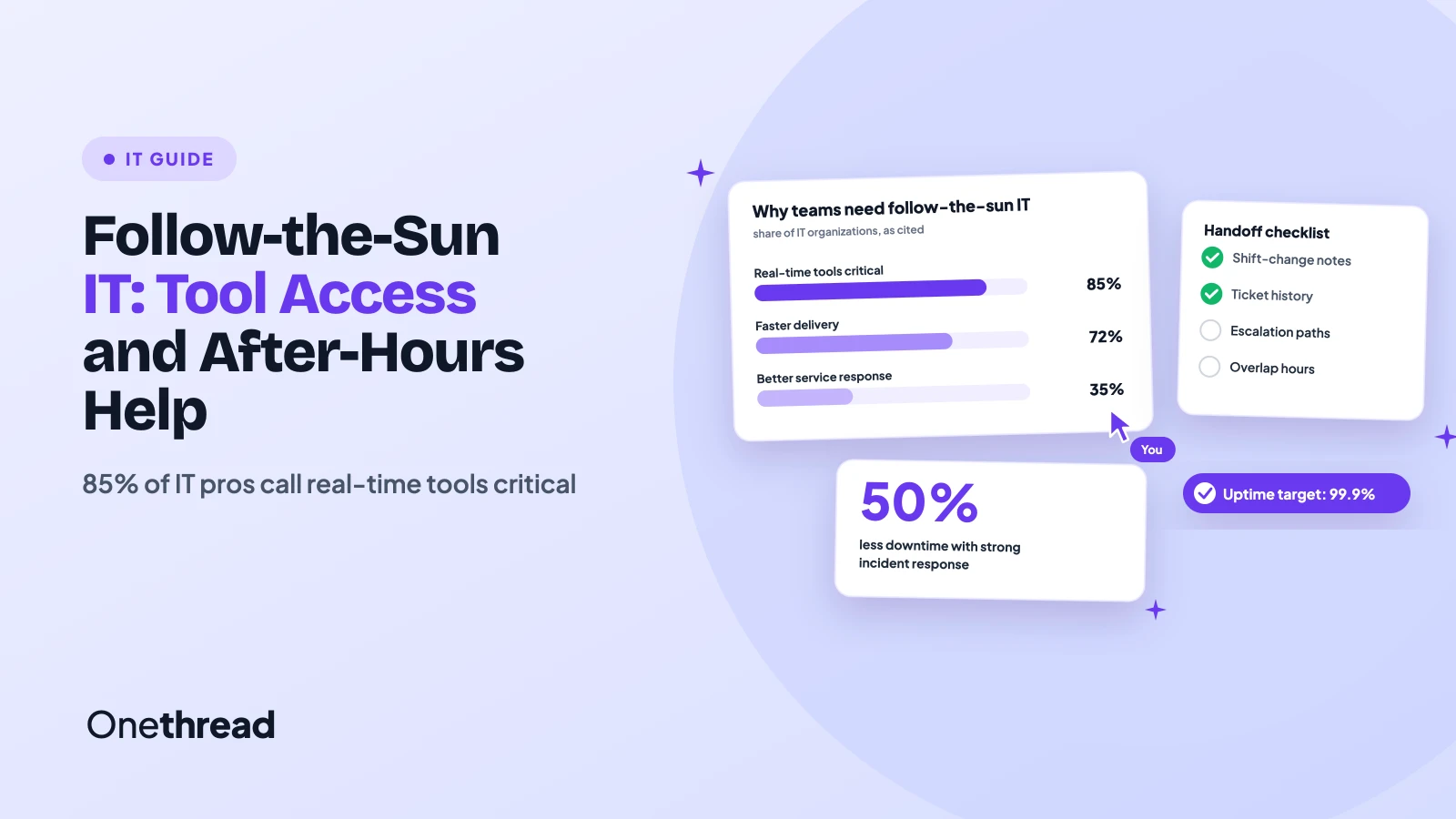
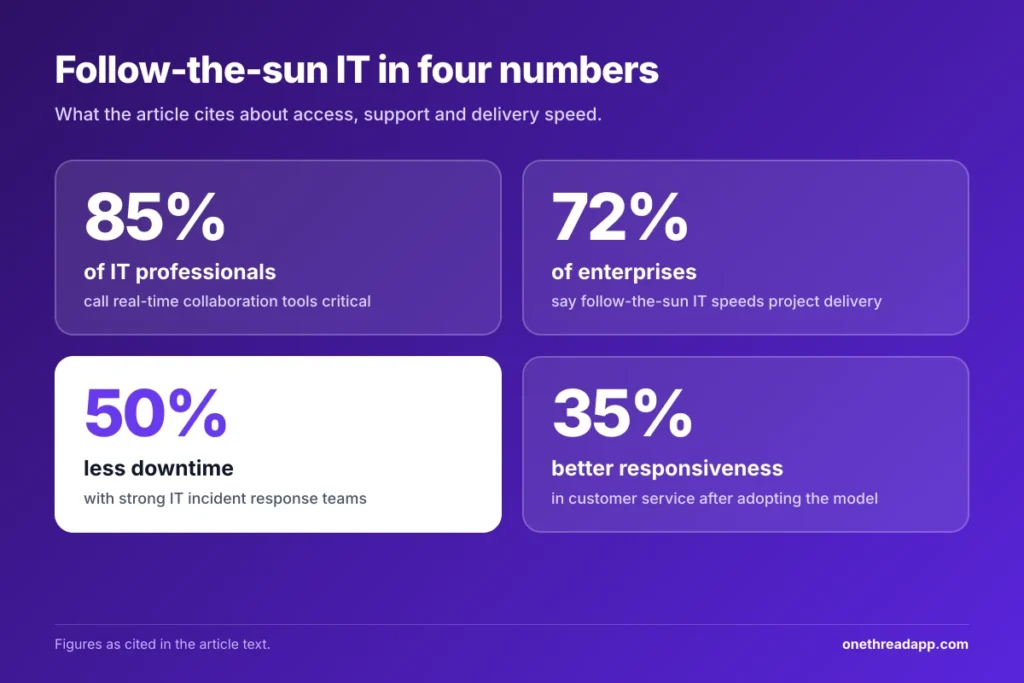
According to recent research, 85% of IT professionals cite access to real-time collaboration tools as critical for successful remote work and distributed teams. This underscores the importance of reliable tool access in follow-the-sun environments.
Moreover, integrating multiple tools across regions can create security risks and compatibility issues. Firms must standardize access protocols and maintain consistent data synchronization to enable seamless transitions. This includes managing permissions, backups, and software updates globally. For example, software version discrepancies can cause conflicts, leading to rework and delays. Ensuring all teams operate on the same software versions and have synchronized data repositories is essential to workflow continuity.
Businesses that seek top technology services in Detroit often prioritize IT providers with expertise in managing such distributed environments. These providers offer tailored solutions addressing follow-the-sun workflow demands, including cloud-based platforms optimized for global collaboration and proactive monitoring to resolve access issues before impacting users. Cloud infrastructure, in particular, is a cornerstone for enabling follow-the-sun access due to its scalability and availability.
Additionally, network latency and bandwidth limitations can affect planning tool performance, especially when teams access data centers thousands of miles apart. To mitigate this, organizations invest in content delivery networks (CDNs) and edge computing solutions to bring data closer to end-users, reducing delays and improving responsiveness.
After-Hours Help: The Backbone of Follow-the-Sun IT Support
24/7 availability is the essence of follow-the-sun IT support. When teams in one region complete their workday, support teams across the globe must seamlessly take over issues or requests without delay. This requires sophisticated ticketing and escalation systems alongside a culture of accountability and clear communication protocols to avoid redundant work or overlooked tasks.
After-hours help extends beyond mere availability; it demands expertise. Support personnel must be well-versed in the specific tools and processes used by their counterparts to provide effective assistance. This is why many organizations partner with specialized service providers, such as Contego Solutions in the industry, who have deep industry knowledge and deliver responsive support tailored to outsourced IT operations.
Statistics highlight the importance of efficient after-hours support: companies with strong IT incident response teams reduce downtime by up to 50%, significantly improving customer satisfaction and operational resilience. Additionally, 72% of enterprises report that follow-the-sun IT models accelerate project delivery by minimizing work stoppages.
Effective after-hours support also depends on clear escalation paths and real-time communication channels. Integrated chat platforms and video conferencing enable support teams to collaborate instantly, even when continents apart. Comprehensive knowledge bases empower support engineers to troubleshoot independently, improving resolution times.
Organizations must also maintain consistent service quality across diverse teams. This requires standardized training programs, shared performance metrics, and regular cross-team reviews to ensure after-hours support aligns with organizational expectations and customer needs.
Key Strategies for Effective Follow-the-Sun IT Management
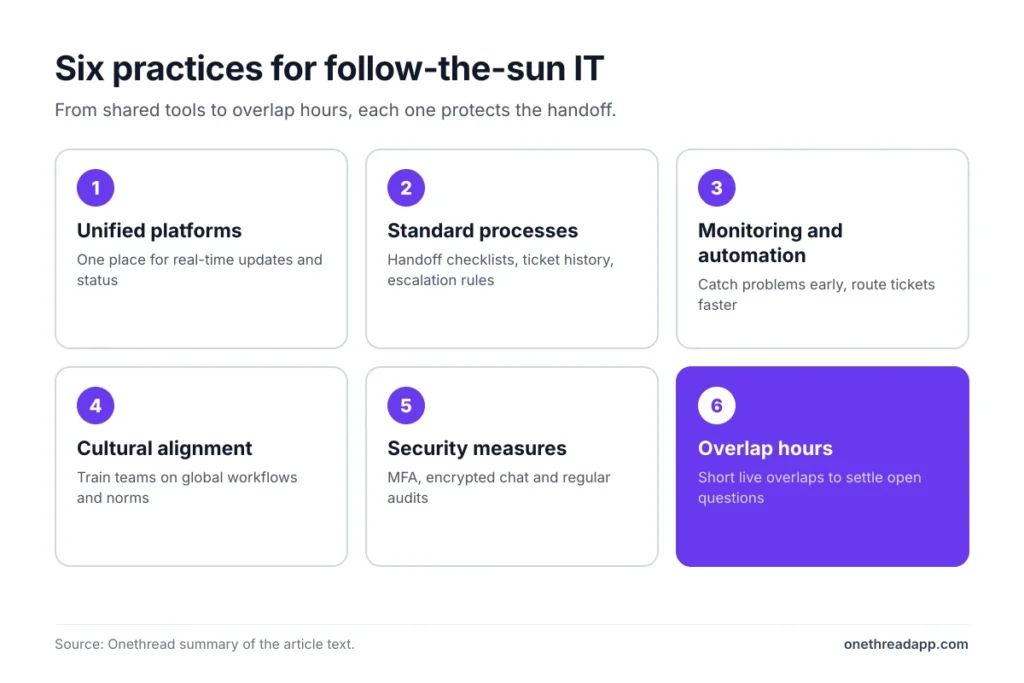
To maximize follow-the-sun IT benefits, organizations should implement several best practices:
- Unified Collaboration Platforms: Deploy integrated tools supporting real-time updates and transparent communication. This reduces miscommunication risks and ensures every team accesses the latest project status. Platforms combining project management, code repositories, and chat streamline workflows and reduce context switching.
- Standardized Processes and Documentation: Establish clear protocols for task handoffs, incident management, and escalation. Comprehensive documentation ensures continuity and empowers teams to resolve issues regardless of location. This includes shift-change checklists, detailed ticket histories, and predefined escalation criteria.
- Proactive Monitoring and Automation: Utilize AI-driven monitoring tools to detect and address potential problems early. Automated workflows streamline ticket routing and reduce manual errors, allowing support teams to focus on high-priority tasks. Studies show automation can reduce manual workload by up to 40%, enabling teams to concentrate on complex problem-solving.
- Cultural Alignment and Training: Foster a culture valuing cross-cultural collaboration and continuous learning. Training programs that familiarize teams with global workflows and communication norms help bridge time zone and language gaps. Encouraging empathy and understanding of different work styles enhances cooperation and reduces friction.
- Robust Security Measures: Implement stringent security policies safeguarding sensitive data accessed by distributed teams. Multi-factor authentication, encrypted communications, and regular audits are essential. Cybersecurity threats increase with distributed access points, making comprehensive security strategies vital.
- Flexible Scheduling and Overlap Hours: While seamless handoffs are the goal, scheduling overlapping working hours can facilitate live collaboration and immediate issue resolution. Even brief daily overlaps help build relationships and clarify expectations.
Measuring Success in Follow-the-Sun IT Operations
Tracking key performance indicators (KPIs) is vital to assess follow-the-sun IT effectiveness. Important metrics include:
- Mean Time to Resolution (MTTR): Lower MTTR indicates quicker problem-solving across time zones. Continuous MTTR monitoring helps identify bottlenecks and improve processes.
- System Uptime: High uptime reflects reliable access to planning tools and support services. Maintaining uptime above 99.9% is often a target for follow-the-sun models.
- Customer Satisfaction Scores: Feedback from internal and external users provides insight into after-hours support quality. Regular surveys and Net Promoter Scores (NPS) quantify satisfaction levels.
- Project Delivery Timeliness: Meeting or exceeding deadlines demonstrates continuous workflow efficiency. Tracking on-time delivery rates highlights follow-the-sun impact.
A recent survey found organizations adopting follow-the-sun IT models report a 35% improvement in customer service responsiveness and a 28% reduction in project delays. These gains translate into competitive advantages, enabling businesses to consistently meet client expectations.
Additionally, companies successfully implementing follow-the-sun models often experience increased employee satisfaction. By distributing workloads evenly and respecting local working hours, organizations reduce burnout and improve retention among IT professionals.
Conclusion
Follow-the-sun projects reshape business operations by enabling continuous progress and around-the-clock support. However, success depends heavily on consistent planning tool access and reliable after-hours help across time zones. Leveraging top technology service providers and industry experts helps companies overcome distributed IT challenges.
Investing in unified collaboration platforms, standardized processes, proactive monitoring, and cultural alignment creates a resilient framework supporting seamless handoffs and rapid issue resolution. Monitoring performance metrics ensures continuous improvement and maximizes follow-the-sun IT value.
In a globalized business environment where speed and reliability are paramount, mastering follow-the-sun IT is not just an operational advantage. It is a strategic imperative. Organizations embracing these practices will be better positioned to innovate, respond to customer needs, and maintain a competitive edge in an increasingly demanding market.
By understanding planning tool access and after-hours support nuances, businesses unlock the full potential of follow-the-sun projects, driving efficiency and fostering collaboration across continents and cultures. The future of IT project management and support lies in harnessing time zones to work smarter, not harder.