
The Importance of Effective Post-Outage Retrospectives
In the fast-paced world of IT and software development, outages are inevitable. What separates high-performing teams from the rest is not the absence of failure, but how they respond when things go wrong. Sprint-style retrospectives are designed to foster continuous improvement by encouraging honest reflection and collaborative problem-solving. However, these sessions can quickly devolve into blame games, especially after a significant outage, undermining team morale and obstructing valuable learning opportunities.
Understanding the common pitfalls that transform a constructive post-mortem into a counterproductive blame session is crucial for teams striving to improve their incident response and resilience. The goal of this article is to explore these retrospective mistakes and provide guidance for turning outage reviews into productive, forward-looking discussions.
Common Retrospective Mistakes Leading to Blame Sessions
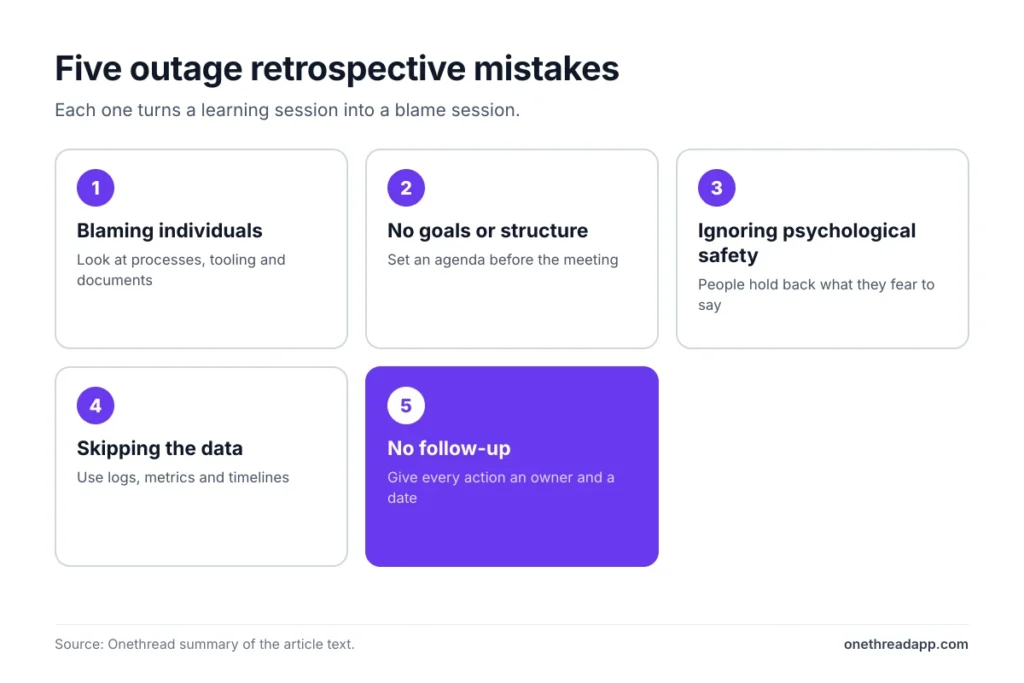
1. Focusing on Individuals Instead of Processes
One of the most frequent errors in post-outage retrospectives is zeroing in on individual mistakes rather than systemic issues. When team members feel targeted, they become defensive, which stifles open communication and honesty. Organizations often overlook how their processes, documentation, or tooling may have contributed to the incident.
Emphasizing technology planning with Protek can help shift the focus from finger-pointing to assessing how technology decisions and infrastructure can be improved for better reliability and responsiveness.
2. Lack of Clear Goals and Structure
Retrospectives that lack a defined agenda or clear objectives tend to meander, making it easier for frustration to build. Without a structured approach, discussions can spiral into anecdotal complaints or unproductive accusations. Setting a framework before the meeting – such as focusing on what went well, what didn’t, and actionable next steps – helps maintain constructive momentum.
For example, integrating a methodology like Turn Key Solutions’ internal framework provides a repeatable, organized approach to incident analysis, ensuring that every session produces tangible improvements rather than devolving into blame.
3. Ignoring Psychological Safety
Psychological safety – the belief that one can speak up without fear of punishment – is essential during retrospectives. If team members suspect repercussions for admitting errors or speaking candidly, they will withhold crucial information. This lack of transparency prevents the identification of root causes and results in superficial fixes.
Creating an environment where vulnerability is met with support rather than criticism fosters trust and leads to more meaningful learning. Leadership plays a pivotal role in modeling this behavior.
4. Overlooking Data and Metrics
Retrospectives that rely solely on subjective narratives are prone to bias and misinterpretation. Incorporating data-driven insights can ground conversations in facts, helping teams move past assumptions. For instance, analyzing system logs, performance metrics, and incident timelines provides a clearer picture of what happened and why.
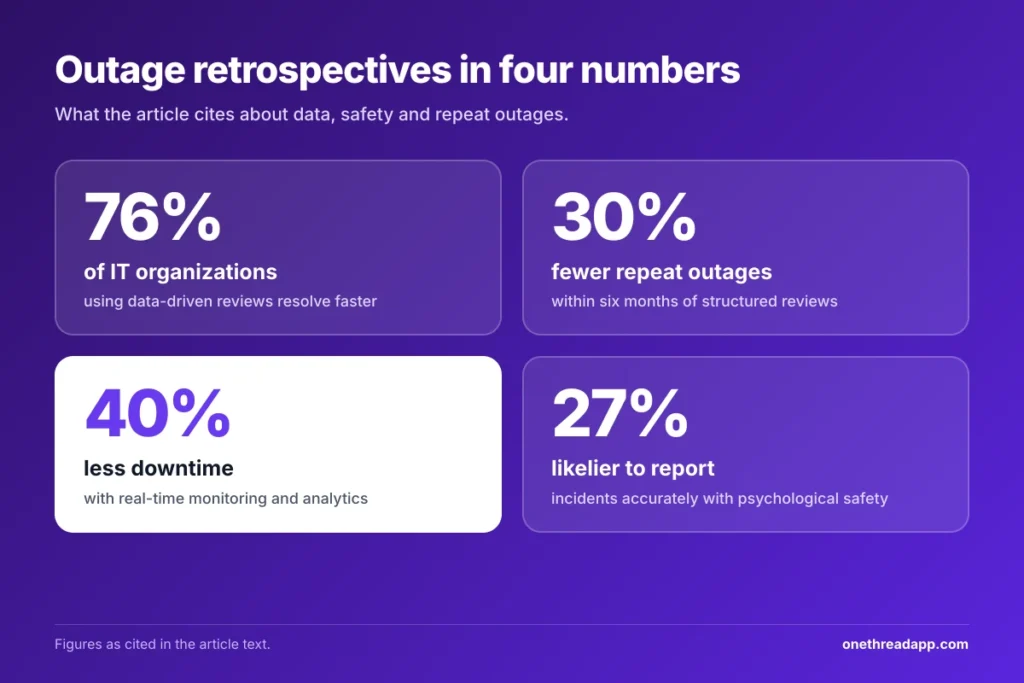
Studies show that 76% of IT organizations that use data-driven incident reviews report faster resolution times and fewer repeat outages. Metrics also help identify patterns that human memory alone might miss.
5. Failing to Document and Follow Up on Action Items
Even the best retrospectives lose value if the lessons learned are not documented and translated into concrete actions. Without accountability and follow-up, teams are likely to repeat the same mistakes. Clear ownership and deadlines for improvements ensure that insights lead to progress rather than just discussion.
How to Prevent Retrospective Sessions from Becoming Blame Games
Emphasize Systems Thinking
Encourage the team to view incidents as outcomes of interconnected systems rather than isolated human errors. This mindset shift promotes learning and improvement by focusing on how workflows, tools, and communication can be optimized. Systems thinking helps uncover latent issues in processes that may not be immediately obvious but contribute significantly to failures.
Use Structured Frameworks
Adopting proven frameworks helps maintain focus and ensures that meetings are productive. These frameworks typically guide participants through stages such as fact-finding, root cause analysis, and action planning, which minimizes emotional conflict. Structured approaches also encourage equitable participation, ensuring that quieter team members have a voice and that discussions remain goal-oriented.
Foster Psychological Safety
Leaders should openly acknowledge their own mistakes and appreciate vulnerability, reinforcing that retrospectives are about collective growth. Anonymous feedback tools or third-party facilitators can also help create a safe space for honest dialogue. Research indicates that teams with high psychological safety are 27% more likely to report incidents accurately and learn effectively from failures.
Incorporate External Expertise
Sometimes internal dynamics can impede objective analysis. Engaging external consultants can provide fresh perspectives and best practices that strengthen incident management strategies. External experts can also introduce proven methodologies and benchmarks from other organizations, helping teams avoid common pitfalls and accelerate improvement.
Leverage Data and Technology
Incorporate automated incident tracking systems and dashboards that capture key performance indicators before, during, and after outages. Transparent access to data helps teams focus on facts and reduces speculation.
According to a recent report, organizations that integrate real-time monitoring and post-incident analytics reduce downtime by up to 40%. These tools empower teams with actionable insights and improve the quality of retrospective discussions.
The Business Impact of Effective Retrospectives
When retrospectives are conducted effectively, organizations benefit from faster incident resolution, reduced downtime, and improved customer satisfaction. According to a 2023 survey, companies implementing structured post-incident reviews experience a 30% reduction in repeat outages within six months. Furthermore, teams report higher morale and stronger collaboration, which translates into better overall productivity.
In contrast, blame-driven retrospectives can erode trust, increase turnover, and delay recovery efforts. The cost of unresolved systemic issues often outweighs the initial financial impact of the outage itself. A study by the Ponemon Institute found that organizational culture issues during incident reviews contribute to 25% longer recovery times on average.
Moreover, poor retrospective practices can have cascading effects on customer retention and brand reputation. A survey by Gartner revealed that 56% of customers are less likely to continue business with a company after repeated service outages, emphasizing the strategic importance of learning from failures.
Practical Steps to Cultivate a Culture of Learning
Encourage Open Communication
Building a culture where team members feel safe to share concerns and admit mistakes without fear is foundational. Regular check-ins that emphasize learning over judgment help normalize transparency. Creating rituals such as “fail forward” sessions or dedicated time for sharing lessons learned outside formal retrospectives can further embed openness.
Train Leaders in Facilitation Skills
Leaders equipped with facilitation techniques can steer retrospectives away from blame and toward constructive analysis. This includes managing emotions, encouraging quieter voices to speak up, and summarizing key takeaways impartially. Investing in leadership development programs focused on emotional intelligence and conflict resolution pays dividends in retrospective quality.
Integrate Retrospectives Into Continuous Improvement Cycles
Rather than treating retrospectives as isolated events, embed them into ongoing improvement cycles. Track the progress of action items across sprints or quarters, and celebrate successes to reinforce positive momentum. This approach signals that retrospectives are part of a larger commitment to excellence, not just a reaction to failure.
Use Technology to Support Collaboration
Tools that enable anonymous input, real-time polling, and shared documentation can reduce social pressure and capture diverse perspectives. This inclusiveness enhances the quality of feedback and idea generation. Platforms that integrate retrospective templates and action item tracking also simplify follow-up and accountability.
Conclusion: Turning Setbacks into Stepping Stones
Outages will continue to challenge IT and development teams, but how organizations respond matters immensely. Avoiding retrospective mistakes such as personal blame, lack of structure, and ignoring psychological safety transforms these sessions into powerful tools for continuous improvement.
By embracing systems thinking, structured frameworks, and seeking outside expertise, businesses can foster a culture of learning and resilience. Prioritizing data-driven, supportive, and actionable retrospectives not only mitigates future risks but also builds stronger, more collaborative teams prepared to navigate the complexities of modern technology environments.
In the end, retrospectives should be viewed not as moments to assign fault, but as critical opportunities to evolve. With the right mindset and tools, post-outage reviews become stepping stones that propel organizations toward greater stability and innovation.