Most people sign up for Coursera to learn one skill. Then they meet six program types and three ways to pay.
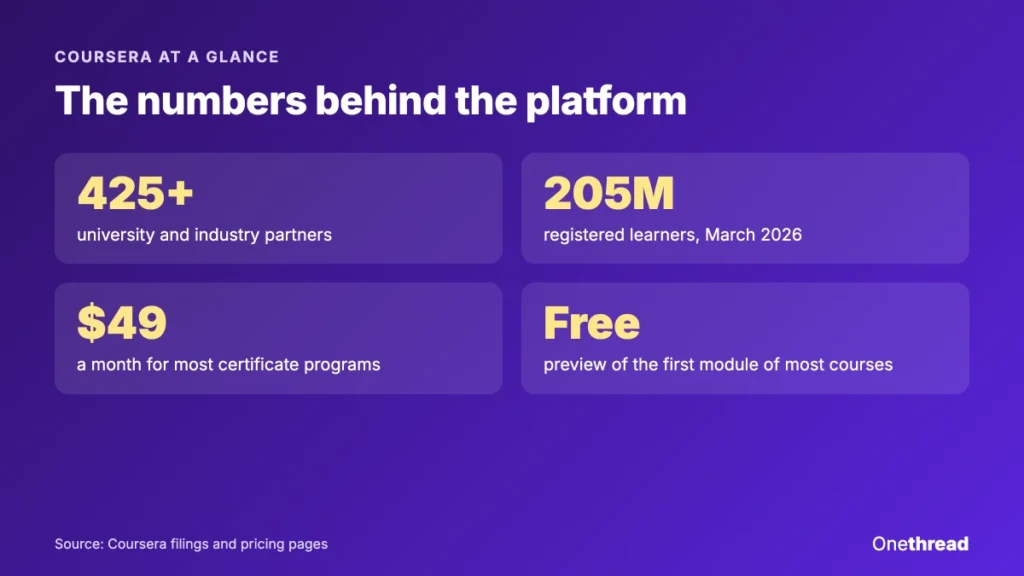
So what is Coursera? It’s an online learning platform with courses, certificates and degrees from over 425 universities and companies. You can preview most courses for free, and paid access starts at $49 a month.
The catalog is big, and the pricing pages don’t make it simpler. That’s where most people get stuck.
We read Coursera’s own pricing, help and investor pages to build this guide. You’ll see how it works, what each program costs, and which one fits your goal.
Key Points
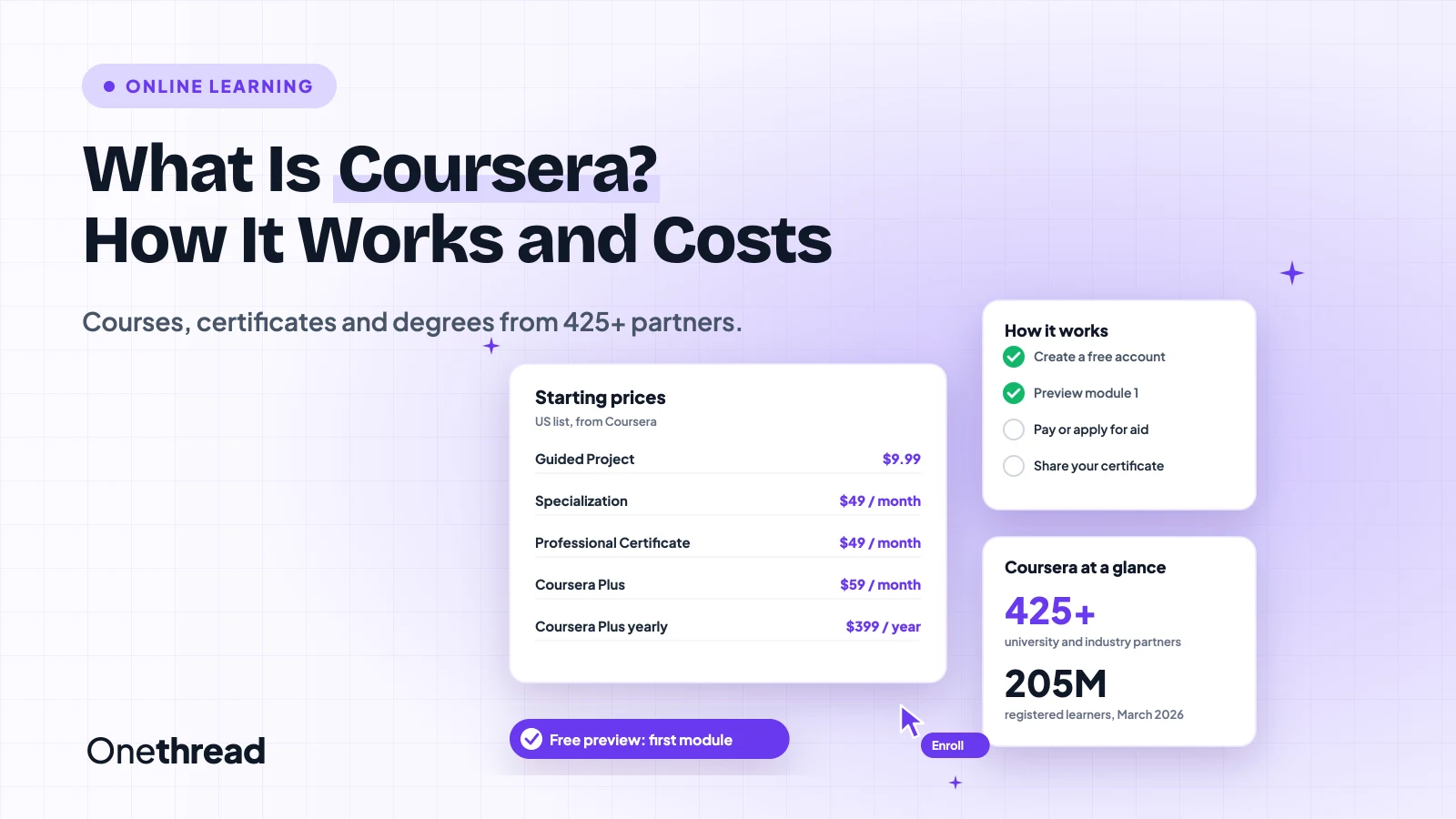
- Coursera is an online learning platform with over 425 university and industry partners. Guided Projects start at $9.99, Specializations and Professional Certificates at $49 a month, and Coursera Plus costs $59 a month or $399 a year.
- Since August 2025, most courses offer a free preview of the first module instead of a full free audit.
- Pick the format by your goal: a Professional Certificate for a new job, a course for one skill, and a degree only when you need the diploma.
- Apply for financial aid before you pay if cost is the blocker.
What Is Coursera and Who Runs It?
Coursera is an online learning platform that sells courses, certificates and degrees made by universities and companies. Stanford professors Andrew Ng and Daphne Koller launched it in 2012.
Coursera doesn’t write most of its own lessons. Partners such as Google, IBM, Microsoft, Stanford and Yale build the content. Coursera hosts it, grades it and issues the certificates.
The company is public and trades on the New York Stock Exchange as COUR. It calls itself a public benefit company, which means it puts a social mission in its charter. In May 2026, Coursera completed its merger with Udemy, and the combined company kept the Coursera name.
The numbers are large. Coursera reported 205 million registered learners as of March 31, 2026. Its latest quarterly filing lists over 425 university and industry partners and over 100,000 instructors.
That’s a lot of choice. And that’s exactly why picking the right program matters more than finding a course.
The Udemy deal matters for learners too. Udemy sells single courses from independent instructors, while Coursera leans on universities and big employers. The merged company now reports more than 290 million learners across both platforms. For you, that means a bigger catalog under one login over time.
What Can You Learn on Coursera?
You can learn almost any career skill on Coursera, from data science to business to health. The catalog covers more than 10,000 courses.
The most popular areas are:
- Data and tech: Data analysis, machine learning, Python and cloud skills.
- Business: Management, finance, marketing and project management.
- Computer science: Programming, web development and software engineering.
- Arts and health: Writing, music, public health and nutrition.
- Languages: English, Spanish and other language courses for work and travel.
Job-focused programs come from employers. Google, IBM and Microsoft all publish Professional Certificates on Coursera. The Google Project Management certificate is a common pick for people who want to move into a project role. Coursera says it can take as little as six months.
Universities add the academic side. Stanford, Yale and the University of Illinois all publish courses, and some offer full online degrees. Those programs carry the same weight as the school’s campus degrees.
If you’re new to the field, start with what is project management before you pay for a certificate. Our list of online project management courses compares Coursera with other places to learn. And if you need a formal credential, our guide to the best project management certification explains which ones employers ask for.
How Does Coursera Work?
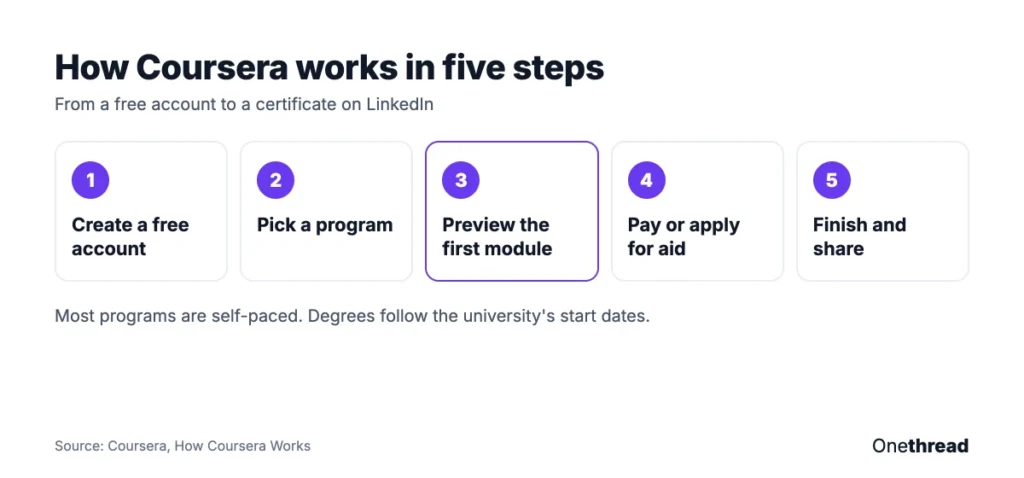
Coursera works in five steps, from a free account to a shareable certificate. Most programs are self-paced, so you learn on your own schedule.
Here’s the path most learners follow:
- Create a free account: Sign up on the website or the mobile app.
- Pick a program: Filter by topic, skill level, length and partner.
- Preview the first module: Watch the videos and try the first graded work for free.
- Pay or apply for aid: Buy the course, subscribe, start a Coursera Plus trial, or request financial aid.
- Finish and share: Pass the graded work and add the certificate to LinkedIn or your resume.
Courses mix short videos, readings, quizzes and graded assignments. Many tech programs add hands-on labs. Some use peer review, where other learners grade your work. Coursera now uses AI to score some peer assignments and give feedback right away.
Degree programs work differently. They follow the university’s own terms, with start dates and an application.
Deadlines are soft in most courses. If you miss one, you can reset your schedule and keep going. That flexibility helps busy people, but it also makes it easy to drift. Set a weekly study slot and treat it like a meeting you can’t skip.
What Types of Programs Does Coursera Offer?
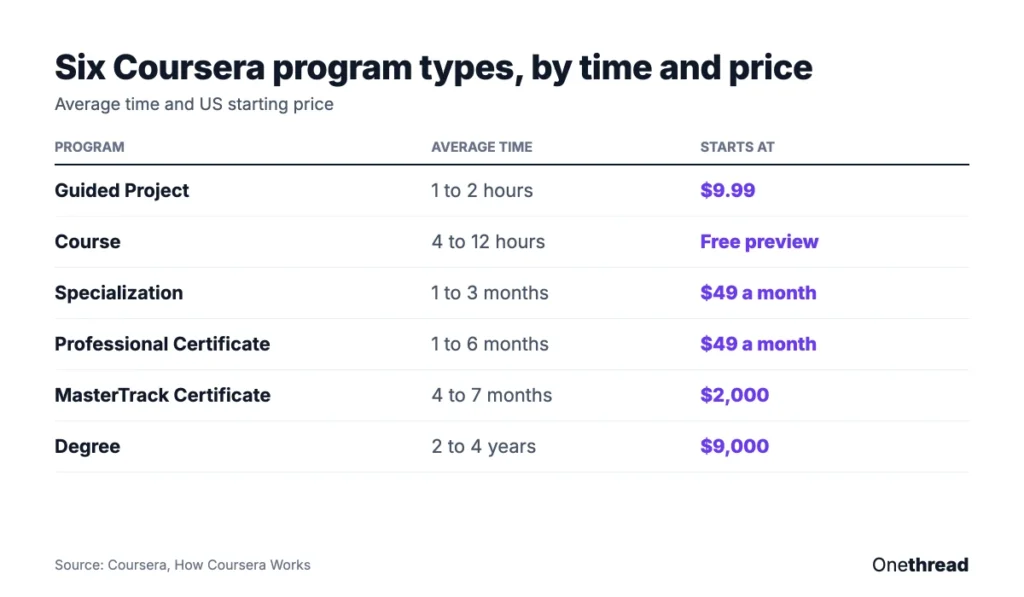
Coursera offers six program types, from a two-hour project to a full degree. Each one costs and takes a different amount of time.
| Program type | Average time | Starting price |
|---|---|---|
| Guided Project | 1 to 2 hours | $9.99 |
| Course | 4 to 12 hours | Free preview |
| Specialization | 1 to 3 months | $49 a month |
| Professional Certificate | 1 to 6 months | $49 a month |
| MasterTrack Certificate | 4 to 7 months | $2,000 |
| Degree | 2 to 4 years | $9,000 |
Source: Coursera’s How Coursera Works page. Prices are US starting prices and can vary by region.
How Specializations and Professional Certificates Differ
A Specialization is a series of related courses on one subject. It often ends in a capstone project, and you earn a certificate for each course plus one for the whole series.
A Professional Certificate is a job-focused program from an employer such as Google, IBM or Microsoft. It targets one role, like data analyst or project manager. Both cost $49 a month on most programs, so the faster you finish, the less you pay. Pick a Specialization for depth and a Professional Certificate for a job switch.
How Coursera Degrees and MasterTrack Work
Online degrees come from accredited partner universities. You apply, pay the school’s tuition, and graduate with a diploma from that university. Undergraduate degrees often take 2 to 6 years, and graduate degrees 1 to 3 years.
MasterTrack Certificates are smaller pieces of a graduate program. They start at $2,000. Some schools count the credit toward the full degree if you’re admitted later. Check each school’s admission rules before you start, since entry requirements differ by program, school and home country.
How Much Does Coursera Cost?
Coursera costs $0 to preview, $49 a month for most certificate programs, and $59 a month or $399 a year for Coursera Plus. Degrees start at $9,000.
Coursera Plus is the all-access subscription. It opens most of the catalog, including Specializations and Professional Certificates. It doesn’t cover degrees or MasterTrack Certificates.
The monthly plan comes with a 7-day free trial. You add a card, and Coursera charges you when the trial ends unless you cancel. The yearly plan has no trial, but it offers a 14-day refund window.
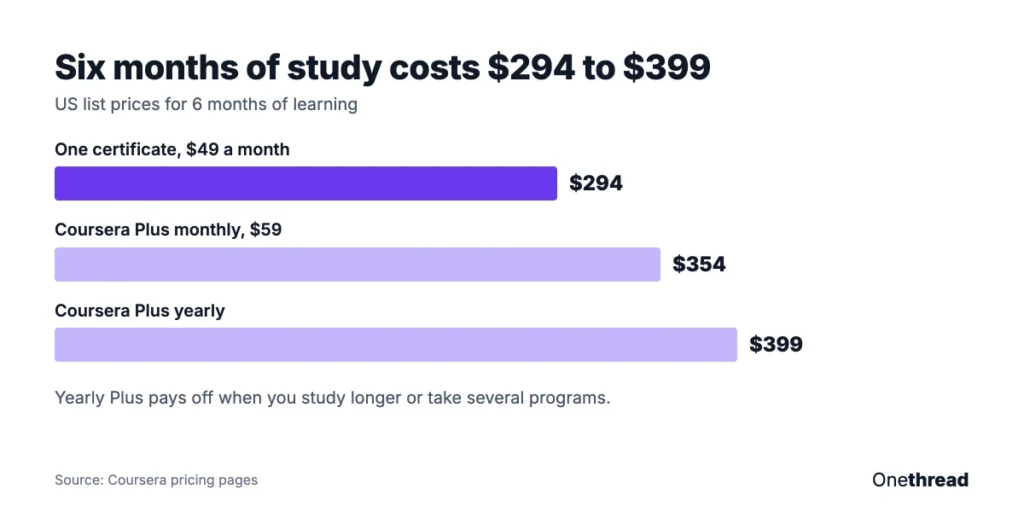
So which is cheaper? It depends on how many months you’ll study.
Example: One Professional Certificate for 6 months costs 6 × $49, or $294. Coursera Plus monthly for the same 6 months costs 6 × $59, or $354. Coursera Plus yearly costs $399, so it only pays off if you study longer or take several programs.
Teams pay differently. Coursera for Teams costs $399 per license a year, for 2 to 499 people. Many companies run it next to a learning management system to track who finished what.
Prices can change by country. Coursera added regional pricing in 2025, so the price you see may be lower than the US list price. Check the price on your own account page before you budget.
Top Tip: Set a calendar reminder for the day before your trial ends. That one step saves you from a surprise $59 charge.
How Much of Coursera Is Free?
Coursera is partly free. You can create an account, preview the first module of most courses, and take some free courses, but full access and certificates cost money.
The rules changed in August 2025. Before that, most courses offered a free audit with all the videos. Now Coursera’s course preview gives you the first module, including videos, some graded work and the AI coach where it’s available.
Some free options remain:
- Free preview: The first module of most courses.
- Community Impact courses: A set of courses that stay free.
- Financial aid: A fee waiver if you can’t afford the course.
Financial aid takes a short application about your finances and goals. If Coursera approves it, you get full access and the certificate at no cost. Apply before you buy, since the waiver replaces the payment. Approval isn’t instant, so start the application a few days before you plan to study.
The preview is still useful. One module shows the teaching style, the workload and the level of the quizzes. That’s usually enough to decide whether to pay.
One caveat worth being honest about: some older Coursera pages still mention free auditing. The preview rules are the ones that apply now.
Which Coursera Certificates Are Worth It, and Is Coursera Accredited?
Coursera certificates are worth it when they match a job you want, but they don’t replace a degree. Coursera says its Professional Certificates don’t equal a college degree.
Employers see a certificate as proof of a skill. You can share it on LinkedIn or download it as a PDF. In Coursera’s 2025 Learner Outcomes Report, 91% of learners reported a positive career outcome. That’s Coursera’s own survey, so treat it as a signal, not a promise.
Accreditation works differently. Coursera itself isn’t an accredited school. But some certificates carry credit recommendations from the American Council on Education (ACE). A college may accept that credit, but the receiving school decides.
Degrees are the exception. They come from accredited partner universities, and the diploma is the university’s own. Check the school’s accreditation before you apply.
If your goal is a career change, pair the certificate with a portfolio project. Hiring managers trust work they can see, and a finished project gives you something to talk about in interviews.
The partner matters as much as the platform. A certificate from Google or IBM carries more weight with recruiters than an unknown name. Our guide to project management skills lists the skills worth showing in that project.
How Do You Pick the Right Coursera Program?
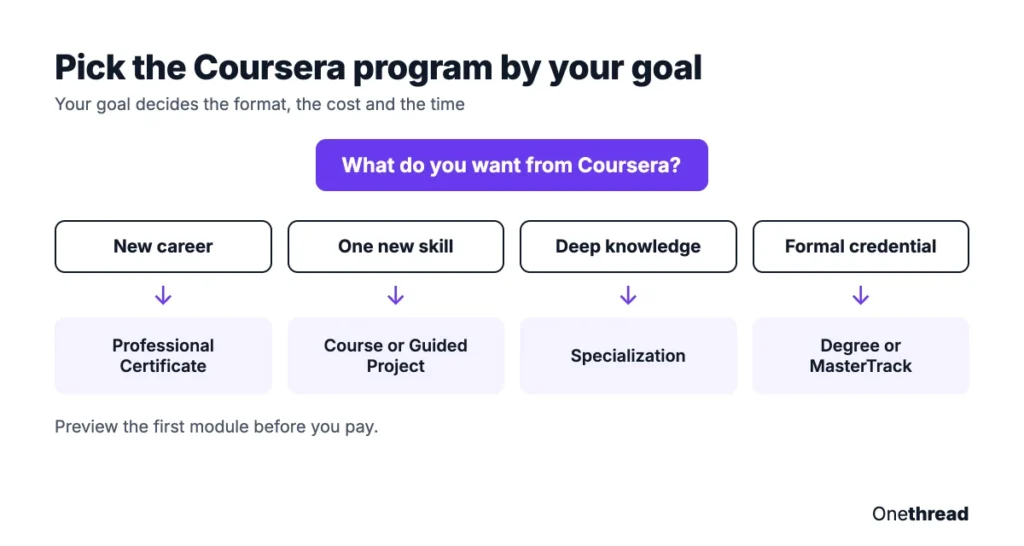
Pick the program by your goal, not by the course title. Your goal decides the format, the cost and the time.
Four checks point you to the right format:
- New career: Pick a Professional Certificate from an employer in that field.
- One new skill: Take a single course or a Guided Project.
- Deep knowledge: Take a Specialization with a capstone project.
- Formal credential: Choose a degree or MasterTrack from a university.
Then check your time. A Professional Certificate takes 1 to 6 months on average, and a single course takes a few weeks. At 5 hours a week, plan for the longer end.
Cost matters too. A short course fits a small budget.
A Professional Certificate on a monthly plan rewards speed. The faster you finish, the less you pay. If you plan to take two or more programs this year, Coursera Plus yearly usually costs less than paying for each one. Do the math with your own plan before you click buy.
Top Tip: Finish the free first module before you pay. If you skip it, you may pay for a course that’s too easy or too hard.
Sources: Coursera about page, How Coursera works, Coursera Plus, Coursera for Teams, Coursera degrees.
What Should You Do Next?
Coursera is a large online learning platform, and its value depends on the program you choose. A certificate helps when it matches a job. A degree helps when you need the diploma. Now you know the formats, the prices and the free options, so you can choose with real numbers.
This week, pick one goal and preview the first module of two matching courses. Then compare the monthly cost with your real study time before you pay. If price is the only thing in your way, apply for financial aid first.
FAQs
Is Coursera Legit?
Yes, Coursera is a legitimate company. It trades on the New York Stock Exchange, and its courses come from known universities and companies such as Stanford, Google and IBM. Its programs are real, but the value of each certificate depends on the partner and on how employers in your field see it.
Can I Put Coursera Certificates on My Resume?
Yes. You can list a Coursera certificate under licenses and certifications on your resume or LinkedIn profile. Coursera lets you share it straight to LinkedIn or download a PDF. Name the partner, such as Google or IBM, since employers trust the issuer more than the platform.
Is Financial Aid Available on Coursera?
Yes. Coursera offers financial aid on most courses, Specializations and Professional Certificates. You fill in a short application about your income and goals. Approval waives the fee and grants full access plus the certificate, so apply before you pay, since aid can’t refund a past charge.
Is Coursera Good for Teams?
Yes, Coursera for Teams gives companies shared access to the catalog for $399 per license a year. It covers 2 to 499 people, and larger groups move to the Enterprise plan. Managers can assign programs and track progress, which helps when you want a whole team to learn the same skill.