Most problems at work don’t need a genius. They need a method.
Problem solving techniques and strategies are repeatable ways to find a cause and pick a fix. A strategy is the overall plan, such as working backward. A technique is the tool you use inside it, such as the 5 Whys or a fishbone diagram.
You’ve probably tried the “get everyone in a room” approach. It works until the loudest person wins.
We read the top guides on this topic and sorted 17 methods by the job they do.
You’ll get a 6-step process, each method with an example, and a table that tells you which one to use.
Key Points
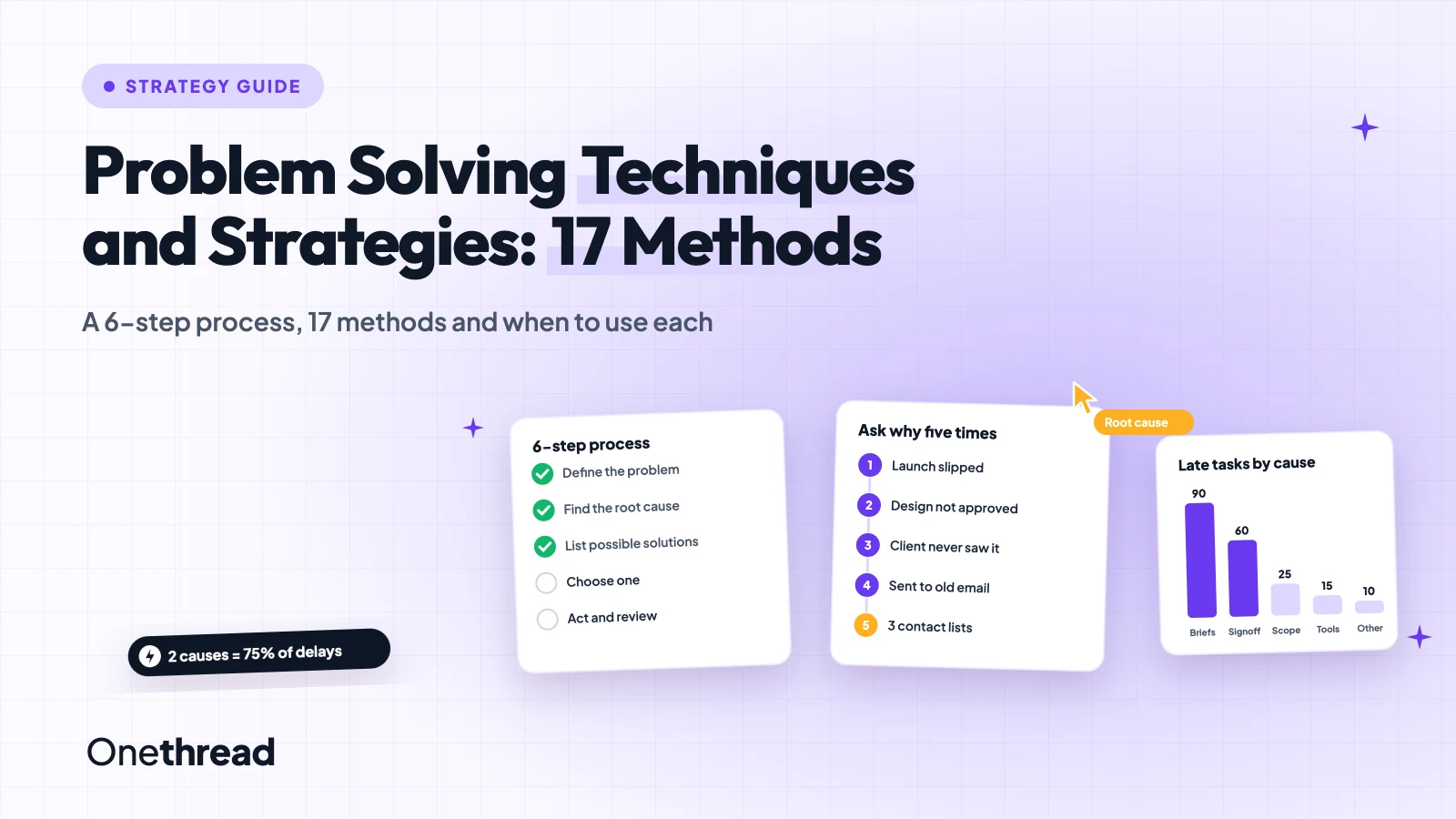
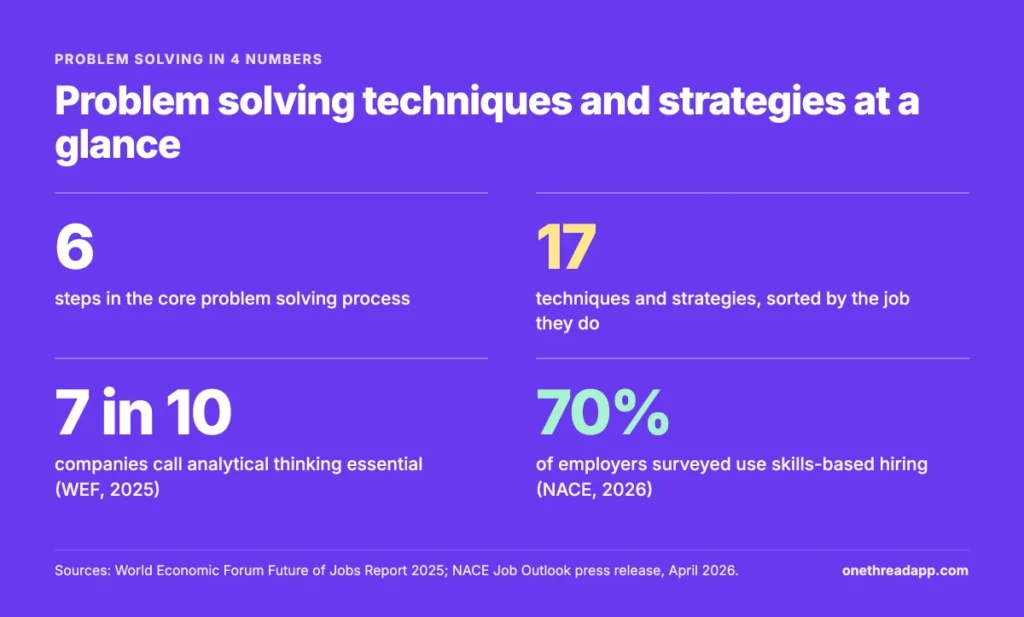
- Problem solving techniques and strategies are repeatable methods for finding a cause and choosing a fix. The core process runs in 6 steps: define the problem, find the root cause, list options, choose one, act, and review the result.
- Match the method to the job. Use the 5 Whys, a fishbone diagram or a Gemba walk to find causes; brainstorming or the Kipling method to find ideas; SWOT or a decision table to choose.
- Problem solving is a skill employers rank near the top. Seven in 10 companies call analytical thinking essential, so practice it on small problems first.
- Under time pressure, use a rapid version: 5 minutes to define, 10 to find the cause, 10 to pick a fix, 5 to assign an owner and a check date.
What Are Problem Solving Techniques and Strategies?
Problem solving techniques and strategies are structured ways to get from “something is wrong” to “here’s the fix”. They replace guesswork with a sequence you can repeat and teach.
The two words get mixed up a lot. A strategy is your general approach to a problem. A technique is the specific tool you run while you follow that approach.
Example: your client reports keep going out late. Your strategy is root cause analysis. Your techniques are the 5 Whys and a quick fishbone diagram.
Psychology sorts the classic strategies into four groups. Algorithms follow fixed steps that always reach an answer. Heuristics are rules of thumb that are fast but can miss.
Trial and error tests options one by one. Insight is the sudden “aha” that often comes after a break.
Smart problem solving means picking the right method for the size of the problem. A typo in a proposal doesn’t need a SWOT analysis. A product launch that keeps slipping might need three methods in a row.
This skill matters for careers, not just projects. In the World Economic Forum’s Future of Jobs Report 2025, analytical thinking is the top core skill. Seven out of 10 companies call it essential.
And it pays off for teams. Problems that get solved early don’t grow into missed deadlines. That’s one reason problem solving sits at the heart of improving team productivity.
What Are the 6 Steps of the Problem Solving Process?
The problem solving process has 6 steps: define, find the root cause, list solutions, choose one, act, and review. Most guides use 4 to 7 steps, but they all cover the same ground. The steps keep you from fixing the wrong thing.
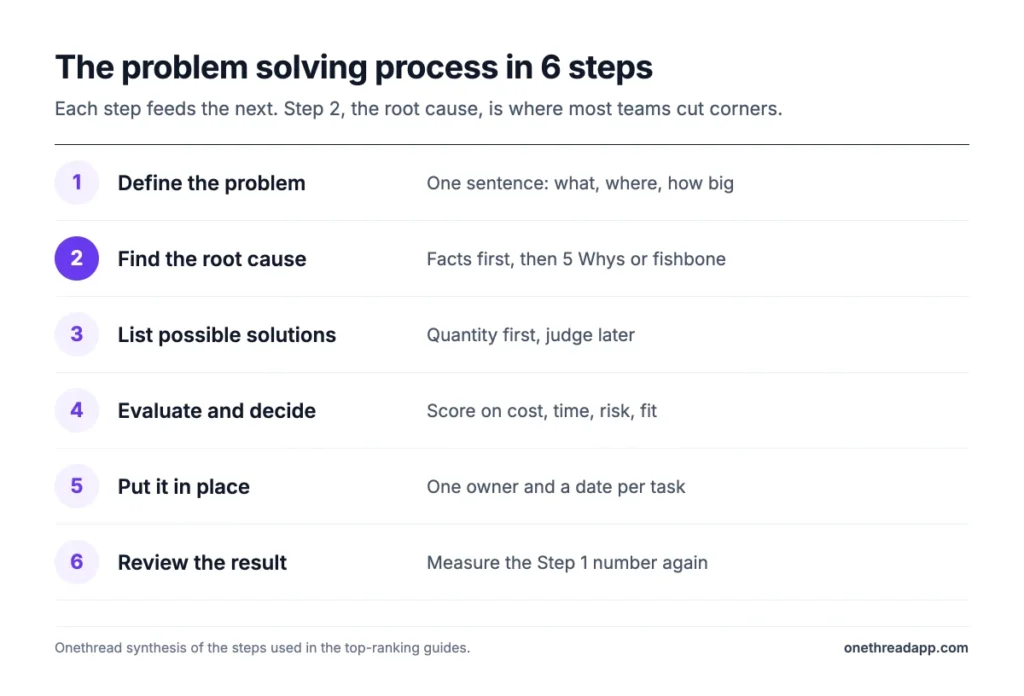
Step 1: Define the Problem
Write the problem in one sentence that names what is happening, where, and how big it is. “Sales are down” is too vague. “Repeat orders from small clients fell 20% this quarter” is a problem you can work on.
Separate the problem from its symptoms. Angry emails from a client are a symptom. A missed handoff between two teams might be the problem.
Check that people agree on the sentence before you move on. If two managers describe two different problems, you have two problems. Pick one first.
Top Tip: Write the problem statement at the top of your notes and reread it at every step. It stops the group from drifting to a different issue.
Step 2: Find the Root Cause
The root cause is the earliest point you can change that would stop the problem from coming back. Fixing a symptom feels faster. But the problem returns next month with a new face.
Collect facts before opinions. Look at dates, numbers, emails, and the steps of the process where the problem shows up. Then use a cause-finding method such as the 5 Whys, a fishbone diagram, or a Gemba walk.
Stop when you reach something you can control. “The client is difficult” is not a root cause. “We don’t confirm scope in writing” is.
Step 3: List Possible Solutions
Generate several options before you judge any of them. The first idea is rarely the best one. It’s just the first one.
Go for quantity in this step. Brainstorming, the Kipling method, and working backward all help you widen the list. Write every option down, even the ones that sound odd.
Invite people from outside the problem area. Someone from finance might spot a fix that the project team can’t see because they’re too close. Good team collaboration at this stage gives you a wider set of ideas to compare.
Step 4: Evaluate Options and Decide
Compare each option against the same criteria: cost, time, risk, and how well it fixes the root cause. A simple score from 1 to 5 on each is enough for most problems.
Example: option A scores 4 on cost, 3 on time, 4 on risk and 5 on fit, so 16 out of 20. Option B scores 5, 5, 2 and 2, so 14. Option A wins, even though B is cheaper and faster.
Make the decision and write down why. If the fix fails later, the record shows what you knew at the time. That’s useful, not embarrassing.
Step 5: Put the Solution in Place
A decision without an owner is a wish. Split the chosen fix into tasks, give each task one owner, and set a date for each.
Tell the people the change affects before it starts. A new approval step that nobody hears about will be skipped by Friday. Clear communication strategies keep the rollout from creating a new problem.
Start small where you can. A pilot with one team or one client shows whether the fix works before you change the whole process.
Step 6: Review the Result
Go back to the problem statement from Step 1 and measure it again. If repeat orders were down 20%, check whether that number has moved after a set period.
If the problem is solved, record what worked so the next team can reuse it. If not, return to Step 2. The root cause you picked may have been a symptom after all.
Set the review date when you choose the fix, not afterward. Reviews that aren’t on the calendar don’t happen. You’ll also build a library of past fixes, which is technique number 1 in our list.
Which 17 Problem Solving Techniques and Strategies Work Best?
The 17 problem solving methods in this section fall into four jobs: finding the cause, finding ideas, choosing between options, and planning the fix. No single method works for every problem. Each entry explains when it helps and gives a short example, so you can pick by the job in front of you.
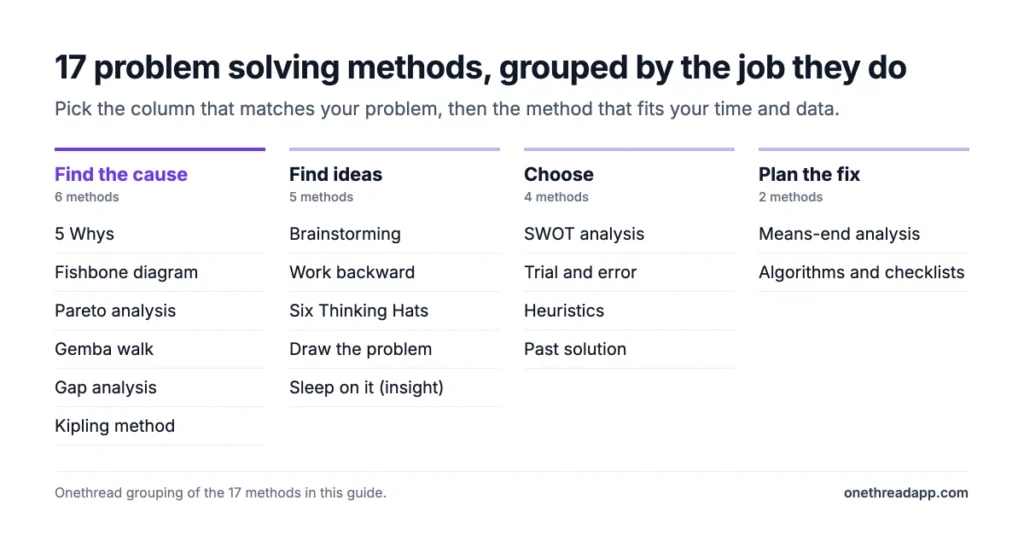
1. Use a Past Solution That Worked
Many problems at work are repeats in disguise. If your team solved something similar before, start with that fix and adjust it.
This method is fast because the hard thinking is already done. Ask “Have we seen this before?” and check old project notes, tickets, or retros.
Example: a client keeps sending late feedback. Last year a similar client got a fixed review window of two working days, and it worked. Try the same rule first.
The risk is forcing an old fix onto a new problem. Check that the cause matches, not just the symptom.
2. Brainstorm Solutions
Brainstorming means a group lists as many ideas as possible without judging them. Judging comes later, in a separate step.
It works best with a clear problem statement, a time limit of 10 to 20 minutes, and one person writing everything down. Quiet people often do better writing ideas alone first, then sharing. Our guide to brainstorming techniques covers formats like brainwriting and round robin.
Example: a team needs to cut onboarding time for new clients. In 15 minutes, six people list 30 ideas, from a welcome video to a shared checklist.
Brainstorming is weak at finding causes. Use it after you know what you’re fixing.
3. Work Backward from the Goal
Working backward starts at the end result and asks what must happen just before it. Then you repeat the question until you reach today.
This strategy suits deadlines and goals with a clear finish line. It also exposes steps you forgot, because each step needs the one before it.
Example: a report must reach the client on Friday. Before that, the manager signs off on Thursday. Before that, the data is ready on Wednesday. So the data request goes out on Monday, not Wednesday.
A close cousin is reverse engineering. You take a finished result, such as a rival’s process, and pull it apart to see how it works.
4. Use the Kipling Method
The Kipling method asks six questions: who, what, where, when, why, and how. It’s named after Rudyard Kipling’s poem about his “six honest serving-men”.
Answering all six forces you to look at the problem from every side. Teams often skip “where” and “when”, and those two catch a lot of patterns.
Example: support tickets are piling up. Most come from new users, in their first week, on the setup page.
That answers who, when and where in one line. It points straight at onboarding, not at the support team.
The method is simple enough to use in any meeting. It works for defining a problem and for planning a fix.
5. Use Trial and Error
Trial and error means you test one option, check the result, and try another if it fails. It’s the oldest strategy there is.
It works well when tests are cheap and quick. Changing an email subject line, a meeting time, or a form layout costs almost nothing to try.
Example: your weekly update email gets few replies. You test three subject lines over three weeks and keep the one that gets the most responses.
It works badly when each test is costly or risky. Don’t trial-and-error a client contract. Keep a short log of what you tried so you don’t repeat a failed option.
6. Use Rules of Thumb (Heuristics)
Heuristics are mental shortcuts: rules of thumb that give a good-enough answer fast. “If two tasks clash, do the one with the closer deadline” is a heuristic.
They save time on small, common decisions. Most experienced managers rely on a handful of them without naming them.
Example: a team uses the rule “anything under 15 minutes gets done today”. That one heuristic clears small tasks before they pile up.
The catch is bias. Shortcuts can lead you to the familiar answer instead of the right one. Use heuristics for routine choices, and a fuller method for big or new problems.
7. Sleep On It (Insight)
Insight problem solving is the “aha” moment when the answer seems to appear. It often follows a break, a walk, or a night’s sleep.
The break isn’t laziness. Stepping away lets you drop the first framing of the problem, which is often the thing blocking you.
Example: you can’t find a way to fit three projects into one team’s month. You stop for the day. The next morning you notice two projects share the same research phase, so they can run together.
Insight needs groundwork first. Study the problem well, then step away. And test the idea before you act on it, because “aha” moments can be wrong too.
8. Use Means-End Analysis
Means-end analysis compares where you are now with where you want to be, then breaks the gap into smaller gaps. You solve each small gap in turn.
It came from early research on how people and computers solve problems. Today it’s useful for any big goal that feels too large to start.
Example: you want to move a team from spreadsheets to one shared project tool. The gaps are data, habits, and access. You solve data first by moving one project, then habits with a two-week trial, then access by adding the rest of the team.
The method keeps big change from feeling like one impossible jump.
9. Ask Why Five Times (5 Whys)
The 5 Whys asks “Why did this happen?” and then asks “why” again about each answer. You stop when you reach a cause you can change, usually after about five rounds.
The method is simple and needs no special tools. The Institute for Healthcare Improvement’s 5 Whys tool puts it plainly: ask “why” again and again until you reach the root cause.
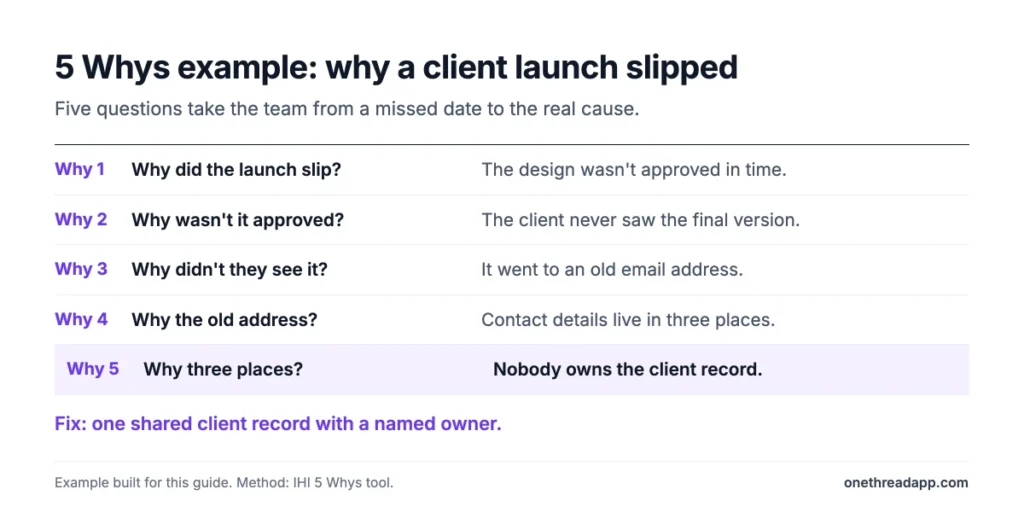
Example: a client launch slipped. Here’s how the five questions run:
- Why did the launch slip? The design wasn’t approved in time.
- Why wasn’t it approved? The client never saw the final version.
- Why didn’t they see it? It went to an old email address.
- Why the old address? Contact details live in three places.
- Why three places? Nobody owns the client record. The fix is one shared record with an owner.
The 5 Whys can stop too early or follow only one path. For problems with many causes, pair it with a fishbone diagram.
10. Map the Causes (Fishbone Diagram)
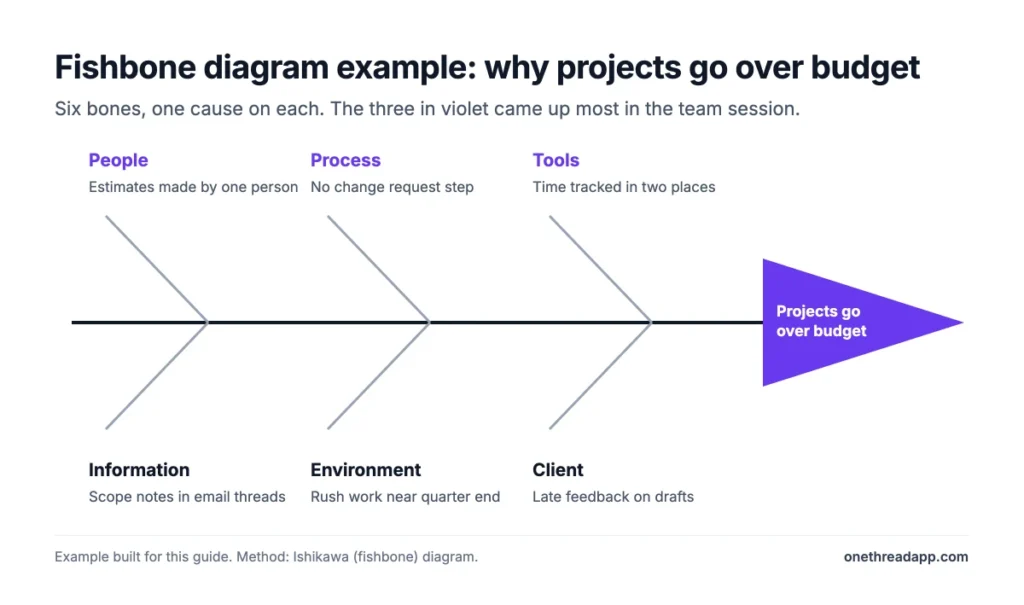
A fishbone diagram, also called an Ishikawa diagram, lays out possible causes as bones off a central spine. The problem sits at the head of the fish.
Each bone is a category, such as people, process, tools, information, environment, and the client. The team adds possible causes under each one.
Example: projects keep going over budget. The process bone gets “no change request step”. The tools bone gets “time tracked in two places”. And the people bone gets “estimates made by one person”.
The picture helps a group see that a problem has several causes at once. It’s a strong partner for the 5 Whys, which you can run on the biggest bone.
11. Fix the Biggest Causes First (Pareto)
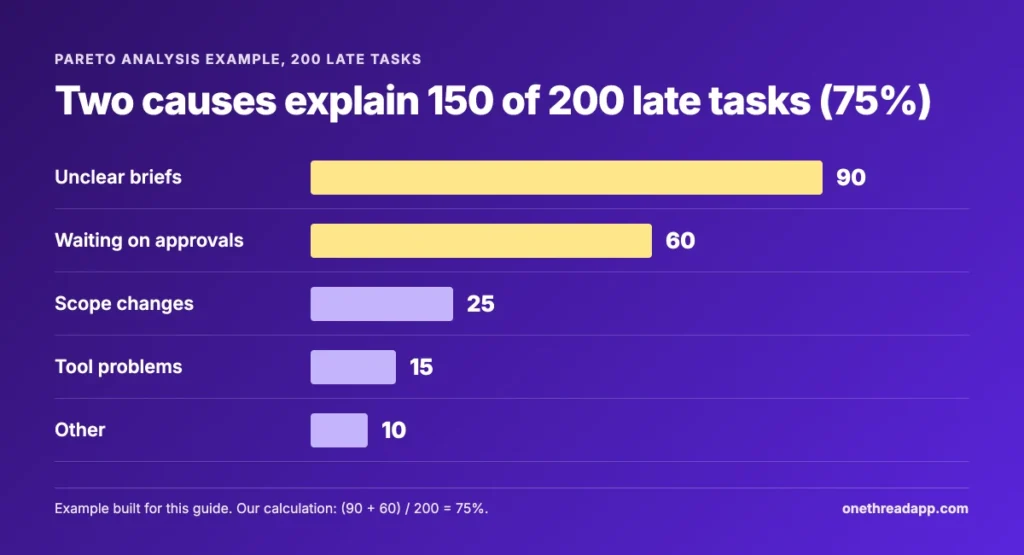
Pareto analysis uses the 80/20 rule: a small share of causes often creates most of the effect. You count how often each cause appears, then fix the biggest ones first.
It works when you have data, such as tickets, defects, or complaints, sorted by cause. A simple bar chart from largest to smallest shows where to start.
Example: a team logs 200 late tasks in a quarter, with 90 from unclear briefs and 60 from waiting on approvals. Those two causes explain 150 of 200, or 75%. Fix briefs and approvals before anything else.
Pareto tells you where to look first. It doesn’t tell you why each cause happens, so follow it with the 5 Whys.
12. Weigh Strengths and Threats (SWOT Analysis)
SWOT analysis lists strengths, weaknesses, opportunities, and threats in a simple grid. Strengths and weaknesses are inside your team. Opportunities and threats come from outside.
It helps with strategic problems, such as whether to enter a new market or drop a service. It’s less useful for a broken process. For wider market questions, some teams add Porter’s Five Forces to look at rivals, buyers, and suppliers.
Example: an agency weighs adding video work. Its grid reads: strength, a strong design team; weakness, no editors; opportunity, clients keep asking; threat, cheap freelancers.
Our guide to SWOT for teams walks through a full example. You can draft the grid with our free SWOT analysis generator.
13. Run a Gap Analysis
Gap analysis compares where performance is with where it should be, then explains the difference. It answers “how far off are we, and why?”
Start with a clear target number. Then measure the real number and list what’s causing the gap.
Example: your team plans to close 40 support tickets a week but closes 28. The gap is 12. You find that 8 of those 12 wait on another team for answers, so the fix is a faster handoff.
The method turns a vague feeling (“we’re slow”) into a number you can track. Re-measure after each change to see if the gap is closing.
14. Take a Gemba Walk
A Gemba walk means going to the place where the work is done and watching it happen. “Gemba” is Japanese for “the real place”. Managers observe, ask questions, and talk with the people doing the work.
A Gemba walk involves going to the actual place where work is done and directly observing the process. You engage with employees to find areas for improvement.
Example: reports keep arriving with errors. On a walk through the process, a manager sees analysts copying numbers by hand between two systems. The fix is an export, not more checking.
For remote teams, the “place” can be a shared screen while someone shows how they do a task.
15. Switch Viewpoints (Six Thinking Hats)
Six Thinking Hats, created by Edward de Bono, splits thinking into six modes. White is facts, red is feelings, black is risks, yellow is benefits, green is new ideas, and blue runs the process.
The whole group wears the same hat at the same time. That stops one person attacking every idea while another defends it.
Example: a team discusses a new pricing plan. Five minutes of white hat collects the numbers. Five minutes of black hat lists risks. Then green hat looks for ways around those risks.
The method keeps meetings calmer and covers angles people usually skip. It works best with a facilitator watching the clock.
16. Draw the Problem
Drawing the problem turns a tangle of words into a picture. Flowcharts, mind maps, or simple boxes and arrows all count.
A sketch often shows a loop, a missing step, or a handoff that nobody owns. People spot gaps faster in a picture than in a long email.
Example: you draw your content approval process and find five steps where it waits for one person. That person is the bottleneck.
For maths-heavy problems, such as pricing models or forecasts, plotting the numbers helps too. Free tools like graphing calculators can show where two cost lines cross, which is often the answer to the question.
17. Follow a Fixed Procedure (Algorithms)
An algorithm is a step-by-step procedure that always produces the right answer if you follow it. Checklists, standard operating procedures, and formulas are all algorithms.
They’re slow to design but fast to use. Once a team has one, anyone can solve the problem the same way.
Example: a team writes a five-step checklist for invoices: rate, hours, tax line, purchase order number, and due date. Errors drop because nobody has to remember the steps.
Use algorithms for problems that repeat. They’re the end point of good problem solving: the fix becomes a routine.
Which Problem Solving Technique Should You Use for Which Problem?
Use the table to match the problem in front of you to a technique. Start with the job you need done, then pick the method that fits your time and data.
| If your problem looks like this | Job to do | Try this first | Then add |
|---|---|---|---|
| It keeps coming back | Find the cause | The 5 Whys | Fishbone diagram |
| Many small causes, lots of data | Find the cause | Pareto analysis | The 5 Whys on the top cause |
| Nobody can describe it clearly | Define it | The Kipling method | Gemba walk |
| You need fresh ideas | Find ideas | Brainstorming | Six Thinking Hats |
| A fixed deadline | Plan the fix | Work backward | Means-end analysis |
| A big strategic choice | Choose | SWOT analysis | Decision table |
| A cheap, quick test is possible | Choose | Trial and error | Gap analysis |
| It happens every week | Make it routine | An algorithm or checklist | Past solution |
The table shows our pairings, based on what each method is built to do. Most real problems need two methods: one to find the cause and one to choose the fix.
How Does Rapid Problem Solving Work Under Time Pressure?
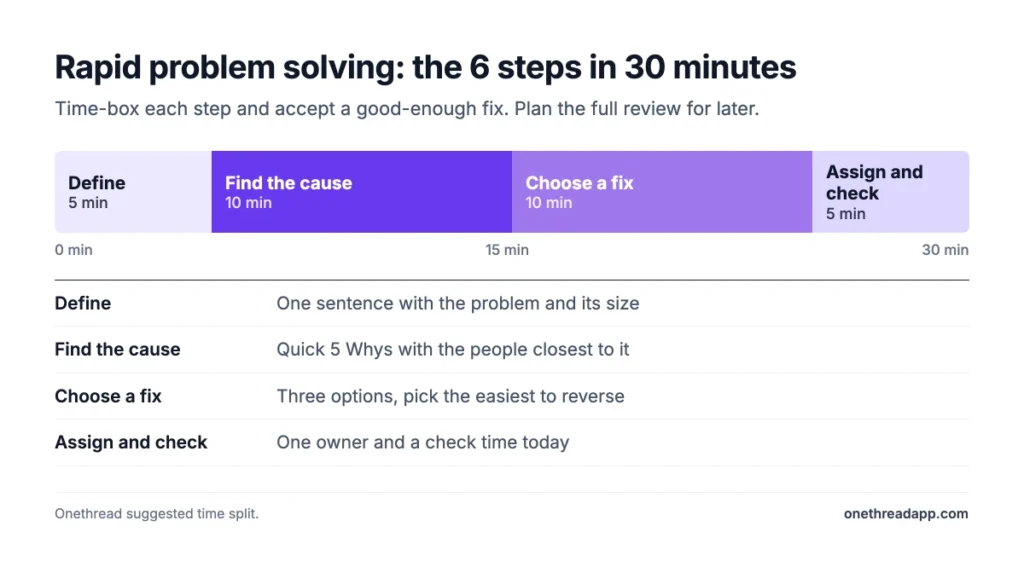
Rapid problem solving squeezes the 6-step process into about 30 minutes. You use it when a client is waiting or a launch is today, and a week of analysis isn’t an option.
The trick is to time-box each step and accept a good-enough answer. Here’s the split we suggest:
- Define (5 minutes): write one sentence that names the problem and its size.
- Find the cause (10 minutes): run a quick 5 Whys with the people closest to the problem.
- Choose a fix (10 minutes): list three options and pick the one that is fastest to reverse if it fails.
- Assign and check (5 minutes): name one owner and set a check time, such as end of day.
Example: a client can’t log in to their portal an hour before a demo. The cause is a password reset email that lands in spam. The fix is a one-time link sent by chat.
The account manager owns it and checks again at 2:30 pm. Total time spent: under 30 minutes.
Rapid fixes are often patches, not cures. Schedule a full review after the pressure is off, or the same fire starts again next month. Put that review on the calendar before you close the chat.
What Skills Make an Effective Problem Solver?
Effective problem solvers combine clear thinking with good people skills. Methods help, but skills decide how well you use them.
Employers look for these skills when they hire. In its Job Outlook research, NACE reports that employers seek critical thinking and problem solving, communication, and teamwork in new graduates. And 70% of surveyed employers now use skills-based hiring.
Seven skills do most of the work:
- Critical thinking: you question the first answer and check the facts behind it.
- Analysis: you break a big problem into parts and read the numbers.
- Communication: you explain the problem and the fix so others act on it.
- Decision-making: you choose with incomplete information and accept the trade-off.
- Planning and prioritizing: you order the steps and pick what to fix first.
- Emotional control: you stay calm, so the group thinks instead of panics.
- Research: you find the data, past fixes, and expert advice you need, and you know when to stop looking.
Leaders need one more: the habit of asking for input before deciding. It sounds soft, but it changes what facts reach you. A team that feels heard shares the facts that a manager can’t see. If you’re working on that, regular, specific feedback in both directions helps.
How Can You Get Better at Problem Solving?
You get better at problem solving the same way you get better at anything: practice, feedback, and a few new methods each year. Talent helps less than habits do.
Six habits make the biggest difference:
- Practice on small problems: use the 5 Whys on a late email before you need it for a failed project.
- Run team exercises: short problem solving activities build the skill in a low-risk setting.
- Ask for feedback: after each fix, ask one person what you missed.
- Learn one new method at a time: try Six Thinking Hats in one meeting, then decide if it’s worth keeping.
- Study good fixes: read how other teams and companies solved problems like yours.
- Keep a problem log: write the problem, the cause, the fix, and the result. It becomes your past-solutions library.
Top Tip: Pick one recurring annoyance this month, like a weekly report that’s always late, and run the full 6-step process on it. One finished cycle teaches more than reading about ten methods.
Experiment with low stakes. Trying a new method on a real but small problem shows you its limits before the stakes are high. A failed test on a minor issue costs an hour, not a client.
What Mistakes Block Good Problem Solving?
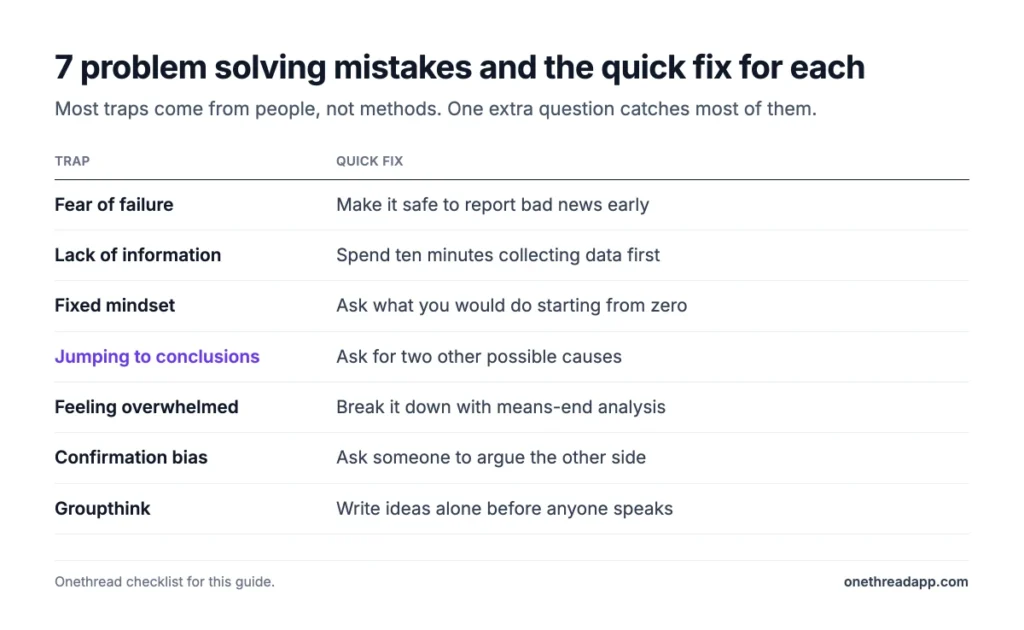
The biggest mistakes in problem solving are about people, not methods. Even the best technique fails if fear, bias, or group pressure shapes the answer.
Watch for these seven traps:
- Fear of failure: people hide problems or avoid trying fixes. Make it safe to report bad news early.
- Lack of information: you decide before you have the facts. Spend ten minutes collecting data first.
- Fixed mindset: “We’ve always done it this way” blocks new options. Ask what you’d do if starting from zero.
- Jumping to conclusions: the first explanation feels right and stops the search. Ask for two other possible causes.
- Feeling overwhelmed: the problem looks too big to start. Break it down with means-end analysis.
- Confirmation bias: you notice only the facts that support your idea. Ask someone to argue the other side.
- Groupthink: the team agrees too fast to avoid conflict. Have people write ideas alone before anyone speaks, then share them in turn.
Most of these traps have the same fix: slow down for a few minutes and ask one more question. Teams that build that pause into meetings catch the trap before it costs them. That small pause is where good problem solving techniques earn their keep.
What Should You Do Next?
Problem solving isn’t a gift some people have and others don’t. It’s a set of problem solving techniques and strategies you can learn, run in 6 steps, and match to the problem with the table above. The better you match the method, the less time you spend fixing the same thing twice.
Pick one recurring problem on your team this week and run the 5 Whys on it with two colleagues. Track the fix as tasks with owners and dates in a tool like Onethread. Then the Step 6 review is already on the calendar.
FAQs
What Are the Most Common Problem Solving Techniques?
The most common problem solving techniques are brainstorming, the 5 Whys, SWOT analysis, trial and error, and fishbone diagrams. Brainstorming finds ideas. The 5 Whys and fishbone diagrams find causes, and SWOT helps with bigger choices. Most teams start with these five because they need no special training or software.
Is Problem Solving a Skill or a Process?
Problem solving is both a skill and a process. The process is the set of steps, such as define, find the cause, choose, act, and review. The skill is how well you run those steps, which improves with practice and feedback. Employers hire for the skill, and teams succeed by writing down the process.
What Are the Four Main Problem Solving Strategies in Psychology?
The four main problem solving strategies in psychology are algorithms, heuristics, trial and error, and insight. Algorithms follow fixed steps and always reach an answer, while heuristics are quick rules of thumb. Trial and error tests options one at a time. Insight is the sudden solution that often appears after a break.
How Do You Solve a Complex Problem?
You solve a complex problem by breaking it into smaller parts and solving them in order. Map the causes with a fishbone diagram, count them with Pareto analysis, and close each gap with means-end analysis. Involve people from different teams, because complex problems rarely sit inside one department.
Which Problem Solving Strategies Work Best for Teams?
The problem solving strategies that work best for teams give everyone a turn. Good picks are silent brainstorming, Six Thinking Hats, and a group 5 Whys. These methods reduce groupthink and let quieter people share facts. Pick one, time-box it, and name a facilitator.