Stripe pricing looks like one number. It isn't.
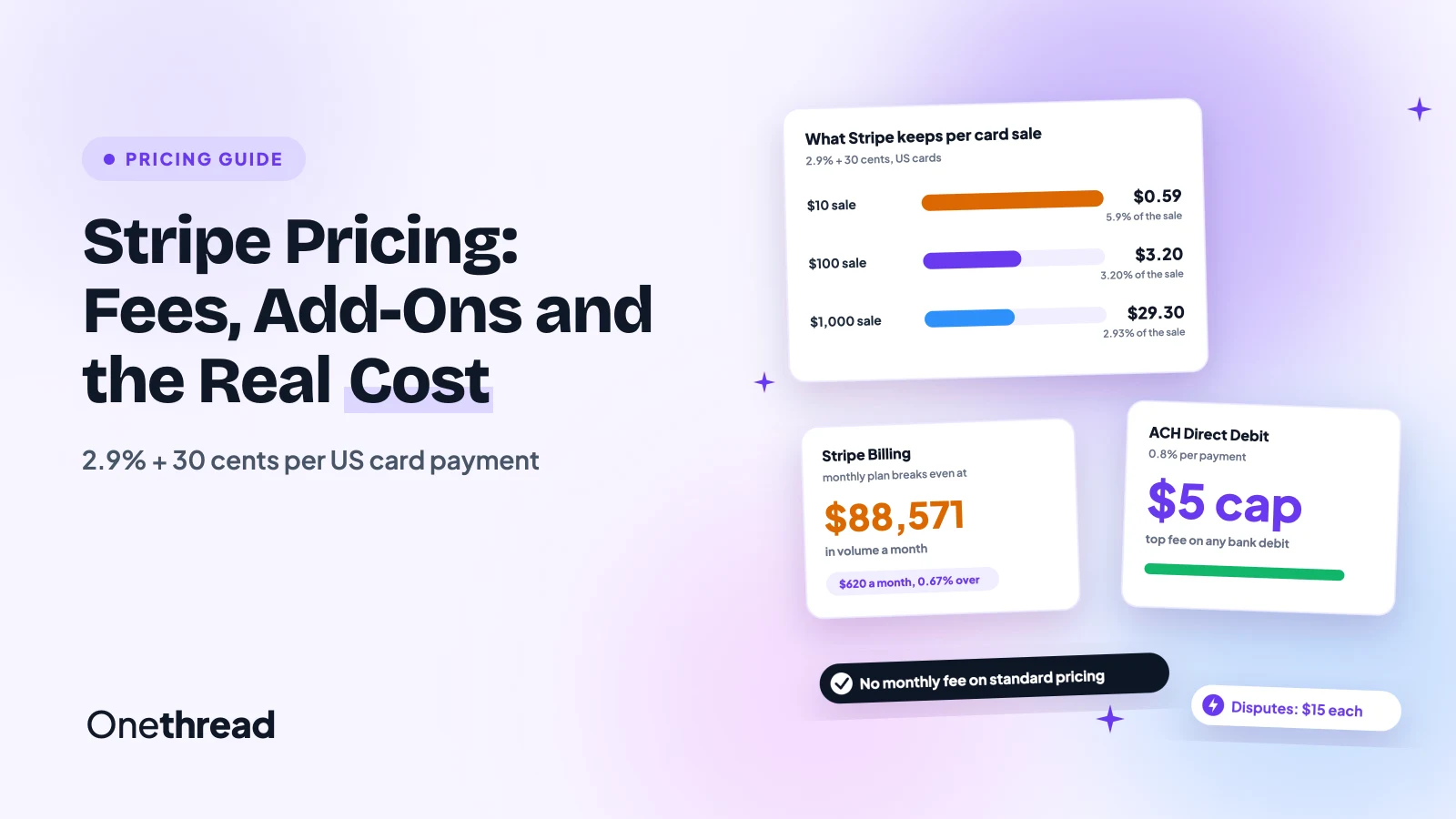
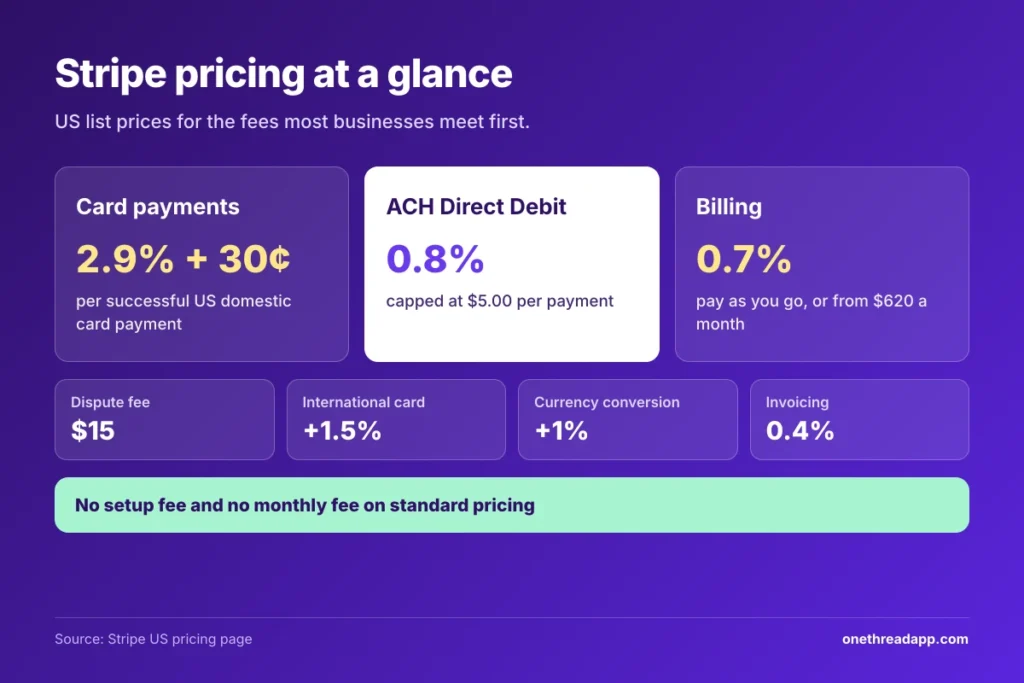
Stripe charges 2.9% + 30 cents for each successful US card payment, with no setup fee and no monthly fee. International cards add 1.5%, currency conversion adds 1%, and ACH Direct Debit costs 0.8%, capped at $5.
The fixed 30 cents is the catch: on a $10 sale, you pay 5.9%.
We read Stripe's own pricing pages and compared 7 top-ranking fee guides. You'll get the real cost by sale size, plus Billing, custom pricing and PayPal and Square side by side.
Key Points
- Stripe's standard pricing is 2.9% + 30 cents per domestic card payment in the US, with no setup or monthly fee. That means $3.20 on a $100 sale and $29.30 on $1,000. International cards add 1.5% and currency conversion adds 1%.
- The fixed fee punishes small sales and rewards big ones. A $10 card sale costs 5.9%, while a $5,000 invoice paid by ACH Direct Debit costs $5.00, because Stripe caps the 0.8% fee.
- Add-ons carry their own prices. Billing costs 0.7% of Billing volume, or from $620 a month on a 1-year contract, and each dispute costs $15.
- Custom pricing exists for high volume. Stripe lists interchange-plus and volume discounts, but publishes no minimum volume, so you have to ask.
What Does Stripe Charge for Each Payment?
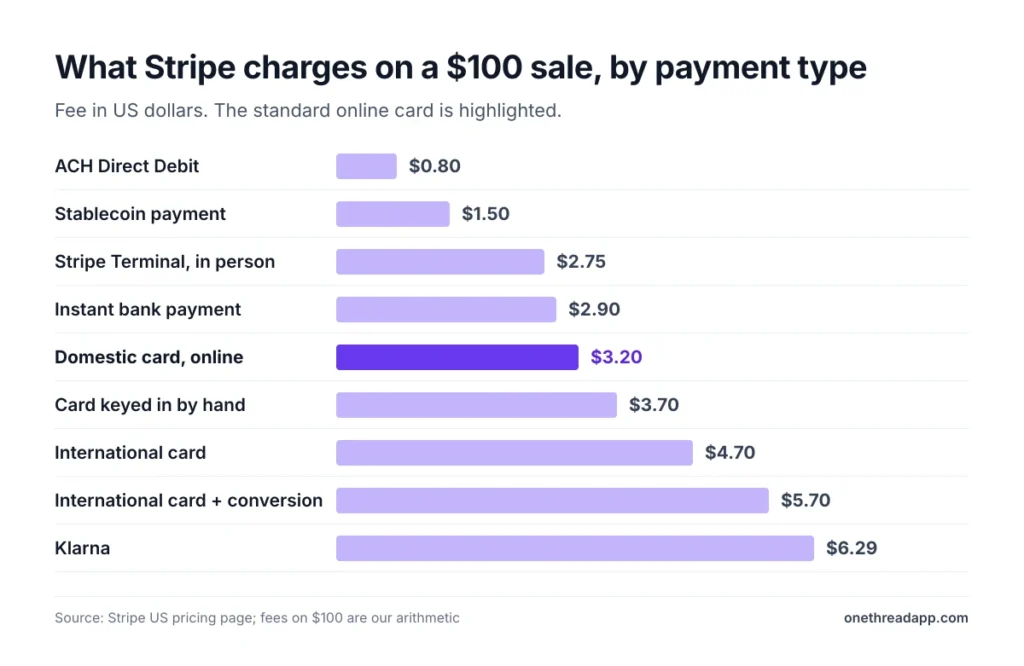
Stripe charges 2.9% + 30 cents for each successful domestic card payment in the US. Its pricing page lists no setup fee, no monthly fee and no hidden fees for standard pricing. Everything below is per payment, and the method your customer picks sets the rate.
| Payment type | Stripe fee | Fee on a $100 sale |
|---|---|---|
| Domestic card, online | 2.9% + 30 cents | $3.20 |
| Card keyed in by hand | 3.4% + 30 cents | $3.70 |
| International card | 4.4% + 30 cents | $4.70 |
| International card with currency conversion | 5.4% + 30 cents | $5.70 |
| ACH Direct Debit | 0.8%, capped at $5.00 | $0.80 |
| Instant bank payment | 2.6% + 30 cents | $2.90 |
| Klarna | 5.99% + 30 cents | $6.29 |
| Stripe Terminal, in person | 2.7% + 5 cents | $2.75 |
| Stablecoin payment | 1.5% | $1.50 |
Stripe lists the base rate and the add-ons (0.5% for keyed cards, 1.5% for international cards, 1% for currency conversion). The 3.4%, 4.4% and 5.4% rows are our arithmetic from those lines.
Sources: Stripe pricing page, checked line by line.
What Does Stripe Keep From a $10, $100 or $1,000 Sale?
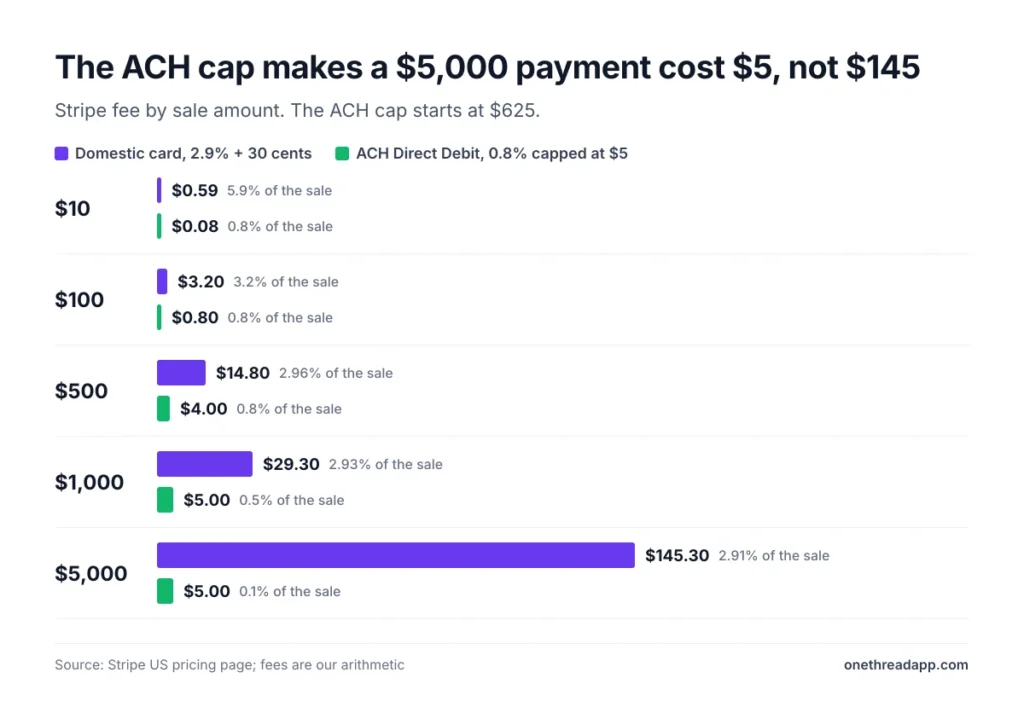
Stripe keeps $0.59 of a $10 card sale, $3.20 of a $100 sale and $29.30 of a $1,000 sale. The 30-cent fixed fee drives the gap: it's 3% of a $10 sale and 0.03% of a $1,000 one.
| Sale amount | Fee by domestic card | Effective rate | Fee by ACH Direct Debit |
|---|---|---|---|
| $10 | $0.59 | 5.9% | $0.08 |
| $100 | $3.20 | 3.2% | $0.80 |
| $500 | $14.80 | 2.96% | $4.00 |
| $1,000 | $29.30 | 2.93% | $5.00 |
| $5,000 | $145.30 | 2.91% | $5.00 |
Example: A $5,000 retainer paid by card costs 2.9% × $5,000 + $0.30 = $145.30. Paid by ACH Direct Debit, 0.8% would be $40, so the $5.00 cap applies. The rail your client picks saves you $140.30.
The ACH cap starts to bite at $625, because $5 ÷ 0.008 = $625. Above that, the fee stops growing.
Top Tip: Offer ACH first on any invoice above $625. Card fees keep climbing with the amount, while the ACH fee stays at $5.
What Does the Stripe Standard Plan Include?
Stripe's standard pricing is a pay-as-you-go plan. You open an account, pay the per-payment rates above, and pay for add-ons only when you switch them on.
Standard pricing covers the everyday tools, and Stripe lists the fee per successful payment. Wallets follow the card rate, and so does Link, Stripe's accelerated checkout.
Payment Links and Checkout cover the selling side. They accept payments at no extra charge, and Stripe Connect with Stripe-handled pricing is included. So is 3D Secure, the extra card authentication step. Accounts on custom pricing pay $0.03 per 3D Secure attempt, so standard pricing holds an edge here.
Say a designer sells a $250 template pack to a US customer. The fee is 2.9% × $250 + $0.30 = $7.55, and she keeps $242.45.
Pricing: 2.9% + 30 cents per domestic card payment, no monthly fee.
Best For
- Startups, freelancers and small shops with mostly US card sales and no time to negotiate rates.
Pros
- No setup fee and no monthly fee.
- Payment Links, Checkout and 3D Secure included.
- One published rate covers cards and wallets.
Cons
- The 30-cent fixed fee makes small sales costly, at 5.9% on $10.
- International cards and currency conversion stack on top of the base rate.
- Each dispute costs $15 on arrival.
Which Extra Fees Raise a Stripe Bill?
Three charges push a Stripe bill past the headline rate: international cards with currency conversion, disputes, and pricing that changes by country. Each one hits some businesses hard, and others never see it. Count all three before you forecast margins.
International Cards and Currency Conversion Stack Up
International cards add 1.5%, and currency conversion adds another 1% when a payment needs converting. A foreign card that needs conversion costs 5.4% + 30 cents. The two charges sit on separate lines. A foreign card paying in US dollars owes the 1.5% only, while a payment in another currency that Stripe converts owes both.
Example: A $100 sale on a foreign card with conversion costs 5.4% × $100 + $0.30 = $5.70. The same sale on a US card costs $3.20, so the foreign card adds $2.50.
Disputes Cost $15 Before You Argue
Stripe charges $15 for each dispute received. Stripe's docs say that "we never return the dispute received fee" unless your contract says otherwise. Countering costs another $15, refunded only if you win.
Example: A $40 order is disputed and you lose after countering. Stripe debits $40 + $15 + $15 = $70.
Customers can usually dispute within 120 days, and the full process can take 2 to 3 months. Stripe also lists Smart Disputes at 30% of the amount you win, with no fee on lost cases.
Stripe Pricing Changes by Country
The numbers in this guide are US prices. Stripe's Australia page lists 1.65% + A$0.30 for domestic cards, and its UK page lists 1.5% + 20p. Canada shows 2.9% + CA$0.30 with a 0.8% international surcharge. Each page lists conversion at 2%, not 1%.
Stripe's search sitelinks also show New Zealand at 2.65% + 30 New Zealand cents and Mexico at 3.6% + 3 pesos.
If you sell from outside the US, open your own country's page before you trust any guide. A guide that quotes 2.9% + 30 cents to a UK reader quotes the wrong price list.
Which Stripe Products Charge a Monthly Fee?
Standard payments charge no monthly fee, but several add-on products do. Stripe lists each one separately, and a few switch from a percentage to a flat fee as you grow.
| Product | What Stripe lists | Fee type |
|---|---|---|
| Stripe Billing | 0.7% of Billing volume, or from $620 a month on a 1-year contract | Percentage or monthly |
| Stripe Invoicing | 0.4% per paid invoice on Starter | Percentage |
| Stripe Tax | Tax Basic 0.5% per transaction, or Tax Complete from $90 a month | Percentage or monthly |
| Stripe Radar | From $10 a month, or from $0.05 per screened transaction | Monthly or per screen |
| Stripe Sigma | $15 a month, or from $10 a month on an annual contract | Monthly |
| Stripe Identity | $1.50 per ID document and selfie check | Per check |
| Stripe Atlas | $500 one-time | One-time |
| Managed Payments | 3.5% on top of payment fees | Percentage |
| Stripe Terminal readers | $59 for M2, $299 for S700 or S710 | Hardware |
Stripe Connect with Stripe-handled pricing costs nothing extra on standard pricing. Platforms that set their own pricing pay from 0.25%.
One Reddit thread in Google's results for this keyword carries the title "stripe charged us $80k in radar fees!!!". We couldn't open the thread, so we can't say what caused it. The lesson holds anyway: check which Stripe Radar plan your account uses before volume grows.
Top Tip: Open your Stripe dashboard and list every product switched on. An add-on you forgot costs the same as one you use.
Sources: Stripe pricing page.
What Does Stripe Billing Cost for Subscriptions?
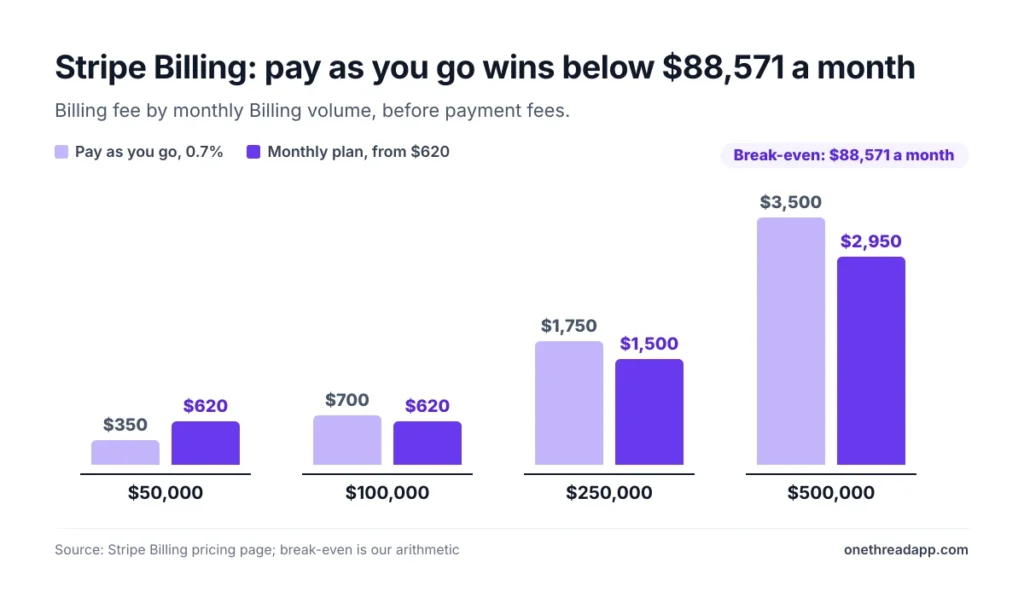
Stripe Billing costs 0.7% of your Billing volume on pay as you go, or from $620 a month on a 1-year contract. Payment fees come on top: 2.9% + 30 cents per card charge, or 0.8% for ACH, capped at $5.
On Stripe's Billing page, the monthly plans bundle volume. The $620 plan covers up to $100,000 of Billing volume a month. The next tiers, at $1,500, $2,950 and $5,750, cover $250,000, $500,000 and $1,000,000. Each adds 0.67% on volume above its limit.
Example: The $620 plan matches pay as you go at $620 ÷ 0.007 = $88,571 of monthly Billing volume. Below that, pay as you go costs less. At $100,000, pay as you go costs $700, so the plan saves $80.
| Monthly Billing volume | Pay as you go (0.7%) | Pay monthly plan | You save with the plan |
|---|---|---|---|
| $50,000 | $350 | $620 | Plan costs $270 more |
| $100,000 | $700 | $620 | $80 |
| $250,000 | $1,750 | $1,500 | $250 |
| $500,000 | $3,500 | $2,950 | $550 |
Billing includes Smart Retries, a customer portal, quotes and invoice auto-reconciliation. Usage-based billing runs through Metronome, a separate product.
Say a small SaaS bills $10,000 a month across 300 card payments. Payments cost 2.9% × $10,000 + 300 × $0.30 = $380. Billing adds 0.7% × $10,000 = $70. The total is $450, or 4.5% of revenue, by our arithmetic.
Pricing: 0.7% of Billing volume, or from $620 a month on a 1-year contract.
Best For
- Subscription businesses that need retries, a customer portal and recurring invoices.
Pros
- Pay as you go carries no recurring fee.
- Monthly plans save 11% to 18% at their volume limits.
- Smart Retries and the customer portal are included.
Cons
- Billing fees come on top of 2.9% + 30 cents per card charge.
- Monthly plans need a 1-year contract.
- Usage-based billing sits outside the base price.
What Does Stripe Custom Pricing Include?
Stripe custom pricing is a negotiated fee schedule for high-volume businesses or unusual models. Stripe lists interchange-plus pricing, volume discounts, multi-product discounts, country-specific rates and discounted flat rates among the options.
Interchange-plus means you pay the card network's cost plus a fixed Stripe margin, instead of one blended rate. Stripe's pricing policy says agreed fees live in a Pricing Agreement and override the matching public fees. When the agreement ends, the public fees apply again.
Custom pricing changes more than the rate. Refund fees follow your fee schedule, and 3D Secure costs $0.03 per attempt, where standard pricing includes it.
Example: A 0.1-point cut in your rate saves 0.001 × $500,000 = $500 a month at $500,000 in monthly card volume. That's the scale where a sales call pays for itself.
Stripe's pricing page lists no minimum volume for custom pricing, so we can't tell you a threshold. Ask when your volume or your product mix stops fitting the public table.
Pricing: Quoted per account. Stripe publishes no rate.
Best For
- Businesses with high card volume or several Stripe products to bundle.
Pros
- Volume discounts and bundled pricing are available.
- Rates can vary by country.
- Fees in your Pricing Agreement stay fixed unless you agree to a change.
Cons
- No public rate or minimum volume.
- Features that standard pricing includes can cost extra.
- Public fees apply again when the agreement ends.
What Does Stripe Cost When You Invoice Clients?
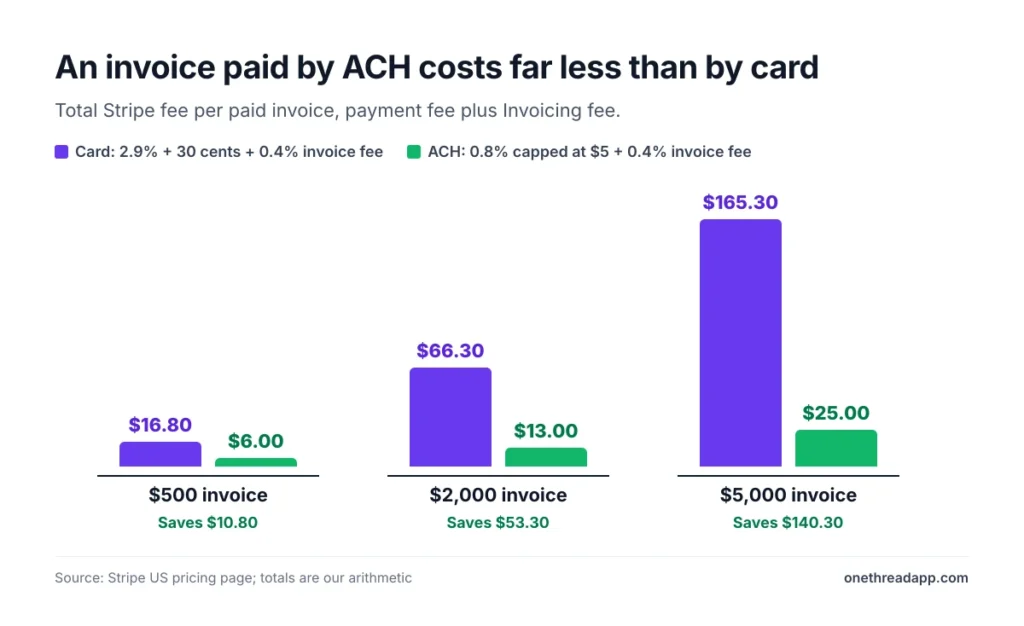
A $2,000 invoice paid by card costs $66.30 on Stripe Invoicing, against $13.00 when the client pays by ACH Direct Debit. Stripe lists Invoicing at 0.4% per paid invoice on Starter, and the payment fee comes on top.
| Invoice amount | Card: 2.9% + 30 cents + 0.4% | ACH: 0.8% capped at $5 + 0.4% |
|---|---|---|
| $500 | $16.80 | $6.00 |
| $2,000 | $66.30 | $13.00 |
| $5,000 | $165.30 | $25.00 |
We add the invoice fee and the payment fee because Stripe lists them on separate lines. Stripe also lists post-payment invoices on Payment Links at 0.4%, capped at $2.00 per invoice.
For agencies and freelancers, those numbers decide how you ask to be paid. A retainer is a big invoice, so the ACH cap matters most there. Plan the work in a project tool such as Onethread, then send the bill through Stripe.
To compare billing apps, read our guide to online invoicing tools. If you only need a PDF invoice, our free invoice generator covers it. If you bill from project data, see the best project management software with invoicing.
Which Costs Less, Stripe, PayPal or Square?
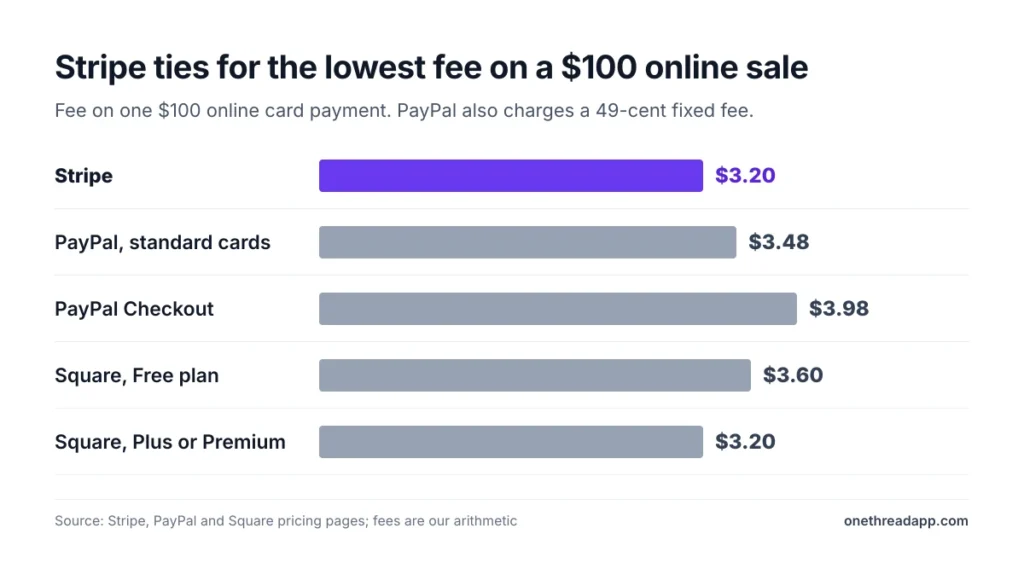
Stripe costs less than PayPal on every online card sale we priced, and it ties with Square's paid plans. On a $100 sale, Stripe charges $3.20, PayPal's standard card rate charges $3.48 and Square's Free plan charges $3.60.
| Processor | Online card rate | Fee on $10 | Fee on $100 | Dispute fee |
|---|---|---|---|---|
| Stripe | 2.9% + 30 cents | $0.59 | $3.20 | $15 |
| PayPal, standard cards | 2.99% + 49 cents | $0.79 | $3.48 | $15 to $20 |
| PayPal Checkout | 3.49% + 49 cents | $0.84 | $3.98 | $15 to $20 |
| Square, Free plan | 3.3% + 30 cents | $0.63 | $3.60 | Not listed |
| Square, Plus or Premium | 2.9% + 30 cents | $0.59 | $3.20 | Not listed |
PayPal's fixed fee is 49 cents, 19 cents above Stripe's, which hurts most on small sales. Square's 2.9% online rate sits on its Plus and Premium columns, and its page lists no chargeback fee.
Sources: Stripe, PayPal and Square pricing pages, read directly. Check each vendor's page before you decide, because rates change. Our fee columns are arithmetic from those rates.
Payments are one line in a bigger stack. If you're mapping the whole stack, our guide to business management software shows where billing fits.
How Can You Lower Your Stripe Fees?
You lower Stripe fees by changing how customers pay, not by hunting for a coupon. Five checks cover most of the savings Stripe's own pricing allows.
- Steer big invoices to ACH: Above $625, ACH Direct Debit costs a flat $5.
- Avoid keyed-in cards: Entering a card by hand adds 0.5%, so use a payment link or Checkout.
- Answer inquiries fast: Stripe's docs say you can resolve an inquiry without a dispute fee by sending evidence or issuing a full refund.
- Pick the cheaper Billing option: Pay as you go wins below $88,571 a month, and the monthly plan wins above it.
- Switch off unused add-ons: Radar, Sigma and Tax each bill on their own line, so turn off any you never open.
Example: A $2,000 invoice costs $58.30 by card and $5.00 by ACH, before the invoice fee. Moving ten of them a month saves 10 × $53.30 = $533.
Then ask Stripe about custom pricing once volume or product mix grows. Stripe's pricing page points high-volume businesses there. None of these checks needs a contract or a sales call. They need an hour with last month's export.
Top Tip: Export last month's payments and sort by amount. Every card payment above $625 is a candidate for ACH.
Which Stripe Pricing Path Is Worth It for You?
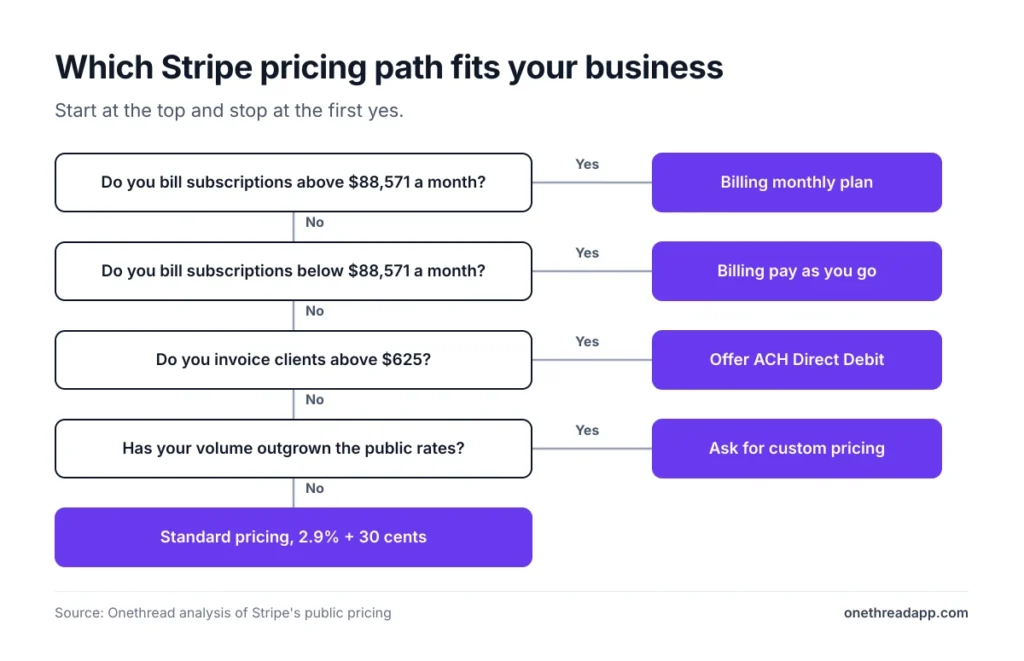
Pick standard pricing if you sell mostly US card payments, and move up only when a specific cost shows up in your export. Most small businesses never need more than the public rates.
| If this sounds like you | Pick |
|---|---|
| You sell mostly US card payments | Standard pricing |
| You bill subscriptions under $88,571 a month | Billing pay as you go |
| You bill subscriptions above $88,571 a month | Billing monthly plan |
| You invoice clients above $625 | ACH Direct Debit |
| You need a merchant of record for global sales | Managed Payments, at 3.5% extra |
| Your volume or product mix outgrew the public table | Custom pricing |
Stripe fits less well if most of your sales come from foreign cards, because 5.4% adds up fast. It also fits less well if you sell tiny items, since 30 cents hurts there. Run your own order sizes through the tables above before you commit.
Here's the problem with guessing: the cheapest rail depends on your sale size, not on the brand. So test with last month's data.
What Should You Do Next With Stripe Pricing?
Stripe pricing comes down to three numbers: your average sale, your share of international cards, and your monthly volume. The 2.9% + 30 cents headline covers small US card sales well. Large invoices, foreign cards and subscriptions each have a cheaper or costlier path.
This week, export last month's Stripe payments and sort by amount. Mark every card payment above $625 and every foreign card. Add up the fees on those two groups and you'll know whether ACH, a currency change or a pricing call is worth the effort. Then reprice one invoice type and compare next month's bill.
FAQs
Why Is Stripe So Expensive?
Stripe isn't the cheapest option on every sale. Its fixed 30 cents makes a $10 sale cost 5.9%, and extras stack: international cards add 1.5%, currency conversion 1%, and each dispute $15. Stripe pricing also bills add-ons such as Billing separately. For most US card sales, though, its 2.9% matches Square's paid plans and undercuts PayPal.
Does Stripe Have Lower Fees for Nonprofits?
Yes, Stripe offers a nonprofit discount on processing fees to eligible organizations. You need registered nonprofit status with tax documentation, an eligible country, and at least 80% of your payment volume from tax-deductible donations. Tickets, memberships, tuition, registration fees and auction payments don't count toward that 80%. Stripe's support page lists no discounted rate, so ask for yours.
How Long Does Stripe Take to Pay Out?
Stripe typically schedules your first payout 7 to 14 days after your first live payment, according to its payout docs. After that, US accounts show an initial settlement timing of 2 business days, and manual payouts take 1 to 4 business days.
Instant Payouts reach a debit card within about 30 minutes for a fee, but new users aren't immediately eligible.
Does Stripe Refund Its Fees When You Refund a Customer?
No, not on standard pricing. Stripe's pricing page says the payment processing, Connect and currency conversion fees from the original transaction aren't returned. So refunding a $100 card sale still costs you the $3.20 fee. Custom pricing follows your own fee schedule, so Stripe pricing stays a cost you carry when a sale reverses.