Shopify is quick to start and costly to keep.
The best Shopify alternatives are WooCommerce for control, BigCommerce for big catalogs and Wix or Squarespace for design. Square Online suits shops with a till, and Ecwid suits existing sites. Entry plans cost $0 to $29 a month.
Card fees, paid apps and plan limits push owners out, and a new platform can charge the same.
We checked seven pricing pages and six top-ranking guides, then priced one $5,000-a-month store on each.
You'll see what each costs, what you give up and how to move your products.
Key Points
- The best Shopify alternatives are WooCommerce, BigCommerce, Wix, Squarespace, Square Online and Ecwid. Entry plans run from $0 (Square Free) to $29 a month on yearly billing, against $29 for Shopify Basic.
- A $5,000-a-month store pays about $180 to $294 a month in plan and card fees across these platforms, against $204 on Shopify Basic. Card fees make up most of that bill.
- Read the plan traps. BigCommerce Core covers $30,000 a year in sales before it moves you up, and Squarespace Basic adds a 2% fee on every store sale.
- Export before you cancel. Shopify's product CSV leaves out image files.
Which Shopify Alternative Fits Which Store?
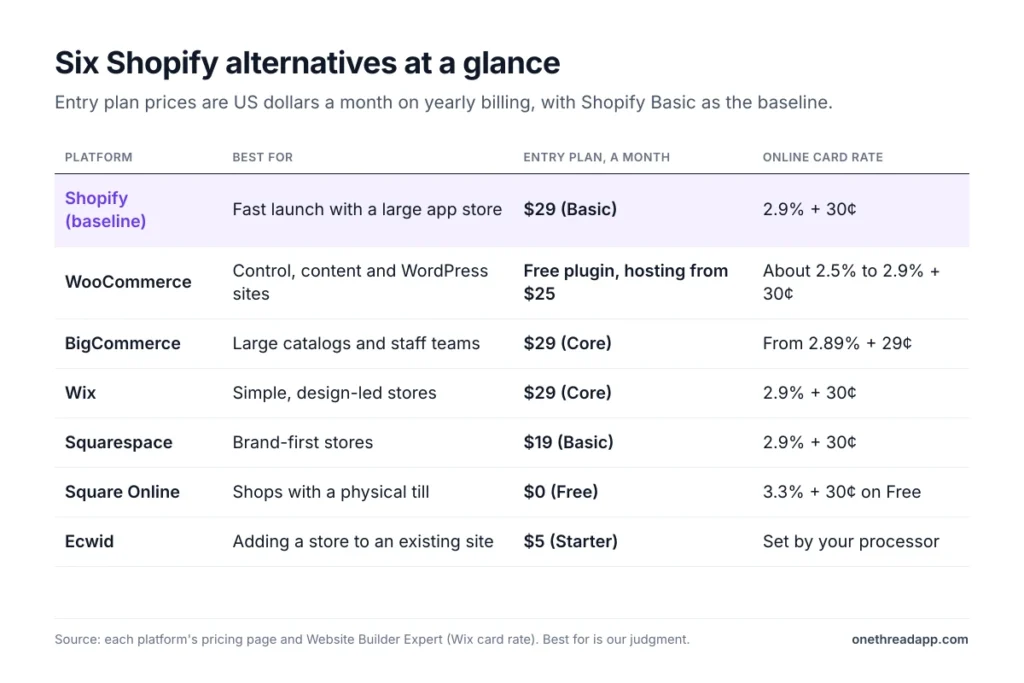
Each platform wins one job, and none beats Shopify at all of them. Shopify sits first in the table as the baseline.
| Platform | Best for | Entry plan, a month (yearly billing) | Online card rate |
|---|---|---|---|
| Shopify | Fast launch with a large app store | $29 (Basic) | 2.9% + 30¢ |
| WooCommerce | Control, content and WordPress sites | Free plugin, hosting from $25 | About 2.5% to 2.9% + 30¢ |
| BigCommerce | Large catalogs and staff teams | $29 (Core) | From 2.89% + 29¢ |
| Wix | Simple, design-led stores | $29 (Core) | 2.9% + 30¢ |
| Squarespace | Brand-first stores | $19 (Basic) | 2.9% + 30¢ |
| Square Online | Shops with a physical till | $0 (Free) | 3.3% + 30¢ on Free |
| Ecwid | Adding a store to an existing site | $5 (Starter) | Set by your processor |
Sources: each platform's pricing page (US dollars) and Website Builder Expert for Wix's card rate. Best for is our judgment.
Why Do Store Owners Look for Shopify Alternatives?
Store owners consider leaving Shopify for three reasons: fees that grow with sales, extras that outcost the plan, and templates that only bend so far. They're the price of an ecommerce platform that runs everything for you.
Fees come first. Shopify charges 2.9% + 30¢ on Basic card sales, and adds 2% when you use a third-party gateway instead of Shopify Payments. Google's People Also Ask box even asks, "What is the biggest problem with Shopify?"
Extras come second. Salesforce's guide says templates and basic features can run around $500, and deeper changes often need custom code or paid apps.
Limits come third. Standard plans can push a growing store toward Shopify Plus, which starts at $2,300 a month. And the trial is short: 3 days free, then $1 a month for 3 months, so the real price arrives in month four.
We picked the six platforms with four checks:
- Entry price: What the first full store plan costs a month on yearly billing.
- Card and sales fees: What each sale pays on top of the plan.
- Plan traps: Caps, fees or missing tools that change the bill.
- Fit: The store type each platform serves best, from a solo shop to a growing catalog.
Why Choose WooCommerce for Full Control?
WooCommerce is a free plugin that turns a WordPress site into an online store. You own the code, the data and the checkout, and WooCommerce takes no revenue share.
The catch is that you run the store like a small website. You pick the host, update plugins and fix conflicts. One r/ecommerce commenter, quoted by DEV Community, described the move from Woo to Shopify as going from building my own car to leasing a Tesla.
Say a food blogger already runs WordPress. Adding WooCommerce keeps the recipes and the checkout in one place.
Hosting is the real bill, and extensions add to it.
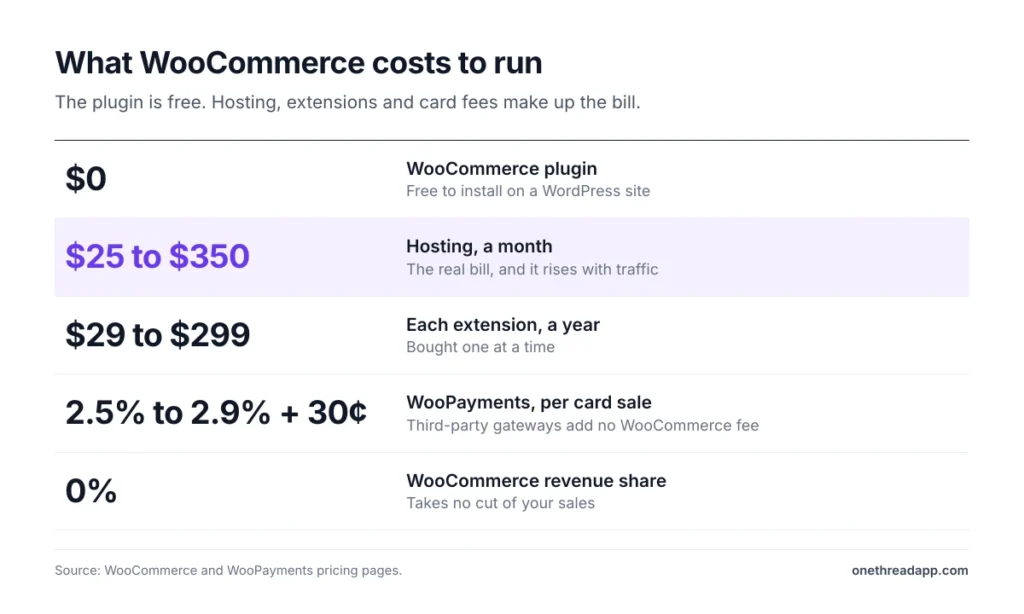
Pricing: The plugin is free. Hosting runs $25 to $350 a month. WooPayments charges about 2.50% to 2.90% + 30¢ per card sale. WooCommerce adds no revenue share and no fee for third-party gateways.
Best For
- Stores that sit on a WordPress site and want full control of code and data.
Pros
- No revenue share and no extra fee for outside payment gateways.
- Extensions are bought one at a time, so you pay only for what you use.
- Content and store share one WordPress site.
Cons
- You manage hosting, updates and security yourself.
- Extensions cost $29 to $299 each per year.
- Hosting costs rise with traffic.
Why Choose BigCommerce for a Growing Catalog?
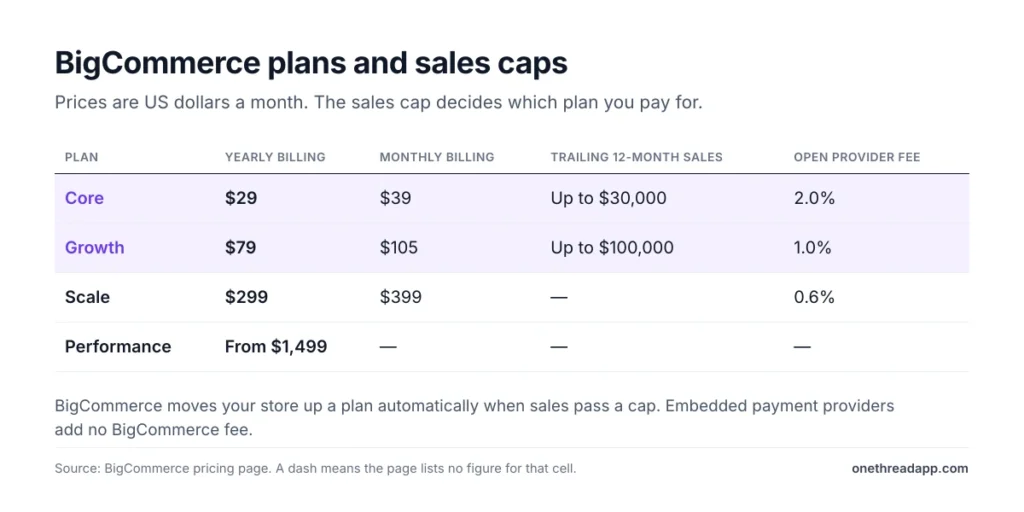
BigCommerce is the closest like-for-like swap. Its yearly prices match Shopify's: Core costs $29 a month, Growth $79 and Scale $299, or $39, $105 and $399 billed monthly. Performance starts at $1,499 a month on yearly billing.
But BigCommerce prices by sales. Core covers up to $30,000 in trailing 12-month sales, and Growth covers up to $100,000. You move up a plan automatically at each cap.
Payment processing splits two ways. Embedded providers carry no BigCommerce fee. Open providers add 2.0% on Core, 1.0% on Growth and 0.6% on Scale, matching Shopify's outside-gateway rates. Card processing begins at 2.89% + 29¢.
Pricing: Core $29 a month yearly or $39 monthly, Growth $79 or $105, Scale $299 or $399. Performance starts at $1,499 a month billed yearly. A 15-day free trial needs no credit card.
Best For
- Growing stores that expect more than $30,000 in yearly sales and want staff accounts on every plan.
Pros
- Staff accounts come with all four plans.
- Embedded payment providers add no BigCommerce fee.
- The 15-day free trial needs no credit card.
Cons
- Core's $30,000 cap moves you to a pricier plan as sales grow.
- Open payment providers add a 2.0% to 0.6% fee.
- Scale charges 0.9% on sales above $33,333 a month.
Why Choose Wix for a Simple, Design-Led Store?
Wix started as a website builder and added commerce on top. Core, at about $29 a month on yearly billing, is the first plan with Basic eCommerce. Business, at $39, adds Standard eCommerce, and Business Elite, at $159, adds Advanced eCommerce.
Wix Payments in the US charges 2.9% + 30¢ per card sale on Business and Business Elite. Website Builder Expert's review lists no separate Wix sales fee. Collaborators climb from 5 on Core to 10 on Business and 100 on Elite.
Say a ceramics studio wants a good-looking site and 40 products. Core covers that without a developer.
Prices vary by country, and Wix's own page shows tax-inclusive amounts, so check yours before you buy. A 14-day money-back guarantee covers the first upgrade.
Pricing: Core about $29, Business about $39 and Business Elite about $159 a month billed yearly. Monthly billing costs $46 on Business and $172 on Business Elite.
Best For
- Small stores where site design matters as much as checkout.
Pros
- A 14-day money-back guarantee covers the first upgrade.
- Collaborator seats rise from 5 to 100 across the store plans.
- Yearly plans include a one-year domain voucher.
Cons
- The Light plan has no store tools.
- Yearly subscriptions are paid in full at purchase.
- Prices differ by country.
Why Choose Squarespace for a Brand-First Store?
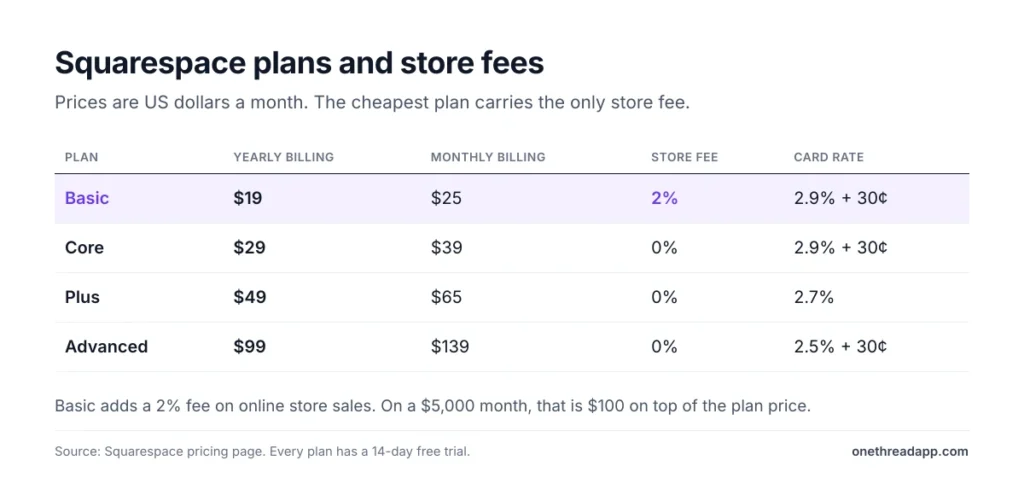
Squarespace sells design first. Basic costs $19, Core $29, Plus $49 and Advanced $99 a month on yearly billing, or $25, $39, $65 and $139 monthly. A design-led store still needs proof, so read our guide to high-trust websites.
The trap sits in the cheapest plan. Basic charges a 2% fee on online store sales, while Core, Plus and Advanced charge 0%. That's $100 on a $5,000 month.
Core is where the selling tools start: discounts, Google Shopping, shipping labels, carrier-calculated shipping and automated tax. Say a photographer sells prints and gift cards. Basic covers that, with unlimited products and cart recovery, if she accepts the 2% fee.
Pricing: Basic $19, Core $29, Plus $49, Advanced $99 a month billed yearly. Card rates are 2.9% + 30¢ on Basic and Core, 2.7% on Plus and 2.5% on Advanced. Every plan has a 14-day free trial.
Best For
- Creators and brands that put design first and sell a modest catalog.
Pros
- Basic includes unlimited products, gift cards and abandoned cart recovery.
- The store fee drops to 0% from Core.
- Card rates fall to 2.5% + 30¢ on Advanced.
Cons
- Basic adds a 2% fee on every store sale.
- Discounts and carrier-calculated shipping start at Core.
- Basic charges 7% on digital content and memberships.
Why Choose Square Online for a Shop With a Till?
Square Online suits shops that already take cards in person. Square's plans cost $0 on Free, $49 on Plus and $149 on Premium per location, and Free includes a website and online ordering.
Free has no monthly fee, but online cards cost 3.3% + 30¢ per sale. Plus and Premium drop that to 2.9% + 30¢. Plus adds site customization and QR code ordering. Premium adds real-time shipping rates, advanced reporting and 24/7 phone support.
Say a bakery already runs a Square reader at the counter. Free adds online orders for $0 a month, the cheapest way to test demand. Square Pro, with custom pricing, covers businesses that process over $250,000 a year.
Pricing: Free $0, Plus $49, Premium $149 a month per location. Online cards cost 3.3% + 30¢ on Free and 2.9% + 30¢ on Plus and Premium.
Best For
- Shops that already sell in person and want online orders at no monthly fee.
Pros
- Free has no monthly fee or startup cost.
- Plus and Premium cut the online card rate to 2.9% + 30¢.
- Premium adds 24/7 phone support.
Cons
- Free charges 3.3% + 30¢ on online cards.
- Plus costs $49 a month per location, above Shopify Basic at $29.
- The plans page lists no product limits.
Why Choose Ecwid to Add a Store to an Existing Site?
Ecwid adds an online store to a site you already have. You embed a code snippet and sell from pages you built elsewhere.
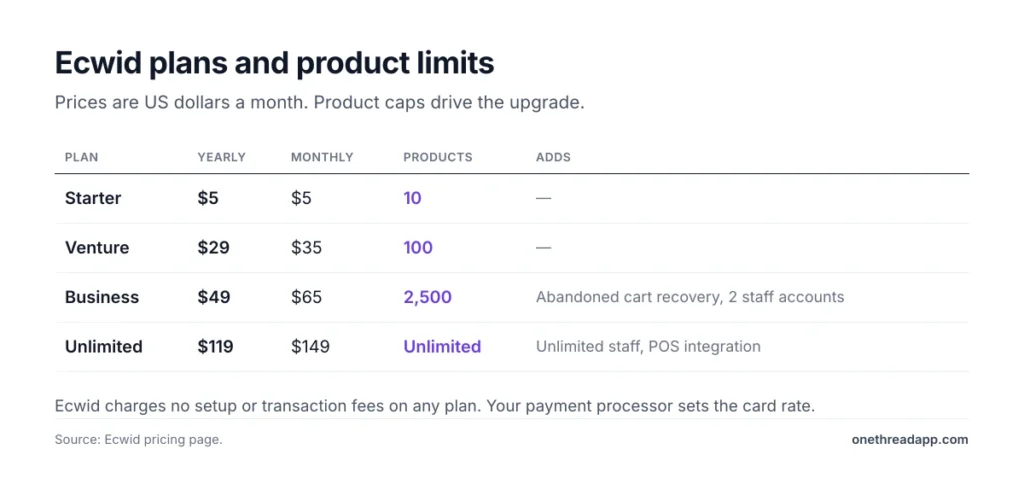
Ecwid's pricing page lists several currencies. Starter costs $5, Venture $29, Business $49 and Unlimited $119 a month on yearly billing, or $5, $35, $65 and $149 monthly. Ecwid charges no setup or transaction fees on any plan.
Product caps drive the upgrade. Starter lists 10 products, Venture 100 and Business 2,500. Business adds abandoned cart recovery and 2 staff accounts, and Unlimited adds unlimited staff and POS integration.
Say a gym already runs a site it likes and wants to sell 12 items of merch. Venture's 100-product cap fits with room to spare.
Pricing: Starter $5, Venture $29, Business $49, Unlimited $119 a month billed yearly. Ecwid sets no card rate, so your processor's rate applies.
Best For
- Owners who like the site they have and need a store on it.
Pros
- No setup or transaction fees on any plan.
- Entry costs $5 a month.
- Catalogs scale from 10 products to unlimited.
Cons
- Starter caps at 10 products.
- Abandoned cart recovery starts at Business.
- Business includes only 2 staff accounts.
- The pricing page lists no card rates, only the plan fee.
What Does a $5,000-a-Month Store Pay on Each Shopify Alternative?
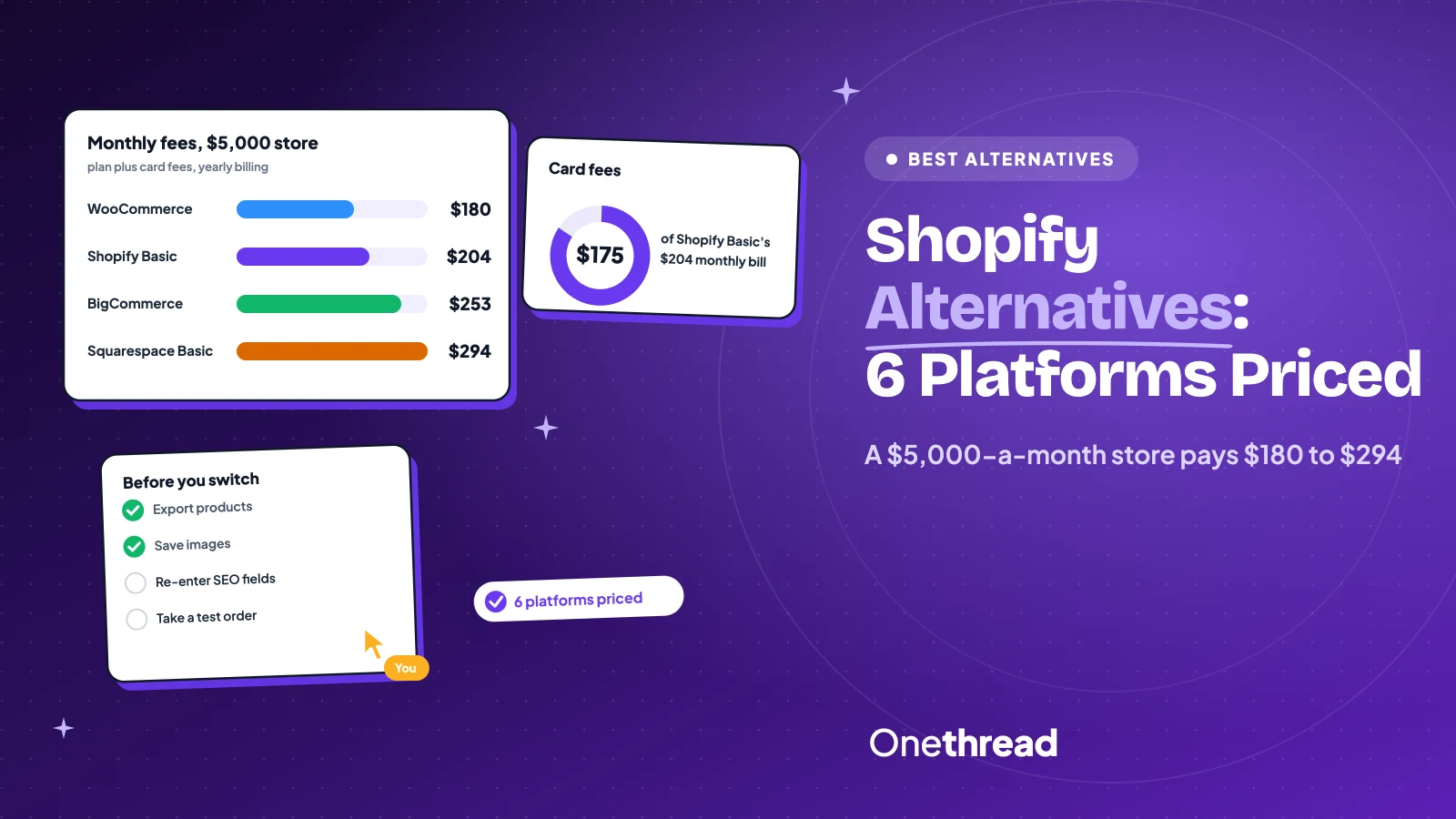
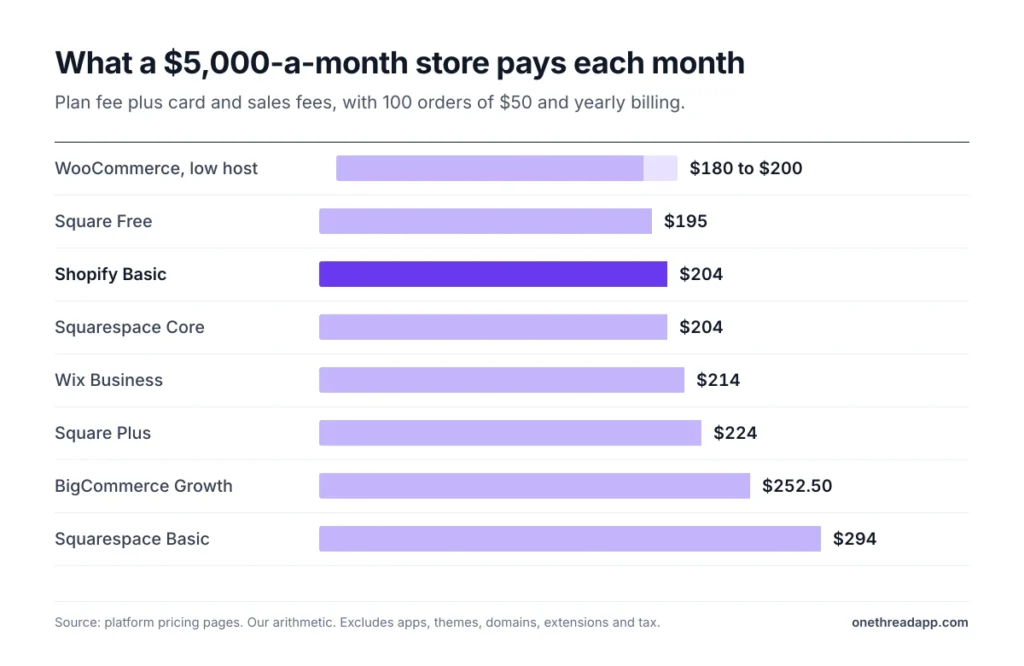
A $5,000-a-month store pays about $180 to $294 a month in plan and card fees on these platforms, against $204 on Shopify Basic. Card fees make up most of it, and they barely differ. Our Shopify pricing breakdown covers each Shopify plan and its card rates.
Example: We assumed 100 orders of $50. At 2.9% + 30¢, cards cost 2.9% × $5,000 + 100 × $0.30 = $145 + $30 = $175. Then we added each platform's plan fee.
| Platform and plan | Plan fee | Card and sales fees | Monthly total |
|---|---|---|---|
| WooCommerce, low-end hosting | $25 | $155 to $175 | $180 to $200 |
| Square Free | $0 | $195 | $195 |
| Shopify Basic | $29 | $175 | $204 |
| Squarespace Core | $29 | $175 | $204 |
| Wix Business | $39 | $175 | $214 |
| Square Plus | $49 | $175 | $224 |
| BigCommerce Growth | $79 | $173.50 | $252.50 |
| Squarespace Basic | $19 | $275 | $294 |
Sources: the platforms' pricing pages, yearly billing. Totals are our arithmetic and exclude apps, themes, domains, extensions and tax. Ecwid and Big Cartel have no published card rate, so we left them out.
BigCommerce lands higher because $60,000 a year in sales passes Core's $30,000 cap and moves the store to Growth. Squarespace Basic lands highest because its 2% store fee adds $100.
Outside gateways change the math. Shopify Basic adds 2%, or $100. BigCommerce Growth adds 1%, or $50, and Squarespace Basic adds 2%.
Premium cards cost more than the 2.9% we used: Shopify lists 3.5% + 30¢ and Squarespace 3.2% + 30¢. Run your own margin through our profit margin calculator.
Which Shopify Alternative Should You Pick?
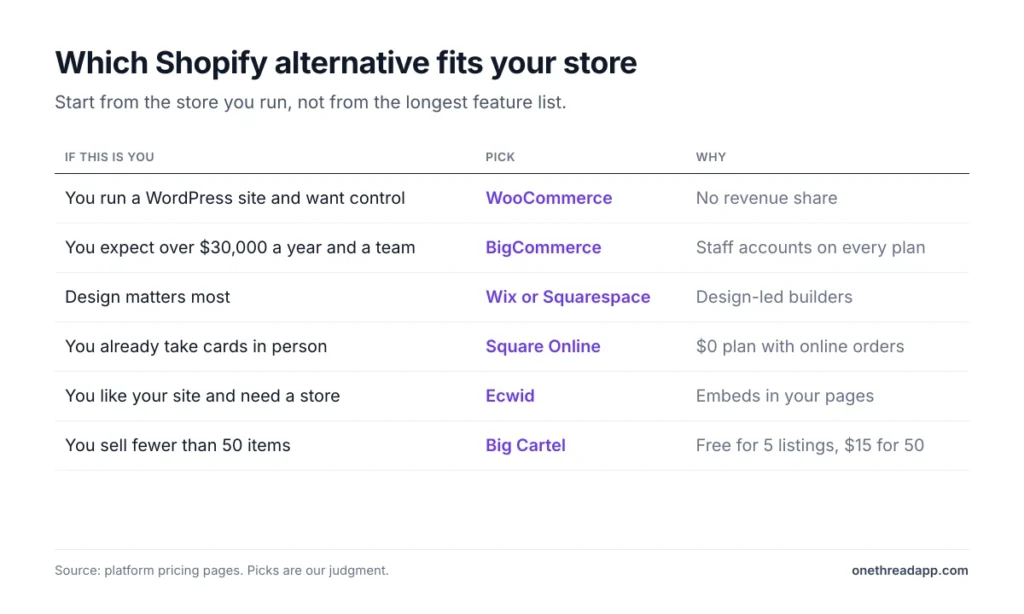
Pick by the store you run, not by the longest feature list.
| If this is you | Pick | Why |
|---|---|---|
| You run a WordPress site and want control | WooCommerce | No revenue share |
| You expect over $30,000 a year and a team | BigCommerce | Staff accounts on every plan |
| Design matters most | Wix or Squarespace | Design-led builders |
| You already take cards in person | Square Online | $0 plan with online orders |
| You like your site and need a store | Ecwid | Embeds in your pages |
| You sell fewer than 50 items | Big Cartel | Free for 5 listings, $15 for 50 |
Three more fit narrower jobs. Big Cartel charges no transaction fees. Platinum costs $15 a month, or $144 a year, for 50 products, with print on demand apps for custom goods.
Adobe Commerce prices by quote for enterprise sales. Gumroad takes a commission on digital sales, not a monthly fee.
If the store is one part of a wider back office, our guide to business management software covers the rest.
Ask each vendor three things first:
- Card mix: Which rate applies to my cards, including premium and international?
- Caps: What happens to my plan when sales pass a limit?
- Exit: What can I export, and in what format?
How Do You Move a Store Off Shopify?
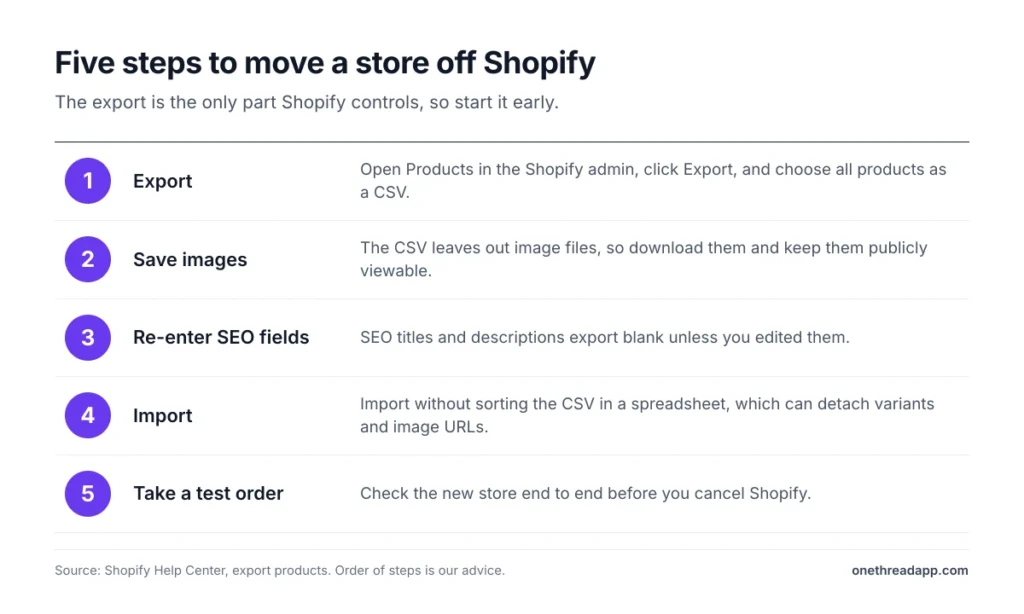
Moving takes five steps, and the export is the only part Shopify controls. Start it early.
- Open Products in the Shopify admin, click Export, and choose all products as a CSV file.
- Save your images separately. The CSV leaves out image files, and images regenerate on import only if they stay publicly viewable.
- Re-enter SEO titles and descriptions you care about. They export blank unless you edited them.
- Import into the new platform without sorting the CSV in a spreadsheet first, because sorting can detach variants and image URLs.
- Take a test order on the new store and check it end to end before you cancel Shopify.
Exports with thousands of variants can time out. Filter the product list and export in smaller batches, per Shopify's help page.
A DEV Community roundup of Reddit threads adds variant limits, URL changes that need redirects and customer passwords that don't transfer. It's one author's summary, so confirm each with your new platform. Need a developer to rebuild custom apps? Our guide to Shopify experts explains what to ask.
Top Tip: Export a test batch of 20 products first and import it. A small batch shows broken variants before you move the whole catalog.
What Should You Do Next With Shopify?
Leaving Shopify rarely cuts card fees, since most platforms charge close to 2.9% + 30¢. The savings sit in plan traps, gateway fees and apps you can drop. So price your own store, not the "starts at" number, before you pick the right alternative.
This week, pull last month's sales and order count. Run the cost table's arithmetic for two platforms with your own sales, then start the free trial of the one that wins. Pricing pages show a starting point, and your own sales decide the rest of the bill.
FAQs
Is There a Better Option Than Shopify?
It depends on the store. WooCommerce gives more control, BigCommerce suits larger catalogs, and Squarespace or Wix suit design-led shops. On a $5,000-a-month store, most monthly totals differ by about $30, so pick the Shopify alternative that fits how you sell.
What Is the Biggest Problem With Shopify?
Cost that grows with sales is the problem owners raise most. Basic card rates start at 2.9% + 30¢ and outside gateways add 2%. Shopify's own rate falls to 2.5% + 30¢ on Advanced. Standard plans can also push a growing store toward Shopify Plus at $2,300 a month.
What Are Some Free Alternatives to Shopify?
Square's free plan costs $0 a month but charges 3.3% + 30¢ on online cards. Big Cartel's free plan lists 5 products. The WooCommerce plugin is free, but hosting costs $25 to $350 a month for most stores. No Shopify alternative is free once you count payments.
Which Shopify Alternative Is Best for Digital Products?
Big Cartel suits digital downloads, since its $15 Platinum plan lists digital products as a feature. Gumroad sells digital products and takes a commission per sale instead of a monthly fee. Check file limits before you move, because pricing pages rarely state them.
Which Shopify Alternative Is Best for Beginners?
Wix and Square Online are the easiest starts in our judgment, since both run from a website builder with no hosting to manage. Square's free plan costs $0 a month, and Wix Core adds Basic eCommerce at about $29. WooCommerce is the hardest Shopify alternative for beginners, because you manage hosting, updates and security yourself.