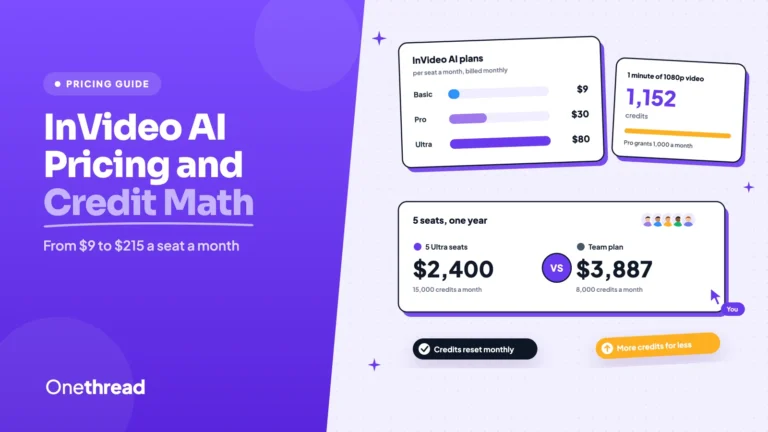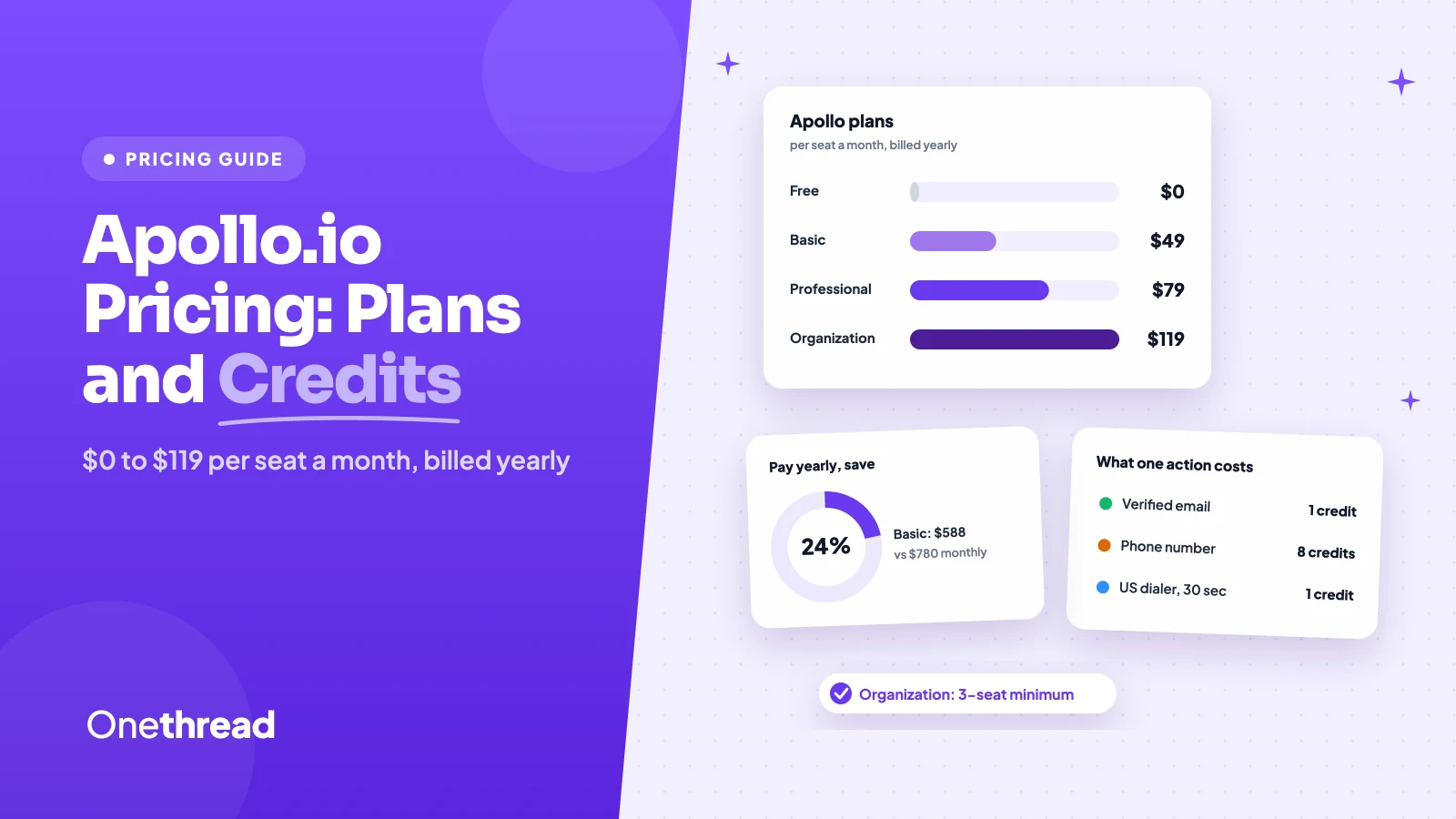
Apollo.io looks cheap at $49 a seat. Then you learn a phone number costs 8 credits.
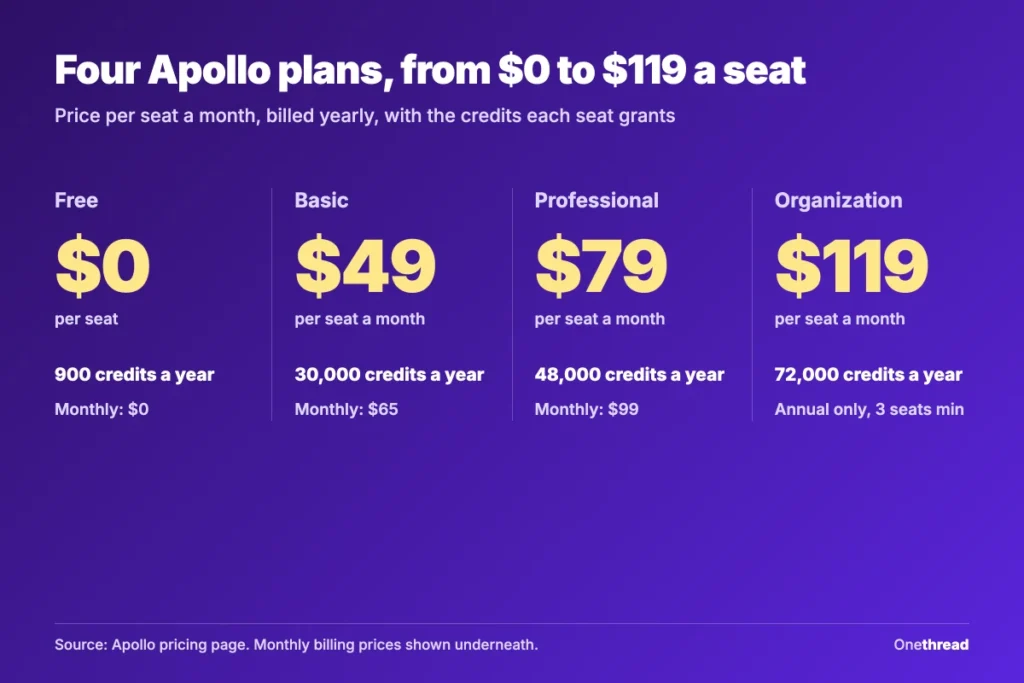
Apollo.io pricing runs from $0 on Free to $49 for Basic, $79 for Professional and $119 for Organization, per seat a month billed yearly. Monthly billing costs $65 or $99, and Organization needs at least 3 seats.
So the seat price is only part of your bill. Credits, add-ons and a 12-month lock decide the rest.
We read Apollo’s pricing page, its credit help docs and 8 top-ranking guides, then priced teams of 1, 5 and 10 seats.
Here’s what each plan includes, what a credit costs you, and which plan fits your team.
Key Points
- Apollo.io pricing is $0 on Free, $49 on Basic, $79 on Professional and $119 on Organization, per seat a month billed yearly. Monthly billing costs $65 or $99, and Organization is annual only with a 3-seat minimum.
- Count credits before seats. An email costs 1 credit and a phone number 8, so a Basic seat’s 30,000 yearly credits cover 3,750 phone numbers.
- Pay yearly only when you’re sure: it saves about 24%, but you can’t return to monthly mid-term.
- Pick Professional for full-time outbound reps, Basic for one-mailbox prospecting, and Free to test the data.
How Much Does Apollo.io Cost per Seat?
Apollo.io pricing plans run $0 to $119 per seat a month on annual billing, or $65 to $99 a month on monthly billing. Every paid seat also grants a yearly credit pool.
| Plan | Billed yearly (per seat a month) | Billed monthly (per seat a month) | Credits per seat | Record selection limit |
|---|---|---|---|---|
| Free | $0 | $0 | 900 a year, 75 a month | 25 |
| Basic | $49 | $65 | 30,000 a year | 1,000 |
| Professional | $79 | $99 | 48,000 a year | 2,500 |
| Organization | $119 (3-seat minimum) | Annual only | 72,000 a year | 10,000 |
Apollo says annual billing saves 24%. We checked the math on Basic: $65 × 12 = $780 a year on monthly billing, against $49 × 12 = $588 on yearly billing. That’s $192 less, or about 25%.
The record selection limit caps how many records you can select in one action. On Free, that’s 25 leads at a time.
Two rules apply everywhere: all seats on one account share one plan, and prices exclude taxes.
Sources: Apollo pricing page, Apollo credits help article, What are Apollo credits, Apollo plan details guide.
What Does the Apollo Free Plan Include?
The Apollo Free plan costs $0 and grants 900 credits per seat a year, released as 75 credits a month. It suits a founder testing whether Apollo’s contact data matches their market.
You get contact and account data, basic filters, 2 sequences per team and an AI assistant capped at 5 chats. Free also includes 1 mailbox per user, 250 email sends a day and call recording up to 150 minutes.
The limits show up fast. You can only connect Gmail accounts, select 25 records at a time and run 2 automated workflows per team. Say you want to email 200 local agencies this month: 75 credits cover 75 verified emails, so you’d stop well short. That’s still enough to test whether the data fits your market.
Pricing: $0, with 75 credits a month per seat.
Best For
- Founders and solo sellers who want to test Apollo’s data before they pay.
Pros
- No time limit, so you can test at your own pace.
- Includes sequences, a Chrome extension and basic call recording.
- Lets you check data quality in your niche for free.
Cons
- Gmail only, so Microsoft 365 users can’t send from Free.
- 75 credits a month covers about 9 phone numbers.
- The 25-record selection limit slows list building.
What Does the Apollo Basic Plan Include?
The Apollo Basic plan costs $49 per seat a month billed yearly, or $65 billed monthly. It grants 30,000 credits per seat a year on annual billing, or 2,500 a month on monthly billing, all released up front.
Basic adds unlimited sequences, advanced filters, CRM integrations, waterfall enrichment and Apollo’s deliverability suite with email warmup. It also allows 5 automated workflows per team, 3 meeting event types and a 1,000-record selection limit.
The catch sits in the sending setup. Basic keeps 1 mailbox per user and 250 email sends a day, the same as Free. A rep who sends 300 cold emails a day across two domains hits that wall in the first week. A founder who sends 50 a day never notices it.
Pricing: $49 per seat a month billed yearly, or $65 billed monthly. That’s $588 a year.
Best For
- Individual sellers and founders who prospect part time from one inbox.
Pros
- 30,000 yearly credits per seat, enough for 30,000 verified emails.
- Unlimited sequences and CRM sync with Salesforce and HubSpot.
- A 14-day trial lets you test it before paying.
Cons
- Only 1 mailbox and 250 sends a day per user.
- No A/Z testing or AI lead scoring.
- Call recording stops at 150 minutes.
What Does the Apollo Professional Plan Include?
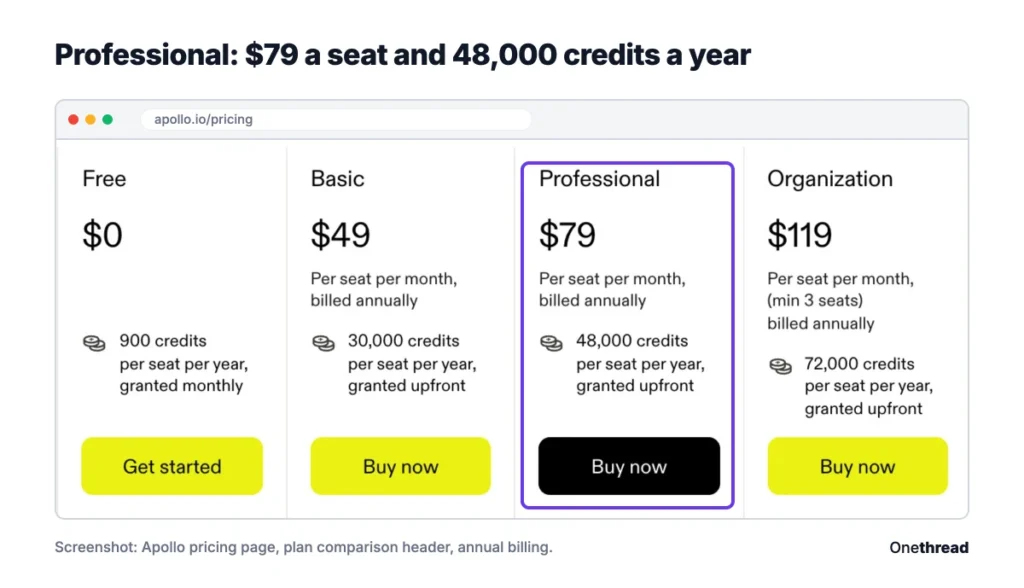
The Apollo Professional plan costs $79 per seat a month billed yearly, or $99 billed monthly. Apollo labels it “Most popular,” and it grants 48,000 credits per seat a year, or 4,000 a month on monthly billing.
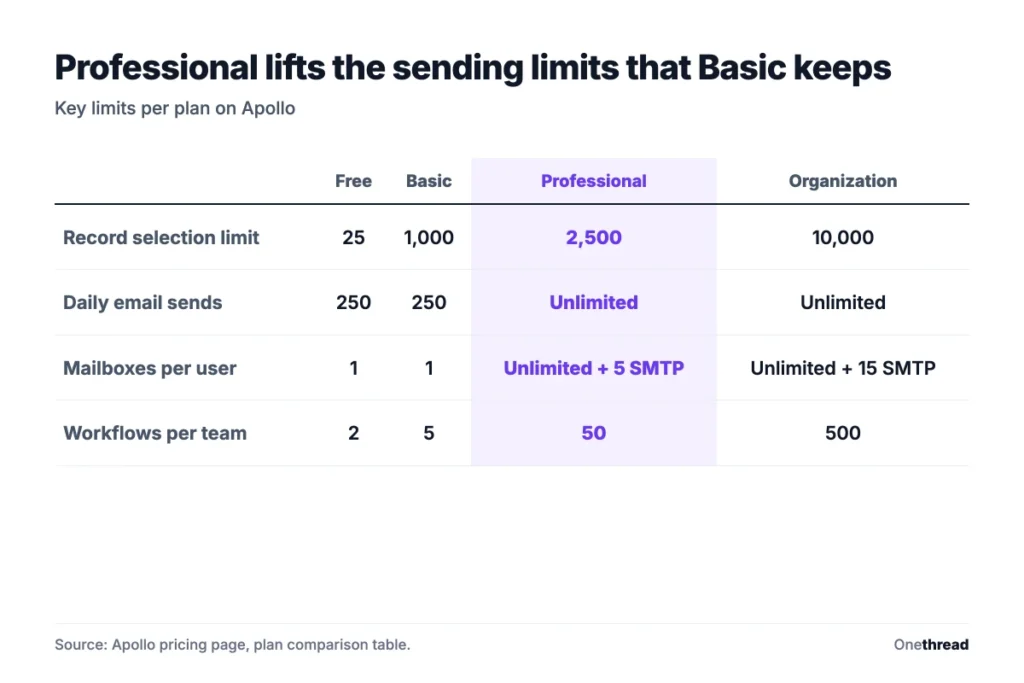
Professional removes the sending ceiling. Each user can connect unlimited Google and Microsoft mailboxes plus 5 SMTP mailboxes, with no daily send cap on Apollo’s side. It adds A/Z testing, AI lead scoring, 50 workflows per team and 4,000 minutes of call recordings with AI insights.
This is the plan for a rep whose whole day is outbound. Say your SDR runs three domains to protect deliverability: Basic blocks that setup, and Professional allows it. The extra $30 a seat buys sending room, not more data per credit.
Pricing: $79 per seat a month billed yearly, or $99 billed monthly. That’s $948 a year.
Best For
- Full-time SDRs and account executives who send from several mailboxes.
Pros
- Unlimited mailboxes and no daily send cap from Apollo.
- A/Z testing and unlimited AI lead scoring.
- 4,000 minutes of call recordings with AI insights.
Cons
- $30 more per seat a month than Basic on annual billing.
- The 2,500-record selection limit still slows large exports.
- Credits still run out if reps reveal many phone numbers.
What Does the Apollo Organization Plan Include?
The Apollo Organization plan costs $119 per seat a month, billed yearly only, with a minimum of 3 seats. That puts the smallest Organization bill at $119 × 3 × 12 = $4,284 a year before any add-ons.
Each seat grants 72,000 credits a year. Organization raises the record selection limit to 10,000 and adds 15 SMTP mailboxes per user. It also includes 500 workflows per team, 12 intent topics, unlimited meeting events, unlimited inbound routers and 8,000 minutes of call recordings.
Teams that need single sign-on (SSO), custom volumes or dedicated support go one step further, to a Custom plan. Apollo lists no price for Custom, and its FAQ says API access sits there too. Ask sales for a quote before you assume Organization covers it.
Pricing: $119 per seat a month billed yearly, 3-seat minimum.
Best For
- Sales teams of 3 or more that run high-volume outbound and inbound routing.
Pros
- 72,000 credits per seat a year, the biggest pool Apollo lists.
- A 10,000-record selection limit for large list pulls.
- 500 workflows and 12 intent topics for heavy automation.
Cons
- No monthly option, so you commit for 12 months.
- 3-seat minimum, even for a team of 2.
- SSO and API access need a Custom quote.
How Do Apollo Credits Work?
Apollo credits are the currency for data and actions. Every paid plan grants its credit pool up front at the start of each billing cycle. The whole team draws from that pool, and unused credits expire when the cycle ends.
| Action | Credit cost |
|---|---|
| Verified email | 1 credit |
| Phone number | 8 credits |
| Data enrichment | 1 to 8 credits |
| AI research | 1 credit per run |
| US dialer | 1 credit per 30 seconds |
| International dialer | Varies by region |
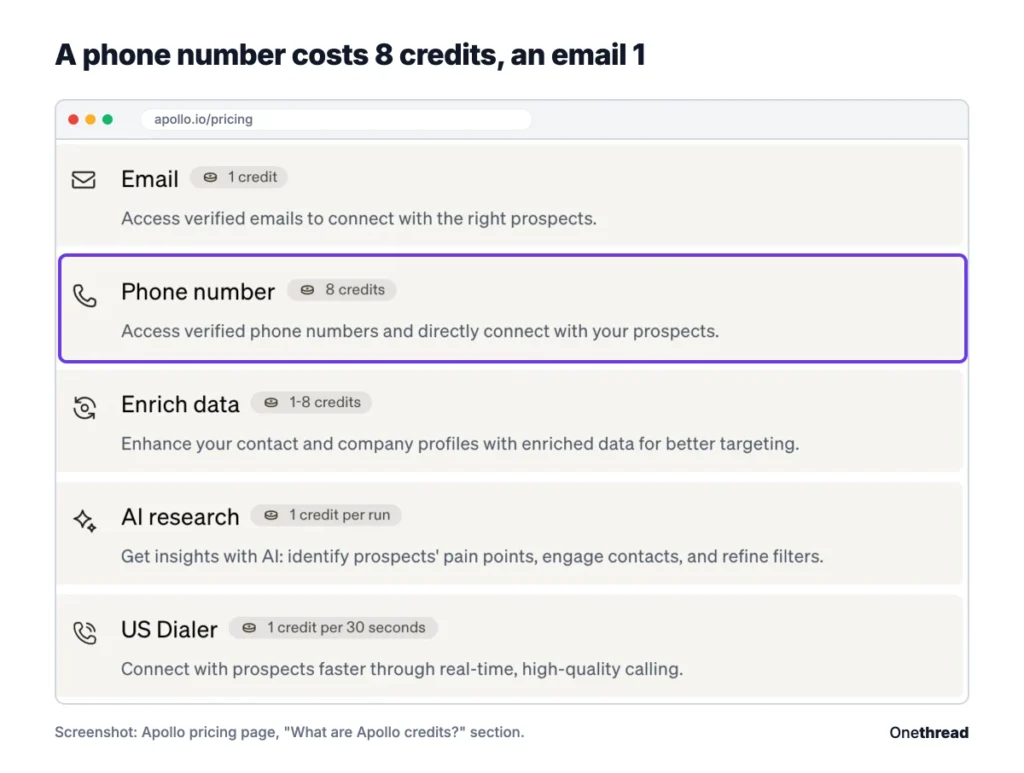
Apollo only charges for emails it can verify, and every phone number type costs the same 8 credits.
We worked out what one credit costs on each plan:
- Basic, yearly: $588 ÷ 30,000 credits = about 2 cents a credit.
- Professional, yearly: $948 ÷ 48,000 credits = about 2 cents a credit.
- Basic, monthly: $65 ÷ 2,500 credits = 2.6 cents a credit.
Example: A Basic seat’s 30,000 yearly credits cover 30,000 verified emails, or 30,000 ÷ 8 = 3,750 phone numbers. Mix them and the math shifts fast: 2,000 phone numbers use 16,000 credits, which leaves 14,000 for emails.
Admins can set per-user credit caps so one rep can’t drain the pool. A cap can also block a rep while the team still has credits left.
Top Tip: Open Settings, then Credit usage, in your first two weeks. It shows who spends credits on phone numbers before the pool runs dry.
What Does an Apollo Team Pay per Year?
An Apollo team of 5 pays $2,940 a year on Basic or $4,740 on Professional with yearly billing. A team of 10 pays $5,880 or $9,480. These totals cover seats only, before add-ons or extra credits.
| Team size | Basic, yearly | Basic, monthly | Professional, yearly | Professional, monthly | Organization, yearly |
|---|---|---|---|---|---|
| 1 seat | $588 | $780 | $948 | $1,188 | 3-seat minimum |
| 5 seats | $2,940 | $3,900 | $4,740 | $5,940 | $7,140 |
| 10 seats | $5,880 | $7,800 | $9,480 | $11,880 | $14,280 |
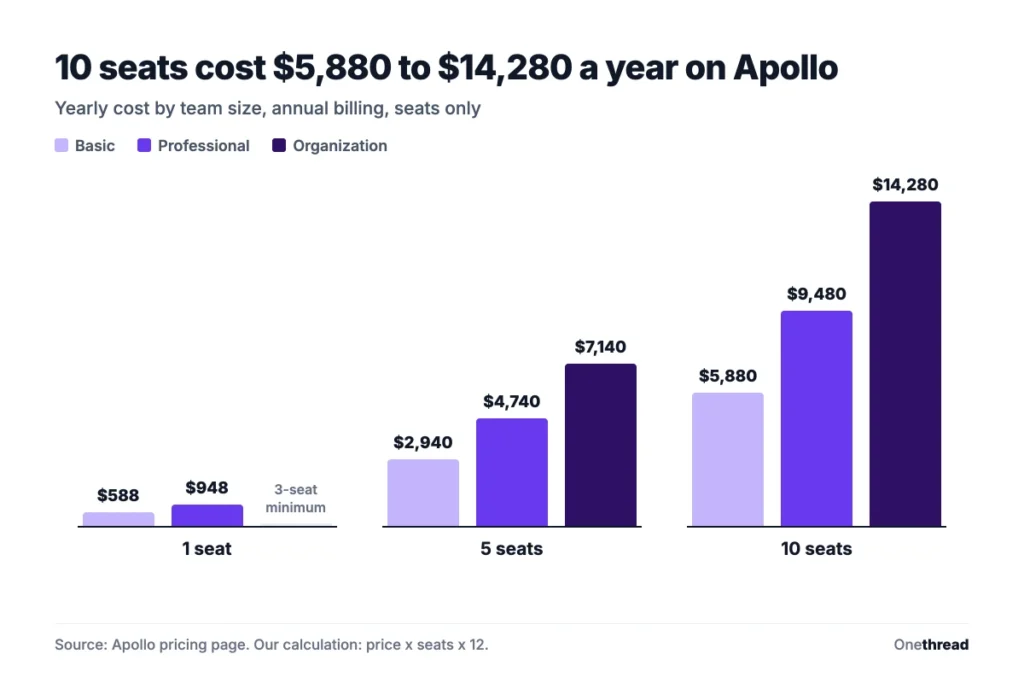
Example: A 10-person SDR team on Professional pays $79 × 10 × 12 = $9,480 a year billed yearly, or $99 × 10 × 12 = $11,880 billed monthly. Paying yearly keeps $2,400 in your budget.
Credits scale with seats. Those 10 Professional seats share 480,000 credits a year. Say each rep reveals 100 phone numbers a week. The team then uses 10 × 100 × 8 × 52 = 416,000 credits a year, inside the pool.
Work out the cost per booked meeting once you know your seat total. Our free CAC calculator helps you check whether the Apollo spend pays back.
What Hidden Costs Come With Apollo Pricing?
The hidden costs in Apollo pricing are add-ons, recurring extra credits and billing rules that keep you paying after you stop using it.
Five costs to check before you sign:
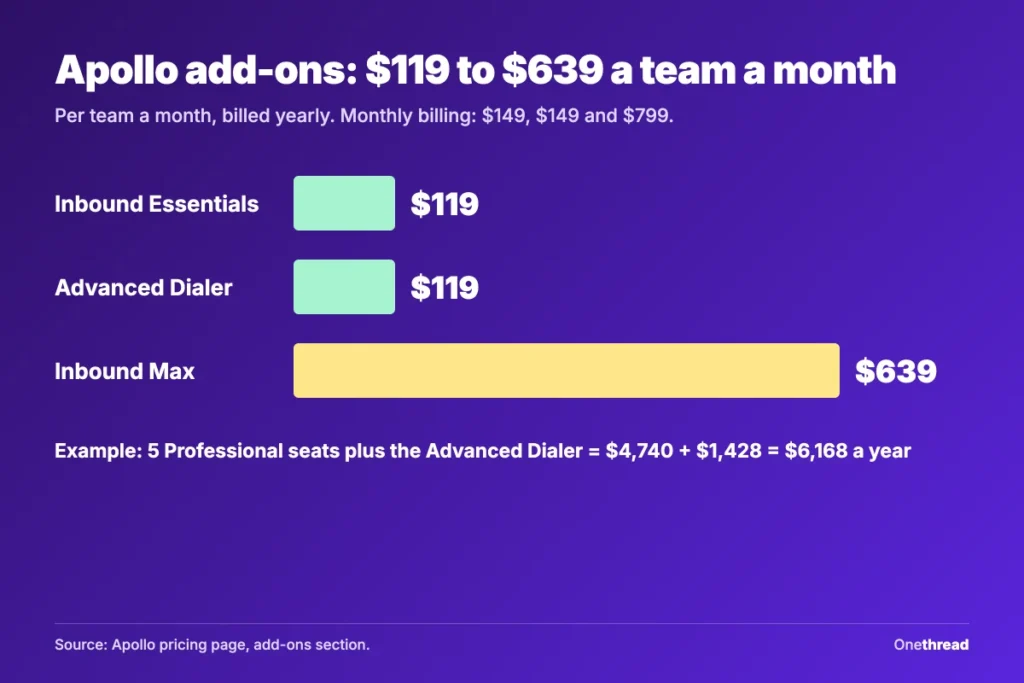
- Inbound add-on: $119 a month for Essentials or $639 for Max, per team, billed yearly, or $149 and $799 monthly. It covers visitor tracking, lead routing and forms.
- Advanced Dialer add-on: $119 a month per team billed yearly, or $149 monthly. It adds international, parallel and power dialing plus local presence.
- Extra credits: You buy them with a slider in Settings. They’re charged at once, not prorated, and renew every cycle until you reset the slider. Apollo’s pricing page lists no per-credit price.
- No rollover: Plan and add-on credits expire each cycle, with no refund.
- Billing lock: Downgrades take effect at once with no refund for unused time. An annual plan can’t switch to monthly until the term ends.
Example: A 5-seat Professional team that adds the Advanced Dialer pays $4,740 + $119 × 12 = $6,168 a year. The dialer alone raises the bill by 30%. Add Inbound Essentials too, and the total reaches $7,596.
Top Tip: Set a reminder 30 days before renewal. Add-on credits renew on their own until you remove them.
How Does Apollo Pricing Compare With ZoomInfo, RocketReach and Lusha?
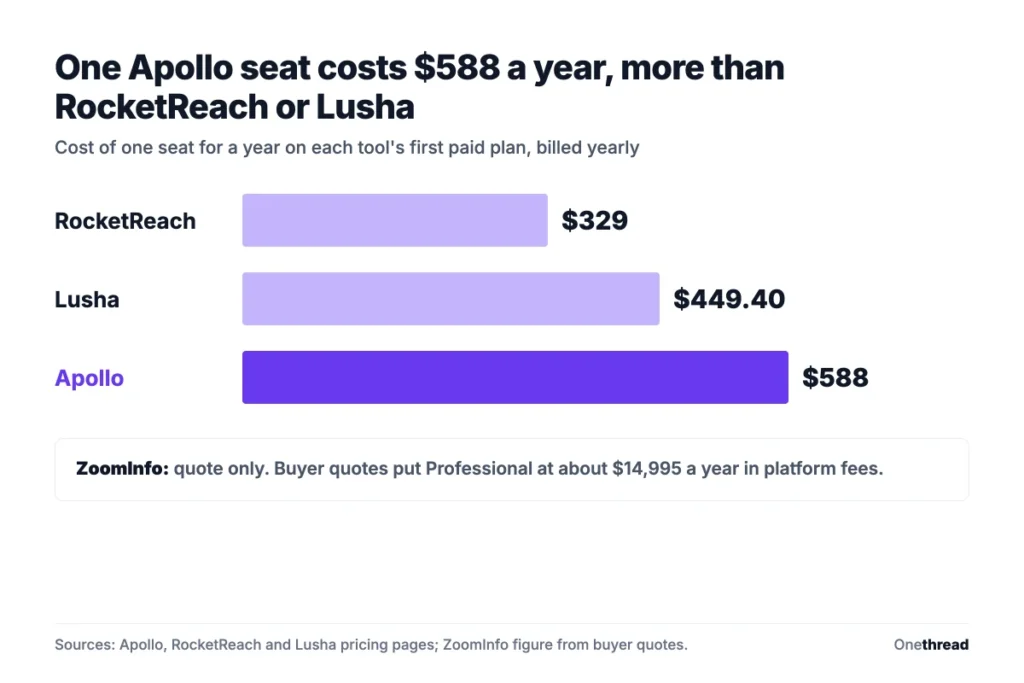
Apollo pricing sits in the middle for one seat. It costs more than RocketReach’s and Lusha’s first paid plans, and far less than ZoomInfo, which only sells by quote.
| Tool | First paid plan, per seat a month (billed yearly) | Cost for 1 seat a year | Best for |
|---|---|---|---|
| Apollo | $49 | $588 | Prospecting plus sequences in one tool |
| RocketReach | $27 | $329 | Email lookups with a fixed export cap |
| Lusha | $37.45 | $449.40 | Quick contact reveals from a browser extension |
| ZoomInfo | Quote only | About $14,995 platform fee (buyer quotes) | Large teams that need intent data and support |
RocketReach and Lusha prices come from their pricing pages. The ZoomInfo figure is buyer-reported, from our ZoomInfo pricing guide. The Best for column is our read.
RocketReach’s first plan covers emails only and caps exports at 1,200 a year, as our RocketReach pricing breakdown shows. Lusha’s Starter grants 4,800 credits a year and charges 5 credits a phone number.
If you mainly need deal tracking, compare a few CRMs for small businesses before paying for Apollo’s deal tools.
When Is Apollo Worth the Price?
Apollo is worth the price when one tool replaces your contact database, email sequencer and dialer. It’s a poor fit when you only need a few hundred contacts a year or one inbox.
Apollo’s case is consolidation. A Basic seat at $588 a year bundles 30,000 credits, unlimited sequences and CRM sync in one login. One tool also means one contact record, so your reps don’t copy leads between apps.
The risk is usage-based pricing you don’t watch. Credits work like the task and execution limits in our n8n pricing guide: the plan looks cheap until volume climbs. Phone-heavy teams feel this first, because each number costs 8 credits.
Three checks help you decide:
- Data match: Run 50 contacts from your real target list through the Free plan. If too many emails bounce, the plan price doesn’t matter.
- Channel fit: Count how many mailboxes each rep needs. More than one means Professional, not Basic.
- Volume: Multiply weekly phone reveals by 8 and by 52. Compare that with the credits your seats grant each year.
If all three checks pass, Apollo’s bundle earns its price. If the data check fails, no plan fixes it, so test a second database before you sign.
Which Apollo Plan Should Your Team Pick?
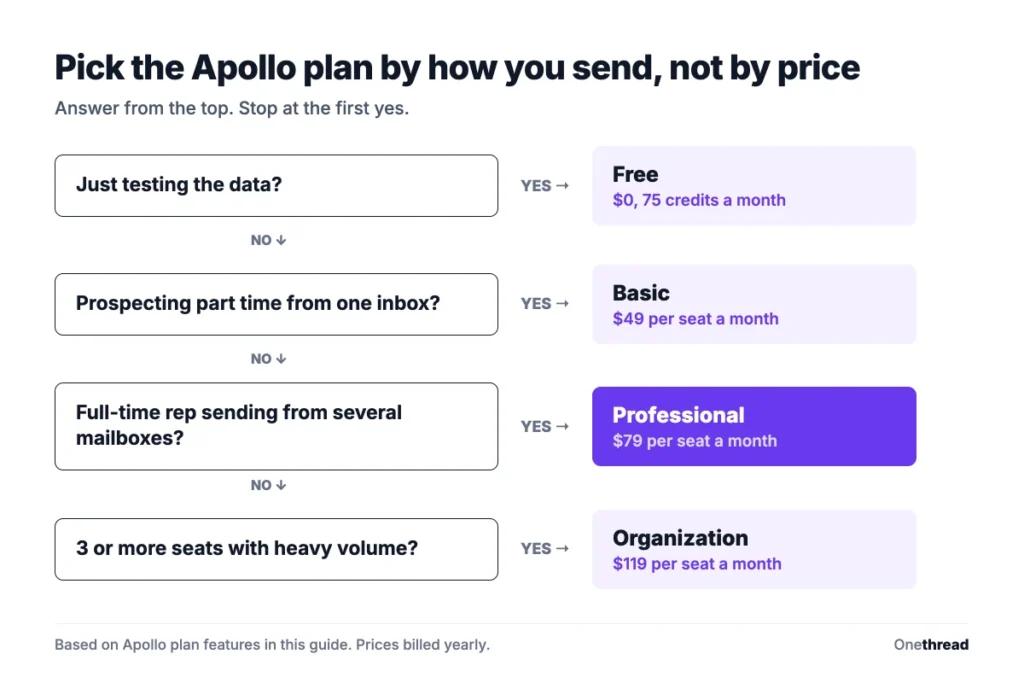
Pick the cheapest Apollo plan that covers your mailboxes and credit volume, then decide on billing. We’d decide in this order:
- Testing the data: Free, until you need Microsoft 365 or more than 75 credits a month.
- Part-time prospecting from one inbox: Basic at $49, if 250 sends a day covers you.
- Full-time outbound reps: Professional at $79, for unlimited mailboxes and A/Z testing.
- Teams of 3 or more with heavy volume: Organization at $119, for the 10,000-record limit and 72,000 credits per seat.
- Teams that need SSO or API access: Ask Apollo’s sales team about a Custom plan.
A team of 1 or 2 can only choose Free, Basic or Professional, since Organization needs 3 seats.
Then pick the billing cycle. Start monthly on Basic or Professional for one or two months while you measure credit use, then switch to yearly. Apollo allows monthly to annual at any time and counts what you’ve already paid toward the annual plan.
Example: A 3-person team that starts on Professional monthly pays $99 × 3 × 2 = $594 for two test months. If usage fits, the switch to yearly cuts each later month from $297 to $237.
Top Tip: Apollo’s 14-day trial runs once per account, so plan your test list before you start it.
What Should You Do Next With Apollo?
Apollo.io pricing comes down to credits and commitment, not the seat price. A $49 seat looks small until phone reveals, add-ons and a 12-month lock add up. Professional often beats Basic for anyone who sends from more than one inbox. The right plan is the one whose credit pool your team uses.
This week, pull 50 real prospects through the Free plan, count how many mailboxes each rep needs, and estimate weekly phone reveals. Then price that volume against Basic and Professional before you pay for a year. A month of real usage beats any calculator.
FAQs
Is Apollo.io Free?
Yes, Apollo.io offers a free tier with no time limit. It grants 75 credits per seat a month, 2 sequences per team and a 25-record selection limit, and it connects Gmail accounts only. Paid plans start at $49 per seat a month billed yearly.
How Much Does Apollo.io Cost per Month?
Apollo.io costs $65 per seat a month on Basic and $99 on Professional with monthly billing. On yearly billing, the same plans cost $49 and $79 per seat a month. Organization costs $119 per seat a month, billed yearly only, with a 3-seat minimum.
Does Apollo Require Annual Billing?
No, Apollo offers monthly billing on the Basic and Professional plans. Organization is annual only. Annual billing saves about 24%, but you can’t switch an annual plan back to monthly until the term ends, and downgrades don’t refund unused time.
Do Apollo Credits Roll Over?
No, Apollo credits don’t roll over. Plan credits and purchased add-on credits expire at the end of each billing cycle, and Apollo doesn’t refund any unused credits. Your new allowance arrives on the first day of the next billing cycle.
Does Apollo Offer a Free Trial?
Yes, Apollo offers a 14-day trial of its Basic and Professional plans. Apollo’s pricing page says the trial includes 75 credits and most features of the plan you pick. When it ends, you can upgrade or move to the free plan.