A client brief rarely dies in one big moment. It slips one feedback round at a time, in an inbox nobody owns.
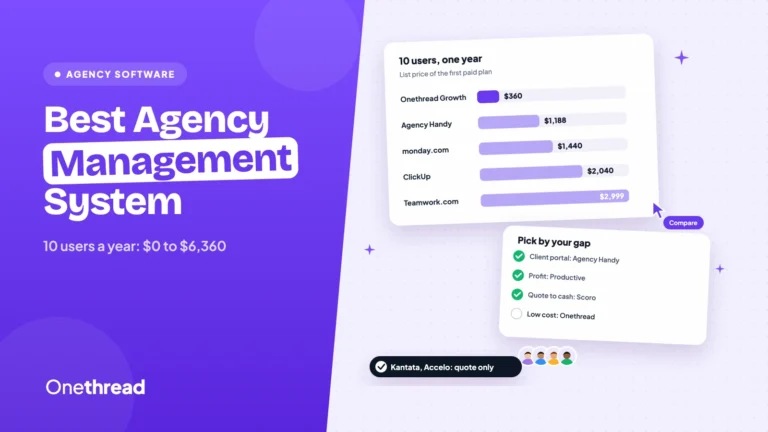
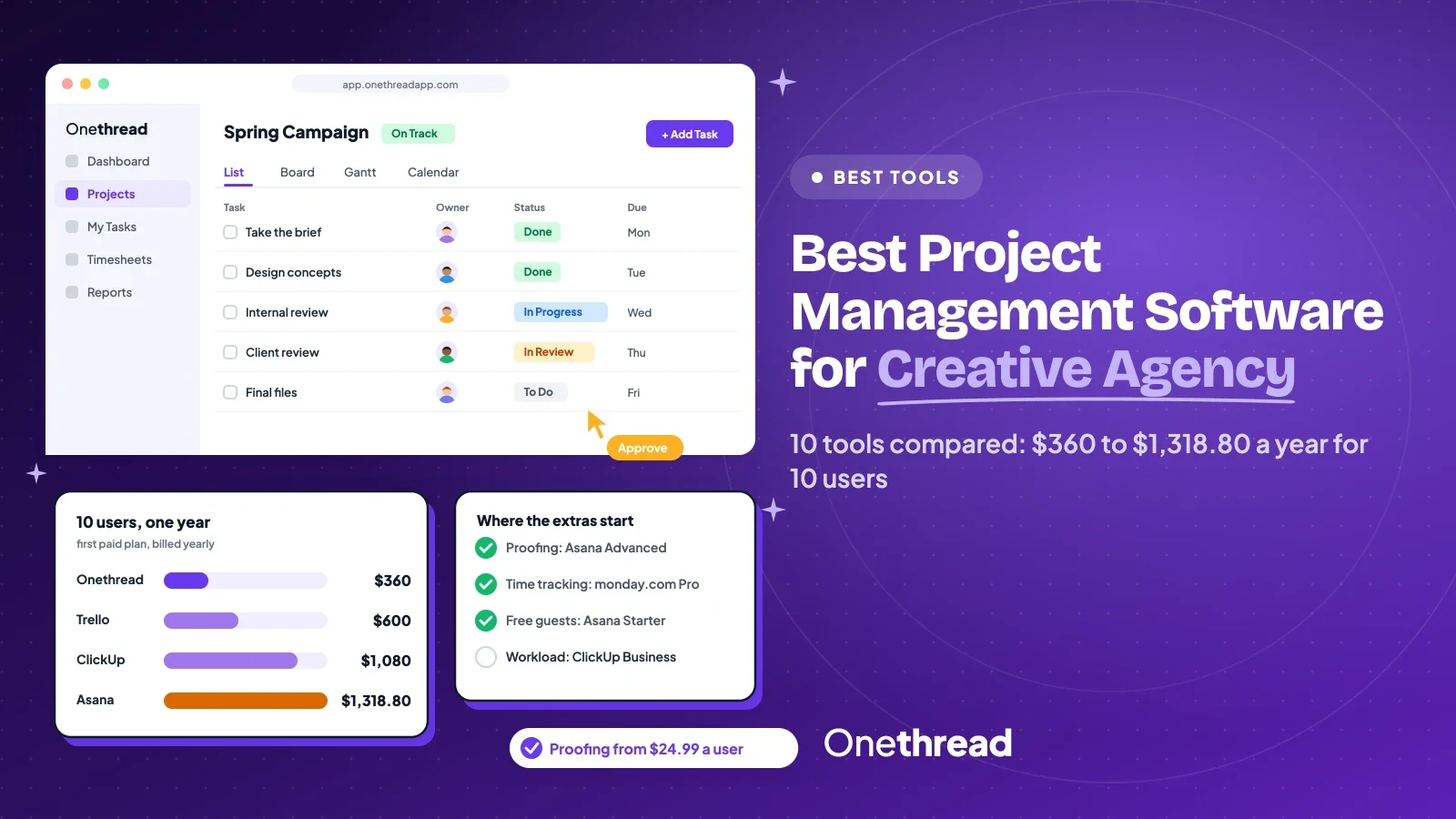
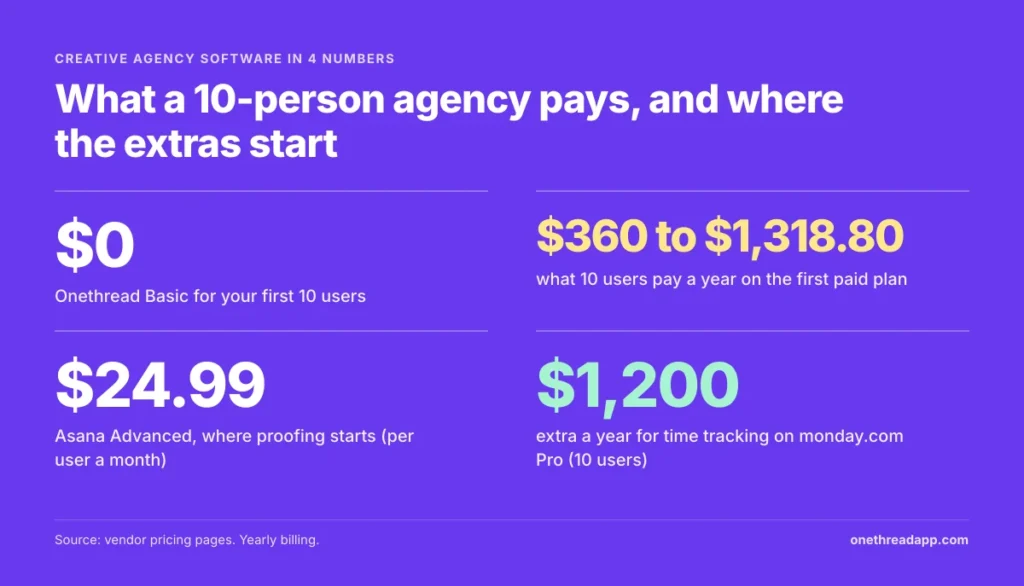
The best project management software for creative agency teams depends on how you bill. Asana and Wrike suit proofing and approvals. Teamwork.com and Bonsai suit hourly billing. For 10 people, first paid plans run $360 to $1,318.80 a year.
That's a narrow gap. The real cost hides in the upgrade.
We compared 10 tools against the 8 top-ranking guides and checked each price on the vendor's page.
You'll get a cost table, a review of each tool and a pick-by-need guide.
Key Points
- For 10 users, the first paid plans cost $360 a year (Onethread Growth) to $1,318.80 (Asana Starter). Trello Standard is $600, and ClickUp, monday.com and Bonsai sit at $1,080. Basecamp Pro is a flat $948 for up to 10 users.
- Check which plan adds the agency features. Proofing on Asana starts at Advanced, at $24.99 a user, and monday.com time tracking starts at Pro, at $19.
- Pick by how you bill. Hourly and retainer agencies need time tracking and invoices. Fixed-fee studios need approvals and client access first.
- Count your clients and freelancers before you buy. Basecamp counts every guest as a user, while Asana and Notion let guests in free.
Which Creative Agency Project Management Software Costs the Least?
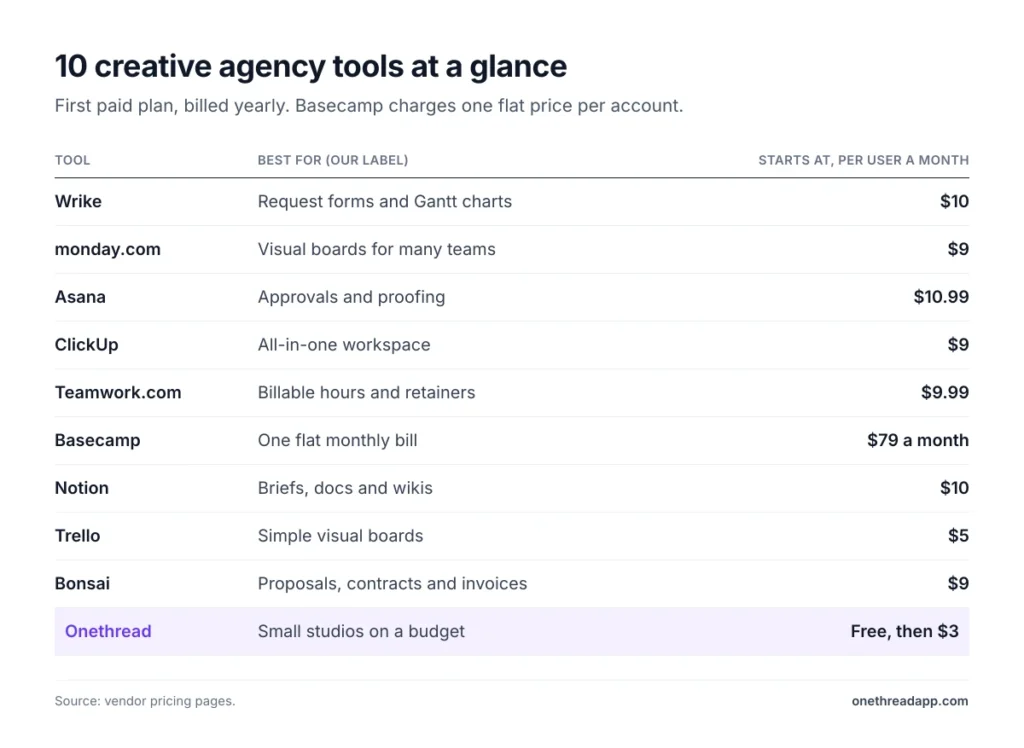
Onethread is the cheapest paid option for a 10-person team, at $360 a year on Growth. Its Basic plan is free for your first 10 users. The table lists each tool's first paid plan and what 10 users pay in a year.
| Tool | Free plan | First paid plan | 10 users for a year | Best for (our label) |
|---|---|---|---|---|
| Onethread | Yes, first 10 users | $3 per user a month, billed yearly | $0 on Basic, $360 on Growth | Small studios on a budget |
| Trello | Yes, 10 collaborators | $5 per user a month, billed yearly | $600 | Simple visual boards |
| Basecamp | Yes, 1 project, 3 users | $79 a month flat (Pro, up to 10 users) | $948 | Client projects with a flat bill |
| ClickUp | Yes, 60 MB storage | $9 per user a month, billed yearly | $1,080 | All-in-one workspace |
| monday.com | Yes, 2 seats | $9 per seat a month, billed yearly | $1,080 | Visual boards for many teams |
| Bonsai | No, 7-day trial | $9 per user a month, billed yearly | $1,080 | Freelance-style agency admin |
| Teamwork.com | Yes, 5 users | $9.99 per user a month, billed yearly | $1,198.80 | Client work and billable hours |
| Wrike | Yes | $10 per user a month, billed yearly | $1,200 | Request forms and Gantt charts |
| Notion | Yes, for individuals | $10 per member a month | $1,200 | Docs, briefs and wikis |
| Asana | Yes, 2 users | $10.99 per user a month, billed yearly | $1,318.80 | Approvals and proofing |
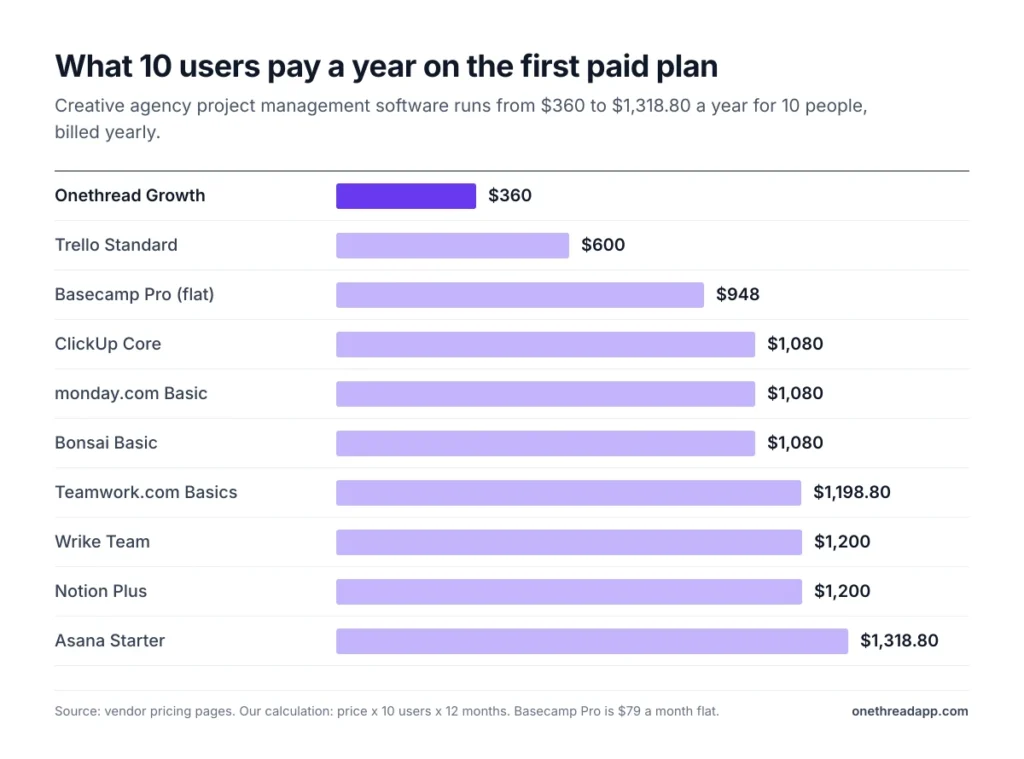
Top Tip: Price the plan that holds your must-have feature, not the first paid plan. For most agencies that's the plan with time tracking or proofing. To save time here, use our free free agency pricing calculator.
How Did We Choose These Creative Agency Tools?
We started from the tools that the 8 top-ranking guides for this keyword review most often. Wrike sits on all 8 lists. monday.com and ClickUp sit on 6, and Asana and Basecamp on 5.
Then we checked each tool's public pricing page in this run. We noted the price of each plan, the free plan limits and the plan where agency features start.
Four features decided our picks:
- Proofing and approvals: can clients mark up a file and sign it off in one place?
- Time tracking: can you log hours against a client and a task?
- Client access: can a client see their project without a paid seat?
- Workload view: can you see who's booked before you say yes to a rush job?
Work patterns matter too. Workamajig's roundup of creative agency statistics cites a Campaign survey of agency offices. Of agencies with open offices, 50% said most staff came in twice a week. So your tool has to work for people who aren't in the room.
We didn't sign up for paid trials. And we don't quote star ratings, since they shift every week.
Our reviewers evaluate software independently. Clicks may earn a commission, which supports testing. Learn how we stay transparent and our review methodology.
Sources: Wrike, monday.com, Asana, ClickUp, Teamwork.com, Basecamp, Notion, Trello, Bonsai and Onethread pricing pages.
What Is the Best Project Management Software for Creative Agency Teams?
The best pick depends on your billing model and your review process. Asana and Wrike lead on approvals, and Teamwork.com and Bonsai lead on hours and invoices. Basecamp wins on a flat bill, and Onethread wins on price. Each review lists the price, who it suits, and the trade-offs.
Wrike: Best for Client Request Forms
Wrike is a work management platform built around request forms, Gantt charts and shared dashboards. It shows up on every top-ranking list we read. That's no accident for agencies with a steady flow of client requests.
Say a client asks for six banner sizes on Friday. A Wrike request form can collect the sizes, copy and deadline before anyone opens a design file. Then the job lands on an interactive Gantt chart with its dependencies.
Wrike suits mid-size teams best. Business covers 5 to 200 users and adds templates, so a recurring campaign starts from the same task list every month.
Our earlier screenshots show the Wrike home screen, Wrike request forms and the Wrike Gantt view. They also cover Wrike collaboration, the Wrike integration list and the Wrike price page.
Pricing: Free plan. Team is $10 per user a month (2 to 15 users) and Business is $25 (5 to 200 users), billed yearly. Pinnacle and Apex are quote only.
Best For
- Agencies that take many small client requests a week.
Pros
- Request forms collect the brief before work starts.
- Interactive Gantt charts start on the Team plan.
- Business adds templates and more integrations.
Cons
- Time tracking and budgets sit on Pinnacle, which is quote only.
- Under 30 seats, Wrike sells seats in groups of five.
- Business is sold on yearly plans only.
monday.com: Best for Visual Boards
monday.com is a board-based work platform with many views, templates and automations. Designers tend to like it because the boards are colorful and easy to scan.
The catch is the plan ladder. Gantt and timeline views, guest access and 250 automations a month start on Standard at $12 a seat. Time tracking starts on Pro at $19. We review the main risks in our guide to client files and guest logins for agencies.
So a studio that bills by the hour skips two tiers before the tool fits. We run the numbers on that jump in the cost section.
Our earlier screenshots show the Monday.com home page and Monday customizable workflow templates. They also show Monday.com visual project tracking and Monday.com collaboration and communication. The set ends with Monday integration options and Monday.com pricing.
Pricing: Free for up to 2 seats. Basic is $9, Standard $12 and Pro $19 per seat a month, billed yearly. Enterprise is quote only.
Best For
- Agencies that want one visual board for account, design and content teams.
Pros
- Unlimited free viewers start on Basic.
- Guest access and timeline views start on Standard.
- Pro adds time tracking and 25,000 automation actions a month.
Cons
- Time tracking needs Pro, the third paid tier.
- Resource management sits on Enterprise.
- No proofing tool appears in the work management plans.
Asana: Best for Proofing and Approvals
Asana is a task and project tool with timelines, portfolios and approvals. Its Advanced plan adds the parts creative teams ask for most: proofing, approvals and time tracking.
Here's what that looks like. A designer uploads a PDF, and the client annotates it inside Asana. Then the approval status tells you the asset is ready to ship.
Asana also handles the guest problem well. Clients and contractors join as free guests from Starter, so a 10-person team with 15 client reviewers still pays for 10 seats.
Pricing: Personal is free for 2 users. Starter is $10.99 and Advanced is $24.99 per user a month, billed yearly, or $13.49 and $30.49 billed monthly. Enterprise is quote only.
Best For
- Studios with heavy client review rounds on images and PDFs.
- Teams that bring many clients and contractors in as guests.
Pros
- Unlimited free guests start on Starter.
- Advanced adds proofing, approvals and resource management.
- Timeline and Gantt views start on Starter.
Cons
- Proofing and time tracking need Advanced, at $24.99 a user.
- Budgets and user rates sit in a Timesheets and Budgets add-on.
- The free plan stops at 2 users.
ClickUp: Best for Low-Cost Time Tracking
ClickUp is an all-in-one workspace with tasks, docs, whiteboards and dashboards. Its Core plan is one of the cheapest ways to get time tracking and guests on the same bill.
Say you run a 6-person content studio. Core gives you unlimited storage, guest permissions and Gantt charts for $9 a user. Timesheets and the workload view wait on Business.
ClickUp's range is also its weak spot. With docs, boards, goals and dashboards in one place, a small team can spend its first week on setup.
Our earlier screenshots show the ClickUp home screen and ClickUp customization settings. They also show ClickUp time tracking, ClickUp Kanban boards and ClickUp pricing.
Pricing: Free Forever with 60 MB of storage. Core is $9 and Business $17 per user a month, billed yearly. Enterprise is quote only.
Best For
- Small agencies that want time tracking on a low per-user price.
Pros
- Time tracking and guest permissions start on Core.
- Unlimited members on the free plan.
- Business adds timesheets, workload view and resource management.
Cons
- The free plan caps storage at 60 MB, which a few design files fill.
- Timesheets need Business, not Core.
- The pricing page shows sale prices next to higher regular prices, so check the rate at renewal.
Teamwork.com: Best for Billable Client Work
Teamwork.com is project management built for client work. It organizes projects by client, tracks billable time and turns logged hours into invoices.
That last part matters for retainer agencies. Accelerate lets you set time budgets and retainers, then build the invoice from the hours. Nobody retypes a timesheet into a billing tool.
Smart forms on Accelerate route new requests to the right team. And workload planning shows live capacity before you accept the next job.
Pricing: Free for up to 5 users and 5 projects. Basics is $9.99 (3-user minimum) and Accelerate is $24.99 (5-user minimum) per user a month, billed yearly. Optimize and Enterprise are quote only.
Best For
- Agencies that bill by the hour or on monthly retainers.
Pros
- Billable time tracking starts on Basics.
- Accelerate adds workload planning, retainers and invoices from logged time.
- Its plan table lists Proofs for file approvals.
Cons
- Seat minimums apply: 3 on Basics and 5 on Accelerate.
- Profitability and revenue insights sit on Optimize, which is quote only.
- The page shows no monthly-billing price, so ask before you commit.
Basecamp: Best for a Flat Monthly Bill
Basecamp is a project and communication tool with message boards, to-dos, schedules and file storage. It charges a flat monthly price per account, not per user.
That's handy for a stable team. But every person you add counts as a user, including clients and contractors. So a studio with many client logins hits the user cap faster than it expects.
Pricing: Free for 1 project and 3 users. Freelancer is $29 a month (5 users), Pro $79 (10 users), Pro Plus $99 (15 users). Pro Unlimited is $199 a month billed yearly, or $329 monthly.
Best For
- Small studios that want one fixed bill and simple client projects.
Pros
- Flat prices, so a full 10-person team pays the same as 6.
- Docs and file storage come on every plan.
- Pro Unlimited removes the user cap.
Cons
- Clients and guests count toward the user limit.
- Time tracking is listed on Pro Plus and above.
- Pro caps you at 8 active projects.
Notion: Best for Briefs and Wikis
Notion is a workspace for docs, wikis and databases. Agencies use it for briefs, brand guides, content calendars and client handbooks.
It's a strong home for the words around a project. But it isn't a full project tool. Notion's pricing page lists no time tracking or timesheets.
Many agencies pair it with a task tool. The brief and brand guide live in Notion, and the deadlines live somewhere else. That works, as long as everyone knows which tool holds the truth.
Pricing: Free for individuals. Plus is $10 and Business is $20 per member a month. Enterprise is quote only. Notion says yearly billing saves up to 20%.
Best For
- Agencies that live in briefs, wikis and content calendars.
Pros
- Guests are free and see only the pages they're invited to.
- Plus allows file uploads up to 5 GB each.
- Databases handle subtasks, dependencies and custom properties.
Cons
- No time tracking or timesheets on the pricing page.
- Notion AI is a trial on Free and Plus.
- Free workspaces with several members cap the number of blocks.
Trello: Best for Simple Kanban Boards
Trello is a Kanban board tool owned by Atlassian. You move cards through lists like To Do, In Review and Done.
It's the fastest tool here to learn. A new freelancer can read a Trello board in a minute. But calendar and timeline views need Premium, and there's no native time tracking.
Trello works best as a first tool. Once you need hours, budgets or approvals, you'll add Power-Ups or move to a bigger platform.
Our earlier screenshots show the Trello homepage, Trello Kanban boards and the Trello custom field panel. Others cover Trello collaboration and communication and the Trello Power-Up directory. The last two show the Trello calendar and Trello pricing.
Pricing: Free for up to 10 collaborators per Workspace. Standard is $5, Premium $10 and Enterprise $17.50 per user a month, billed yearly.
Best For
- Small teams that want a simple visual board and nothing more.
Pros
- The free plan covers 10 collaborators and unlimited cards.
- Standard adds unlimited boards and single-board guests.
- Power-Ups add extras to each board.
Cons
- No native time tracking, proofing or budgets.
- Calendar and timeline views need Premium.
- Multi-board guests are billed like users.
Bonsai: Best for Proposals and Invoices
Bonsai is agency software that mixes projects with the business side: proposals, contracts, invoices and payments. It suits small agencies that want one login for both.
Say you send a proposal, the client signs, and the project starts. Bonsai's Essentials plan keeps the contract, client portal and invoice next to the tasks.
That makes Bonsai close to creative agency management software, not just a task board. The trade-off is depth: proofing and big-team resourcing aren't on the pricing page.
Pricing: No free plan, a 7-day trial. Basic is $9, Essentials $19, Premium $29 and Elite $49 per user a month, billed yearly. Monthly billing costs $15 to $59.
Best For
- Small agencies that want projects, proposals and invoices in one tool.
Pros
- Time tracking and unlimited clients start on Basic.
- Essentials adds invoices, proposals, contracts and a client portal.
- Premium adds workload management and profit reports.
Cons
- No free plan.
- Workload and Gantt views need Premium, at $29 a user.
- No proofing tool appears on the pricing page.
Onethread: Best for Small Studio Budgets
Onethread is project management software for small teams, with tasks, timelines and team talk in one place. It covers task management, Gantt and calendar views, sprints, issues and a timesheet.
For a creative team, the draw is the price. Your first 10 users are free on Basic, with unlimited projects and 15 GB of file sharing. Discussion rooms keep client threads next to the work, and vendor management helps with freelancers.
It's the most basic tool here for review work, though. There's no file markup, so client feedback lives in comments and discussion threads.
Our earlier screenshots show the Onethread homepage and the Kanban board. They also cover collaborative discussions and feedback, task management, the timesheet and the Onethread price plans.
Pricing: Basic is free for your first 10 users. Growth is $3 and Scale $5 per user a month, billed yearly, or $3.60 and $6 billed monthly.
Best For
- Small studios that want tasks, timelines and a timesheet on a tight budget.
Pros
- Free for your first 10 users, with unlimited projects.
- Gantt, calendar and timesheet in the same product.
- Scale adds custom workflows, custom roles and advanced reports.
Cons
- No built-in proofing or file markup.
- No client invoicing, and budgeting is listed as upcoming.
- Fewer creative tool integrations than the larger platforms.
What Features Should Creative Agency Software Have?
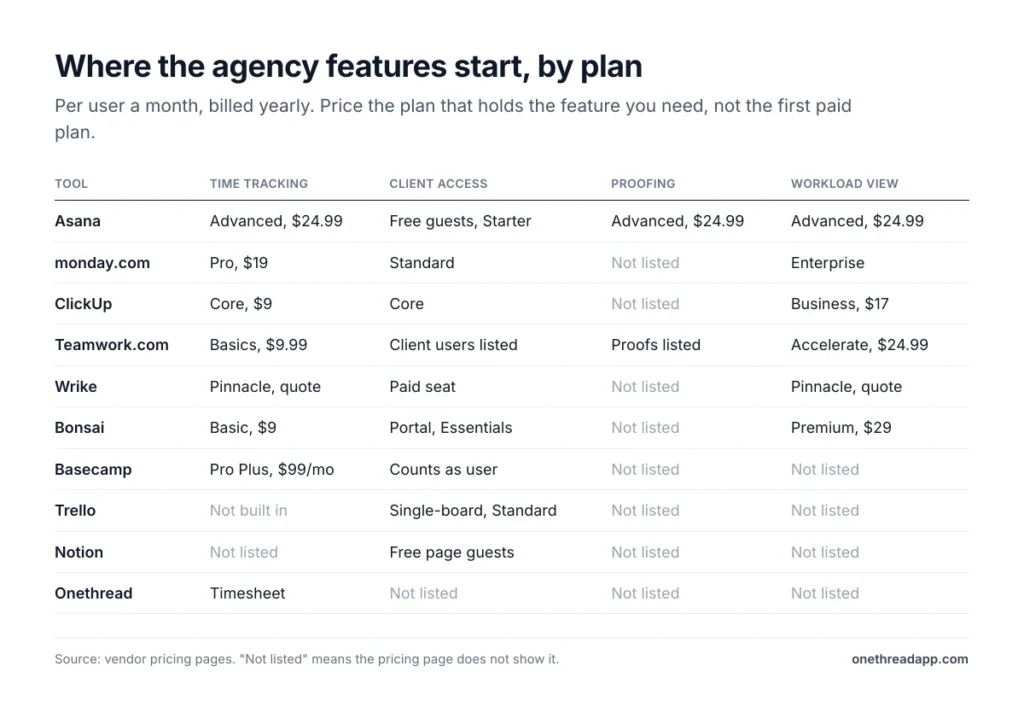
Creative agency software needs four things beyond a task list: proofing, time tracking, client access and a workload view. The table shows the plan where each one starts, so you can price the plan you'll actually use.
| Tool | Time tracking starts on | Client or guest access | Proofing or file approval | Workload view starts on |
|---|---|---|---|---|
| Asana | Advanced, $24.99 | Free guests on Starter | Advanced, $24.99 | Advanced, $24.99 |
| monday.com | Pro, $19 | Guest access on Standard | Not listed | Enterprise, quote |
| ClickUp | Core, $9 | Guests on Core | Not listed | Business, $17 |
| Teamwork.com | Basics, $9.99 | Client users listed | Proofs listed | Accelerate, $24.99 |
| Wrike | Pinnacle, quote | External users need a paid seat | Not listed | Pinnacle, quote |
| Bonsai | Basic, $9 | Client portal on Essentials | Not listed | Premium, $29 |
| Basecamp | Pro Plus, $99 a month | Clients count as users | Not listed | Not listed |
| Trello | Not built in | Single-board guests on Standard | Not listed | Not listed |
| Notion | Not listed | Free page guests | Not listed | Not listed |
| Onethread | Timesheet in the product | Not listed | Not listed | Not listed |
A few more features earn their place in a creative agency:
- Intake forms: a form turns a client email into a brief with sizes, copy and dates.
- Templates: a campaign or website template copies the same 20 tasks in one click.
- File storage: design files are large, so check the storage cap on the free plan.
- Integrations: look for your file host, chat app and accounting tool.
Names vary. A creative agency project management system, creative services project management software and software for a creative project manager all need these same checks.
If proofing is your main need, also read our guide to creative project management software. It goes deeper on review rounds.
How Much Does Creative Agency Project Management Software Cost?
Creative agency project management software costs $0 to about $25 per user a month on public plans. Basecamp is the exception, with flat prices from $29 to $199 a month. The real bill depends on which plan holds the feature you need.
Example: A 10-person studio bills by the hour. On monday.com, time tracking starts on Pro: 10 × $19 × 12 = $2,280 a year. Basic costs 10 × $9 × 12 = $1,080. Hourly billing adds $1,200 a year.
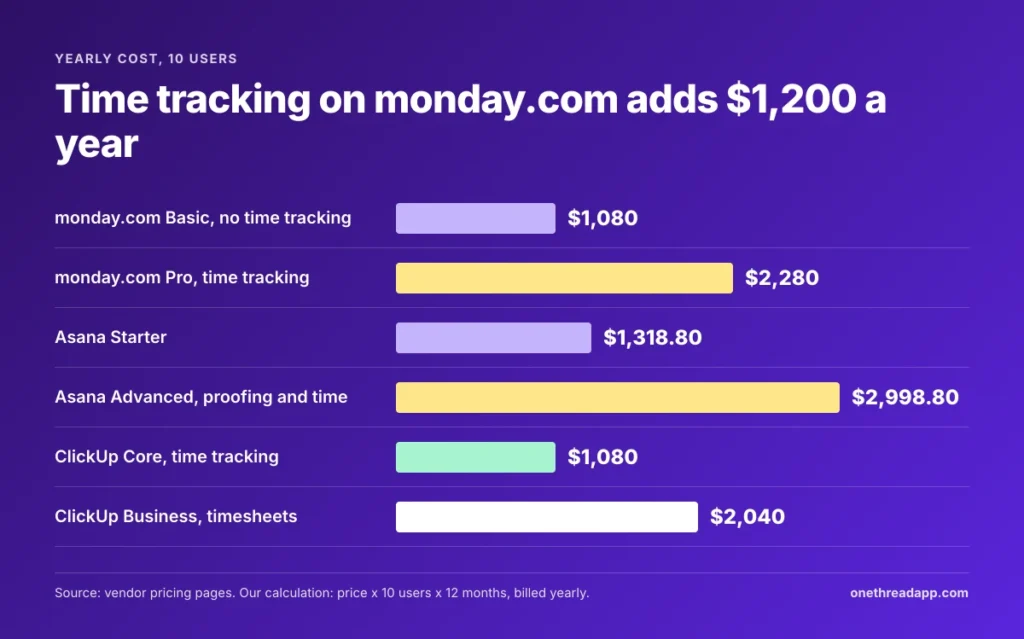
Asana works the same way. Starter costs $1,318.80 a year for 10 users, and Advanced costs $2,998.80. So proofing and time tracking add $1,680 a year.
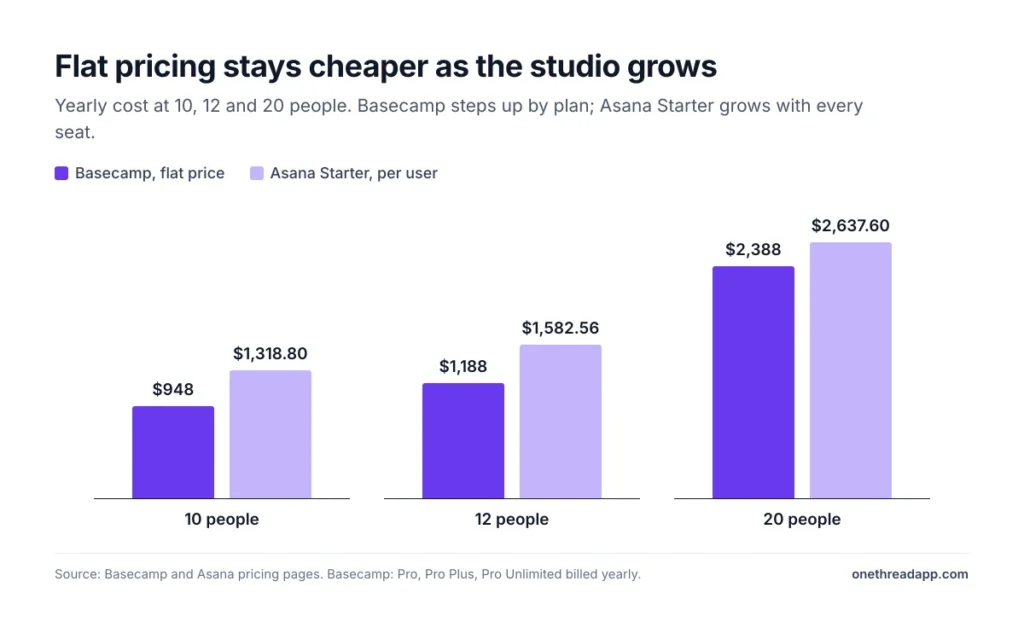
Per-user and flat pricing also grow in different ways.
Example: A 12-person studio outgrows Basecamp Pro's 10-user cap and moves to Pro Plus: $99 × 12 = $1,188 a year. On Asana Starter, 12 people pay 12 × $10.99 × 12 = $1,582.56 a year.
| Team size | Basecamp (flat) | Asana Starter (per user) |
|---|---|---|
| 10 people | $948 a year on Pro | $1,318.80 a year |
| 12 people | $1,188 a year on Pro Plus | $1,582.56 a year |
| 20 people | $2,388 a year on Pro Unlimited | $2,637.60 a year |
Seat minimums change small-team math too. Teamwork.com Accelerate needs at least 5 users. A 3-person studio still pays 5 × $24.99 × 12 = $1,499.40 a year.
Top Tip: Count freelancers and clients before you compare. On Basecamp they count as users, while Asana Starter and Notion let guests in free.
Use your own numbers: your headcount, your guests and the plan with your must-have feature.
How Do You Choose Project Management Software for a Creative Agency?
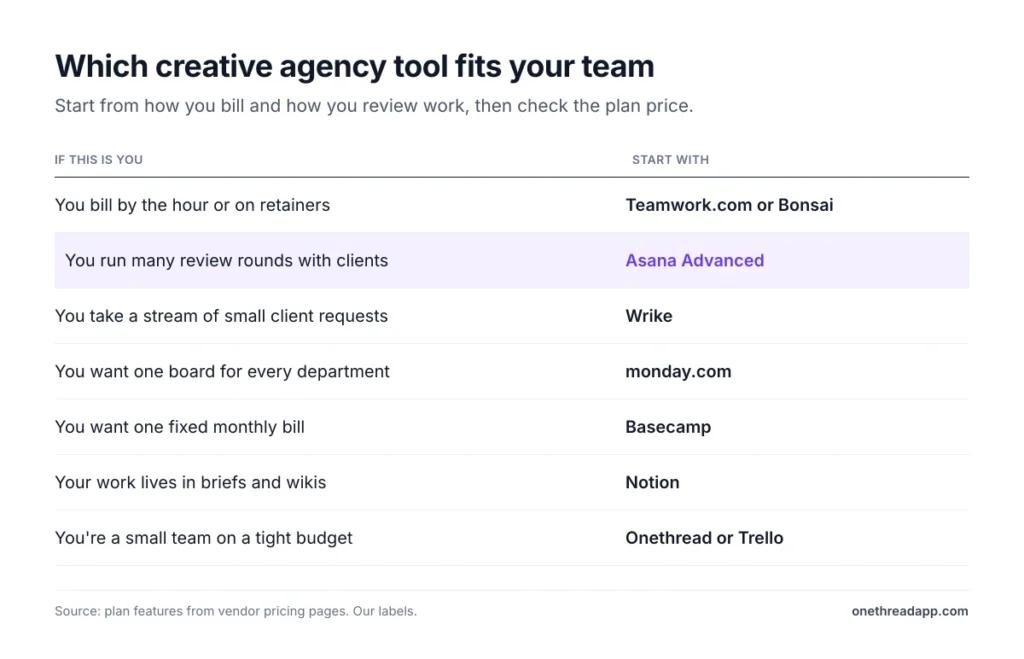
Choose by how you bill first, then by how you review work. The table pairs common agency situations with the tool that fits best.
| If this is you | Start with | Why |
|---|---|---|
| You bill by the hour or on retainers | Teamwork.com or Bonsai | Billable time and invoices from logged hours |
| You run many review rounds with clients | Asana Advanced | Proofing, approvals and free guests |
| You take a stream of small client requests | Wrike | Request forms and Gantt charts |
| You want one board for every department | monday.com | Many views and templates |
| You want one fixed monthly bill | Basecamp | Flat price, docs and files on every plan |
| Your work lives in briefs and wikis | Notion | Docs, databases and free page guests |
| You're a small team on a tight budget | Onethread or Trello | Free for 10 users, low paid plans |
Five checks keep the shortlist honest:
- Match the tool to your billing: hourly agencies need time tracking on the plan they buy.
- Test one real project: run a live client job through the free plan or trial for two weeks.
- Count every login: add your clients, freelancers and contractors to the seat count.
- Check the storage cap: a few video files can fill a 60 MB free plan in a day.
- Ask about renewal prices: some pricing pages show sale prices next to regular ones.
Running a larger shop with many departments? Our list of agency project management software covers tools for bigger teams. Design-only studios can also check our design project management software guide.
How Do You Set Up a Creative Agency Workflow in the Software?
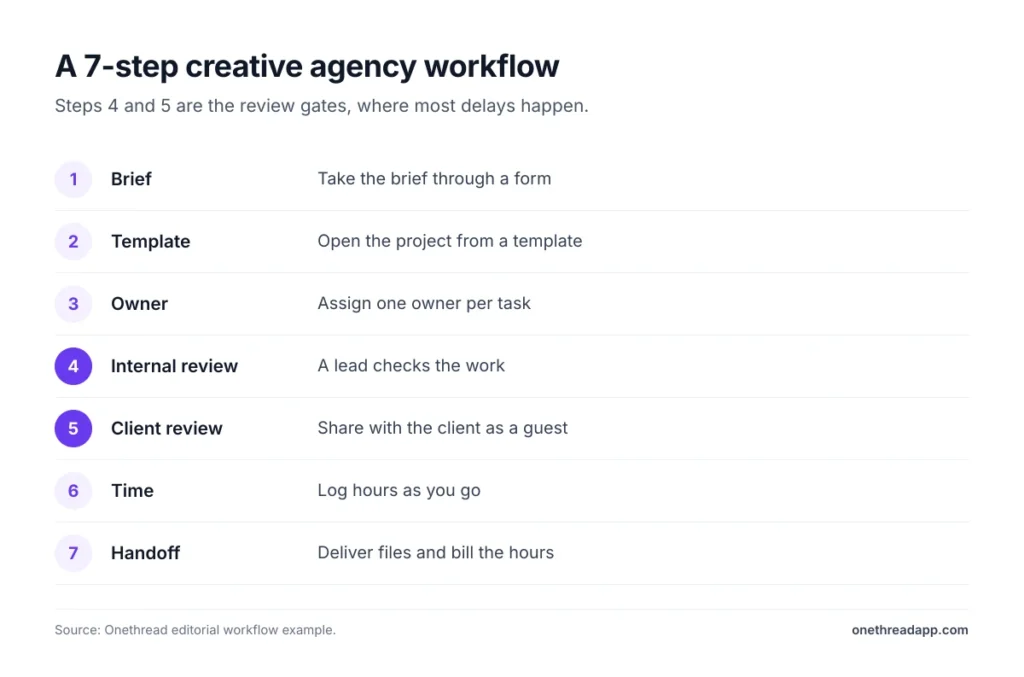
Set up your creative agency workflow around review gates, not just tasks. Most delays happen between "draft done" and "client approved", so give that gap its own stages.
- Take the brief through a form: collect sizes, copy, brand files and the deadline before work starts.
- Open the project from a template: copy the standard tasks for a campaign, site or video.
- Assign one owner per task: every deliverable has a single person who moves it forward.
- Add an internal review stage: a lead checks the work before the client sees it.
- Add a client review stage: share the file with the client as a guest, with a clear due date.
- Log time as you go: track hours against the client and task, not at the end of the week.
- Close with a handoff: deliver final files, mark the task done and bill the hours.
For the time side, our guide to time tracking software compares the tools in more depth. For staffing, read our resource management software roundup.
Keep the stages short. A board with 12 columns gets ignored, while a board with 6 gets used.
This setup also works as creative agency workflow software for small teams. You don't need a creative production management suite to get there.
What Mistakes Do Creative Agencies Make With Project Software?
The biggest mistake is buying on the first paid price, then upgrading three months later for one missing feature. Most of the other mistakes come from the same habit: picking the tool before mapping the work.
- Buying for features you won't use: a 6-person studio rarely needs portfolio dashboards or enterprise roles.
- Forgetting the guests: clients and freelancers can double your seat count on tools that bill them.
- Skipping the review stage: without a client review column, approvals drift back into email.
- Logging time at the end of the week: hours typed from memory make every invoice a guess.
- Running two tools for one job: if tasks live in one app and deadlines in another, nobody trusts either.
Here's the thing. Most agencies switch tools because of one of these five, not because the software failed.
A quick self-check helps. Can you say which plan holds your must-have feature, and what it costs for your real headcount? If not, you're comparing list prices, not tools.
Fix the cheapest mistake first. Add a client review stage to the tool you already have this week. If approvals still drift back into email after a month, the tool is the problem, and the decision table above shows where to look next.
What Should You Do Next With Your Creative Agency Software?
Picking the best project management software for a creative agency comes down to two questions: how you bill, and how you review work. A first paid plan rarely shows the real cost. It's the plan that holds time tracking or proofing that sets your bill, so price that one.
This week, list your team, your freelancers and your regular client reviewers. Then price the plan with your must-have feature for that headcount, and run one live client project through the trial before you commit. Two weeks of real work tells you more than any feature list.
Related reading: Best agency management system and Software advertising agency.
Creative Agency Project Management Software FAQs
What Is Creative Agency Project Management Software?
It's a tool that plans, tracks and delivers client creative work in one place. It holds briefs, tasks, files, review rounds and deadlines. Many tools add time tracking and client access. Design studios, marketing agencies and content teams use project management software for creative agencies to keep many client jobs moving at once.
Is There Free Project Management Software for Creative Agencies?
Yes. Onethread Basic is free for your company's first 10 users, with unlimited projects. Trello Free covers 10 collaborators per Workspace, and ClickUp Free Forever allows unlimited members with 60 MB of storage. Free plans for creative agencies usually leave out proofing, time tracking or storage, so check those limits first.
Which Project Management Tool Is Best for Proofing and Approvals?
Asana Advanced is the clearest pick for proofing in our list. Its pricing page lists annotation of PDFs and images and approval requests, at $24.99 per user a month billed yearly. Teamwork.com also lists Proofs for file approvals. For a creative agency, test proofing with a real client file during the trial.
Do Clients Need a Paid Seat to Review Work?
It depends on the tool. Asana offers unlimited free guests from Starter, Notion guests are free on any plan, and Trello Standard includes single-board guests. Basecamp counts every client as a user, and Wrike external users need a paid seat. Check the guest rules before you price project management software for a creative agency.
What Are the Best Visual Project Management Tools for Creative Agencies?
The most visual picks for creative agencies are monday.com, Trello and Asana. With colorful boards and many views, monday.com is easy to scan, and Trello keeps work on simple Kanban cards. Asana adds timelines and Gantt views from Starter. Onethread also includes Kanban, Gantt and calendar views, free for your first 10 users.