Google Workspace looks cheap until you multiply it by every inbox on the team.
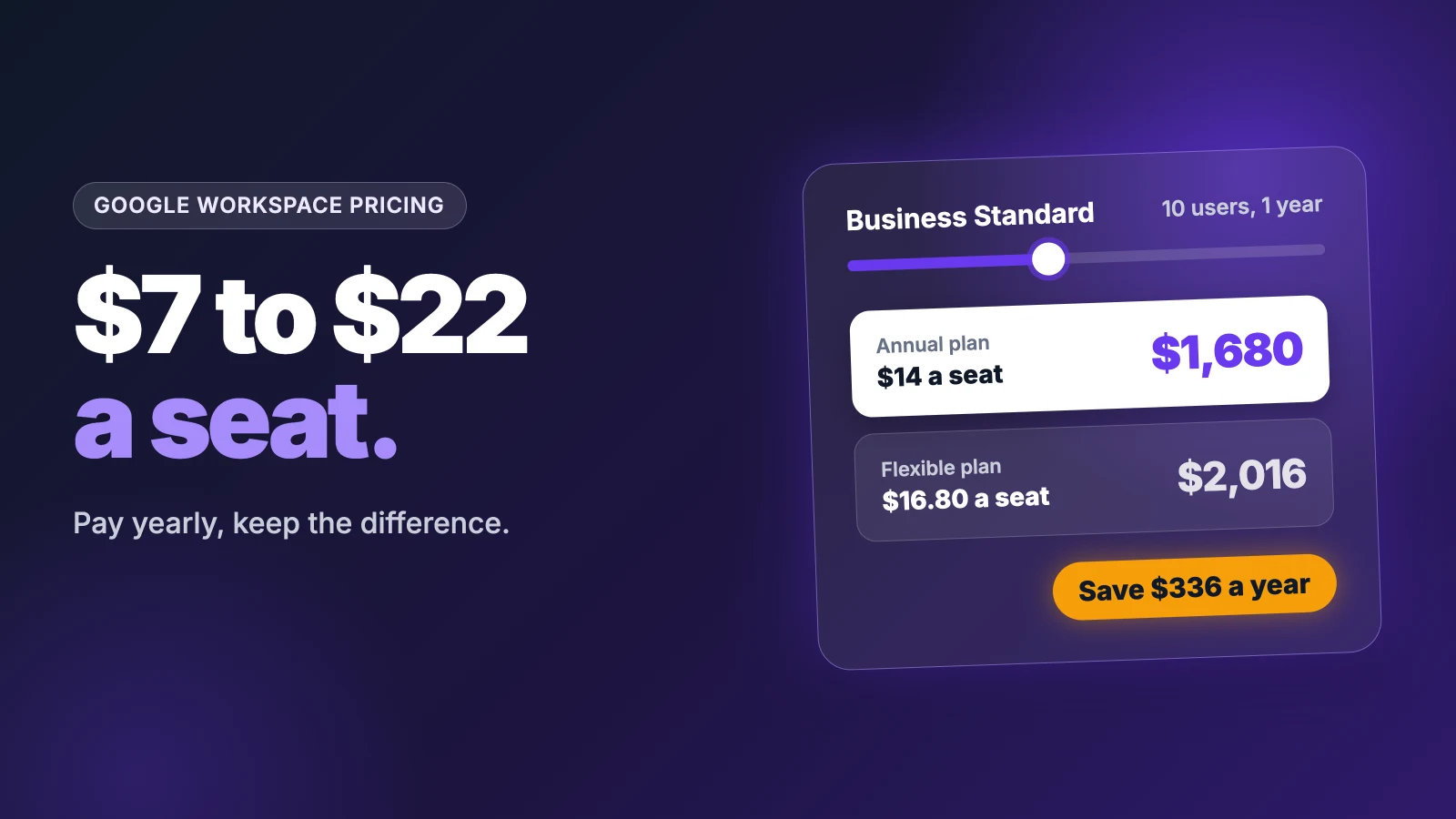
Google Workspace pricing starts at $7 per user a month for Business Starter on an annual plan. Business Standard costs $14 and Business Plus $22. Month to month, those prices rise to $8.40, $16.80 and $26.40.
Gemini AI now comes with every plan, so you can’t buy around it. And the gap between annual and monthly billing adds up fast.
We read Google’s live pricing page and compared five top-ranking guides to price each plan for a real team.
Here’s what each plan costs, what it includes, and which one fits your team.
Key Points
- Google Workspace costs $7, $14 or $22 per user a month on the annual plan, and $8.40, $16.80 or $26.40 on the flexible plan. Enterprise Standard lists at $32.40 and Enterprise Plus at $42, sold through Google sales.
- Pick Business Standard for most small teams. It adds 2 TB of storage per person, Meet recording and Gemini in Docs and Meet for $7 more than Starter.
- Commit to the annual plan for any seat you’ll keep 10 months or longer. A 10-person team on Standard saves $336 a year.
- Check the discounts before you pay list price. New customers get 10% off Starter and Standard for 12 months on their first 20 users, and qualifying nonprofits pay $0 to $6.16.
How Much Does Google Workspace Cost Per User?
Google Workspace costs $7 to $22 per user a month on the three Business plans when you commit for a year. The Flexible Plan bills the same plans month to month at a 20% higher rate, and you can add or remove users at any time.
| Plan | Annual price per user a month | Flexible price per user a month | Pooled storage per user | Meet participants |
|---|---|---|---|---|
| Business Starter | $7 | $8.40 | 30 GB | 100 |
| Business Standard | $14 | $16.80 | 2 TB | 150 |
| Business Plus | $22 | $26.40 | 5 TB | 500 |
| Enterprise Standard | $32.40 list, quoted by sales | Quoted by sales | 5 TB, more on request | 500 |
| Enterprise Plus | $42 list, quoted by sales | Quoted by sales | 5 TB, more on request | 1,000 |
Prices are in US dollars. Business plans stop at 300 users, while Enterprise has no minimum or maximum.
A user means one personalized email address. Group aliases such as sales@ or support@ cost nothing, which is a small mercy for anyone running five shared inboxes.
Sources: Google Workspace pricing, Google Workspace for Nonprofits.
What Does the Business Starter Plan Include?
Business Starter covers the basics: a custom email address, 30 GB of storage per person and Meet calls for up to 100 people. Gemini comes included, but only in Gmail and the Gemini chat app. Google Vids, the AI video editor, is in too.
So are security and admin controls, plus spam filtering that Google says blocks more than 99.9% of phishing and spam attacks. That baseline is the same on every plan.
Say you run a three-person studio that mostly emails clients and shares a few docs. Starter covers that for $21 a month on the annual plan.
The gaps show up quickly. Starter skips Meet recording, appointment booking pages and eSignature. And 30 GB fills fast once video files land in Drive.
Pricing: $7 per user a month on the annual plan, or $8.40 on the flexible plan. New customers pay $6.30 for the first 12 months.
Best For
- Small teams that need custom email, shared docs and short video calls.
Pros
- Lowest price of the three Business plans.
- Gemini included in Gmail and the Gemini app.
- Group aliases don’t count as extra users.
Cons
- 30 GB per person is tight for video or design files.
- No Meet recording.
- Gemini doesn’t reach Docs, Sheets or Meet on this plan.
What Does the Business Standard Plan Include?
Business Standard is the plan most small teams end up on. Storage jumps to 2 TB per person, which Google calls 65 times more than Starter. Meet calls hold 150 people, with recording and noise cancellation.
Gemini works in Gmail, Docs, Meet and more, plus Gemini Notebook for research. You also get appointment booking pages, eSignature for Docs and PDFs, and mail merge in Gmail.
Say a client needs to sign off on a proposal. You send it for eSignature straight from Docs, with no extra signing tool on the bill.
Pricing: $14 per user a month on the annual plan, or $16.80 on the flexible plan. New customers pay $12.60 for the first 12 months.
That intro price covers your first 20 users only. After 12 months, every seat moves to $14. Standard also includes the Workspace Migrate tool for moving data in from another system.
Best For
- Client-facing teams that record calls, book meetings or sign documents.
Pros
- 2 TB per person covers most file-heavy teams.
- Gemini across Gmail, Docs and Meet.
- Booking pages and document signing built in.
Cons
- No Google Vault for keeping or searching old records.
- Costs twice as much as Starter.
- Meet calls top out at 150 people.
What Does the Business Plus Plan Include?
Business Plus adds the compliance layer. Google Vault lets you retain, archive and search email and files, and eDiscovery helps when a legal request arrives.
Storage climbs to 5 TB per person. Meet holds 500 people and tracks attendance, which helps with training sessions. Admins get Secure LDAP, advanced endpoint management and stronger security controls.
Say a client contract makes you keep project email for several years. Vault handles that without a separate archive tool.
Here’s what that costs. A 10-person team pays $2,640 a year on Plus and $1,680 on Standard, so Vault and the extra storage add $960 a year. Plus has no intro offer, so year one costs the full list price.
That trade is worth it only when someone actually asks for old records. If nobody has, Standard keeps the $960.
Pricing: $22 per user a month on the annual plan, or $26.40 on the flexible plan. Google shows no new-customer discount for Plus.
Best For
- Teams in regulated or contract-heavy work that must keep records.
Pros
- Vault and eDiscovery included.
- 5 TB per person.
- Meet calls of 500 with attendance tracking.
Cons
- $8 more per user than Standard.
- No intro discount for new customers.
- Still capped at 300 users per account.
What Do Google Workspace Enterprise Plans Cost?
Enterprise Standard lists at $32.40 per user a month and Enterprise Plus at $42, but Google sells both through its sales team. Neither has a user minimum or maximum, so Enterprise is also the only path past 300 users.
Enterprise Standard brings 5 TB per person with more on request, live streams to 10,000 viewers, data retention and a 99.9% uptime guarantee. Enterprise Plus adds S/MIME and client-side encryption, 1,000-person meetings and data residency controls. It also labels Drive files with AI and moderates content in Chat.
Example: At list price, 10 users on Enterprise Standard cost $32.40 × 10 × 12 = $3,888 a year, before any sales discount.
Say you’re at 280 people and hiring. Start the sales conversation before you hit the Business cap, not after. Sales quotes take time, and new hires won’t wait.
Pricing: Enterprise Standard lists at $32.40 and Enterprise Plus at $42 per user a month. Your final price comes from Google sales.
Best For
- Companies over 300 people or with strict security rules.
Pros
- No user limit.
- Client-side encryption on Enterprise Plus.
- Meet calls of up to 1,000 people.
Cons
- Pricing needs a sales call.
- No public split between annual and monthly terms.
- Most small teams won’t use the extras.
How Do the Flexible and Annual Google Workspace Plans Differ?
The Flexible Plan bills monthly at a 20% premium and lets you drop users at any time. The Annual Plan locks the lower price for a year. Hiver’s Google Workspace billing guide reports you can add licenses mid-term but only cut them at renewal.
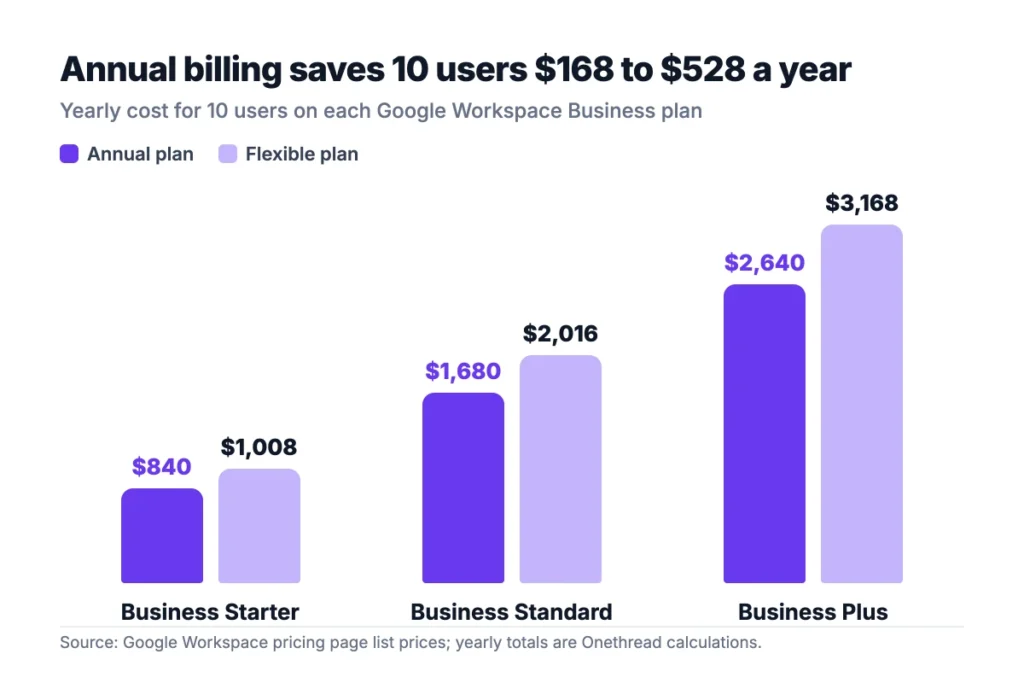
Example: A 10-person team on Business Standard pays $14 × 10 × 12 = $1,680 a year on the annual plan, or $16.80 × 10 × 12 = $2,016 on flexible. Committing saves $336, which covers two more Standard seats for a year.
Here’s the break-even, worked out from Google’s list prices. One annual seat on Standard costs $168 a year, and flexible billing reaches $168 after 10 months. So any seat you’ll keep for 10 months or more is cheaper on annual.
Seasonal contractors are the exception. If someone joins for a three-month project, the flexible plan wins. You pay $50.40 for that seat instead of $168.
Starter shows the same pattern at smaller numbers. Ten users cost $840 a year on annual and $1,008 on flexible. Either way, Google’s FAQ says billing runs monthly and the term only sets the rate.
Top Tip: Pick your term during the 14-day trial. Hiver reports that moving from annual to flexible only works during a trial or at renewal.
Why Did Google Workspace Pricing Go Up With Gemini?
Google raised prices when it bundled Gemini AI into every Business and Enterprise plan. Annual prices moved from $6, $12 and $18 to $7, $14 and $22, 9to5Google reported. Flexible prices went from $7.20, $14.40 and $21.60 to $8.40, $16.80 and $26.40.
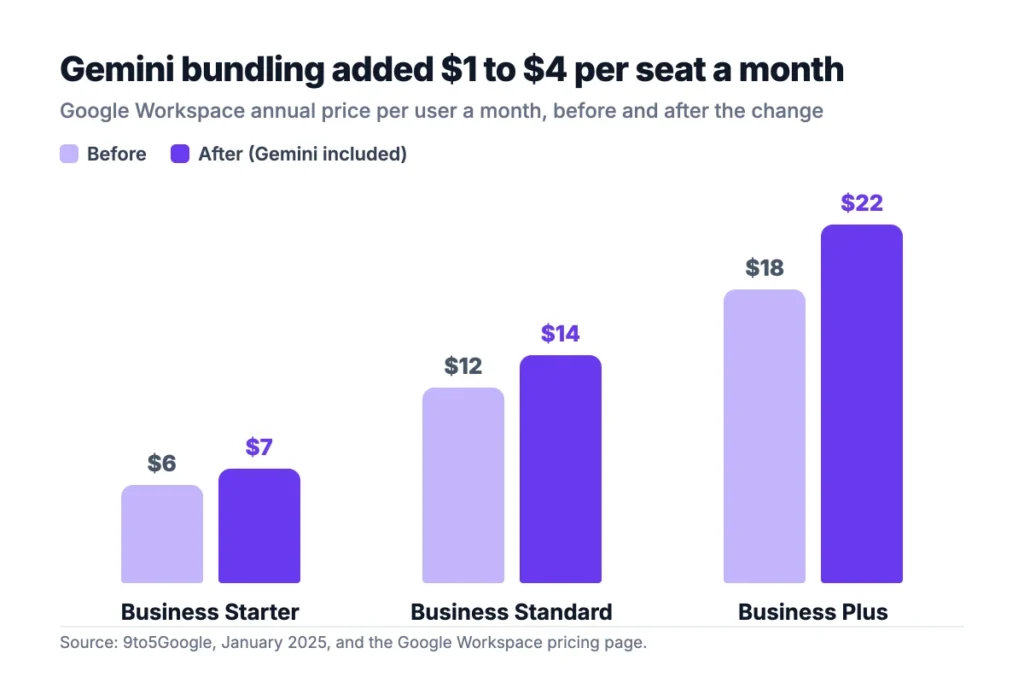
New customers paid the new rates from January 16, 2025. Existing customers moved from March 17, 2025, or at their next renewal, whichever came later.
Before the change, Gemini was a paid add-on. Jerry Dischler, Google’s President of Cloud Applications, framed the move as “removing the need to pay for an add-on”. His own example: a Business Standard customer who paid $32 with the Gemini Business add-on now pays $14.
Redress Compliance lists the retired add-ons at $20 per user for Gemini Business and $30 for Gemini Enterprise. Both now live inside the base plans.
Not everyone cheered. Some Reddit users say they feel forced to pay for AI, according to eesel’s summary of those threads.
Here’s the thing. If your team never opens Gemini, the $2 bump is pure cost. If it replaces a $20 add-on, it’s a bargain. Ask your team which Gemini features they used last month before you pick a tier on AI alone.
What Does a Team Pay for Google Workspace Each Year?
On the annual plan, a 10-person team pays $840 a year on Business Starter, $1,680 on Business Standard and $2,640 on Business Plus. We calculated each total from Google’s annual prices, before tax and the new-customer discount.
| Team size | Business Starter per year | Business Standard per year | Business Plus per year |
|---|---|---|---|
| 5 users | $420 | $840 | $1,320 |
| 10 users | $840 | $1,680 | $2,640 |
| 25 users | $2,100 | $4,200 | $6,600 |
Use the next table to match your team to a plan. The fit labels are our own reading of each plan’s limits.
| If your team | Pick |
|---|---|
| Mainly needs email, docs and short calls | Business Starter |
| Records calls, books meetings or signs documents | Business Standard |
| Must keep email and files for legal reasons | Business Plus |
| Has more than 300 people | Enterprise |
Workspace rarely sits alone on the bill. If your team also pays for chat or a wiki, compare Slack pricing and Notion pricing before you stack subscriptions.
How Can You Get Google Workspace for Free or Cheaper?
You can cut the bill three ways: the free Essentials Starter edition, nonprofit pricing, and Google’s new-customer offer. Every Business plan also starts with a 14-day trial.
Essentials Starter costs nothing but skips Gmail, so you keep your existing email. Cloudwards lists 15 GB per user and Meet calls of up to 100 people for 60 minutes. If that cap pinches, our guide to video conferencing software lists other options.
New customers get 10% off Starter and Standard for 12 months, on the first 20 users only. Nonprofits get the deepest cuts:
| Nonprofit plan | Annual price per user a month | Flexible price per user a month | Discount stated by Google |
|---|---|---|---|
| Workspace for Nonprofits | $0 | $0 | Free, 100 TB shared |
| Business Standard | $3.50 | $4.20 | 75% or more |
| Business Plus | $6.16 | $7.40 | 72% or more |
| Enterprise | Quoted by sales | Quoted by sales | 70% or more |
What Should You Do Next With Google Workspace?
Google Workspace pricing comes down to two choices: the plan and the billing term. Business Standard on the annual plan covers most small teams without paying for archiving they won’t use. The flexible plan only pays off for seats you’ll drop within 10 months.
This week, count the people who need their own address. Then list who records calls or signs documents, and price both terms against the team cost table. If client files are spreading across too many folders, our roundup of document management systems compares tools built for that job.
FAQs
What Is Google Workspace?
Google Workspace is Google’s paid suite of business apps. It includes Gmail with a custom email address, plus Drive, Docs, Sheets, Slides, Meet, Chat and Calendar, with admin and security controls on top. Google Workspace pricing is per user per month, and each plan adds storage, bigger meetings and more Gemini features.
Can You Mix Google Workspace Plans in One Company?
Yes, as long as every edition is paid. Google’s Admin Help on multiple editions says you can combine paid editions, but you buy them through a Google sales rep or partner. You can’t mix the free nonprofit edition with paid Google Workspace plans.
How Does Google Workspace Compare With Microsoft 365 on Price?
Microsoft lists Business Basic at $7, Business Standard with Copilot at $23.50 and Business Premium with Copilot at $32 per user a month, paid yearly. Google Workspace charges $7, $14 and $22 for its three Business plans, with Gemini included. Check Microsoft’s own page before deciding, since both vendors change prices.
What Add-Ons Cost Extra With Google Workspace?
Google sells Voice, AppSheet, Meet hardware and an AI Expanded Access add-on separately. Third-party guides list Google Voice from $10 per user a month and AppSheet from $5. Google doesn’t print the AI Expanded Access price on its pricing page, so ask sales before you budget for it.