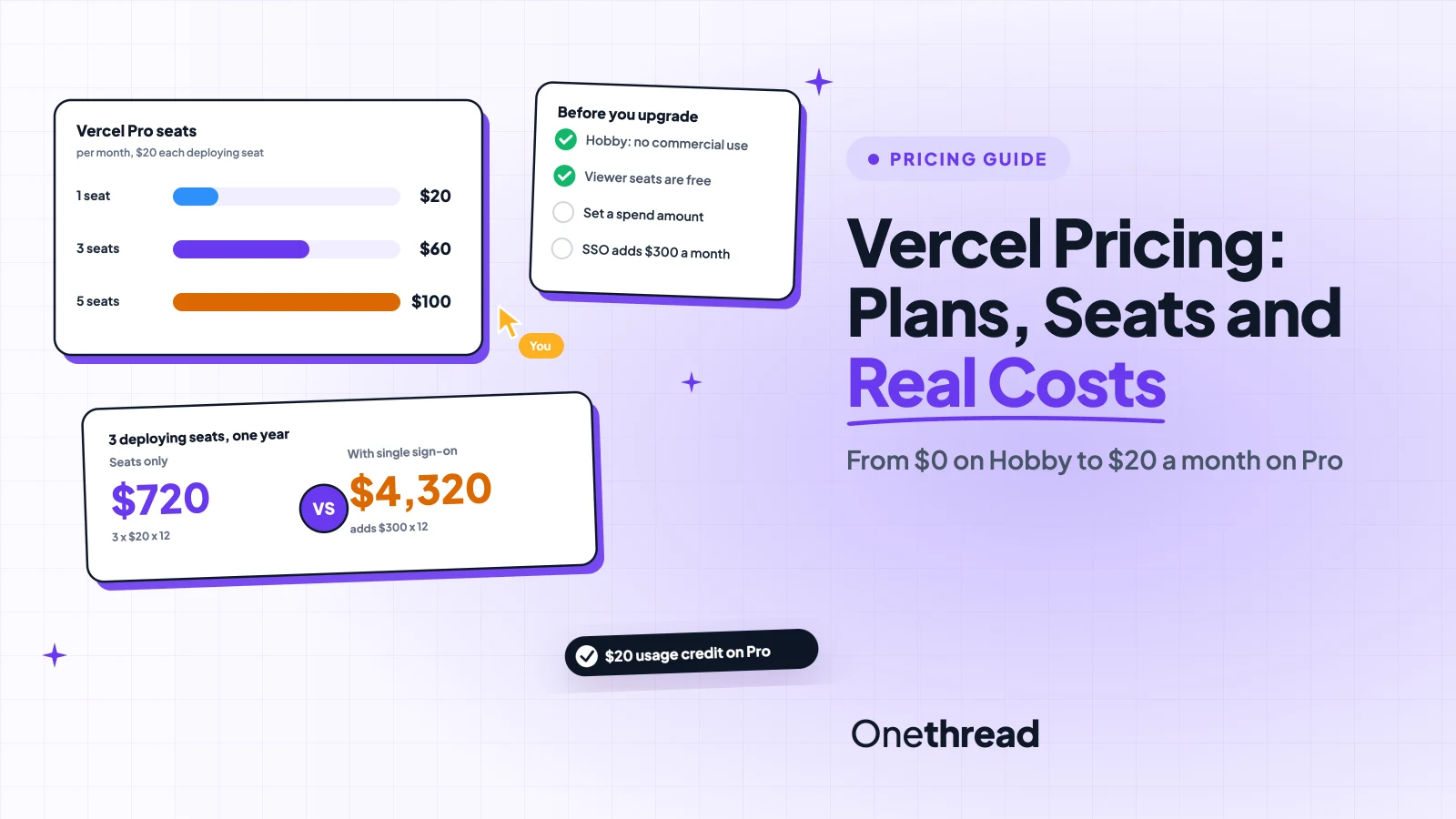
Vercel’s free plan feels endless. Then your side project lands its first paying customer.
Vercel pricing has three plans. Hobby is free for personal, non-commercial projects. Pro costs $20 a month for one deploying seat and $20 of usage credit, and each extra deploying seat adds $20. Enterprise is a custom quote.
So where does the bill grow? Extra seats, traffic past the included CDN tier, and add-ons such as $300 single sign-on.
We read Vercel’s pricing page and plan docs, then checked eight top-ranking guides.
You’ll see what each plan includes and what your team will pay in a year.
Key Points
- Vercel costs $0 on Hobby and $20 a month on Pro, which covers one deploying seat and $20 of credit. Extra deploying seats cost $20 a month each, viewers are free, and Enterprise is quoted.
- Keep Hobby for personal, non-commercial work. Past a limit, that feature usually stops for 30 days.
- Budget by deploying seats first. Three seats on Pro cost $720 a year before usage and add-ons.
- Set a spend limit on day one. Pro bills usage past 100% on demand.
How Much Does Vercel Cost per Month?
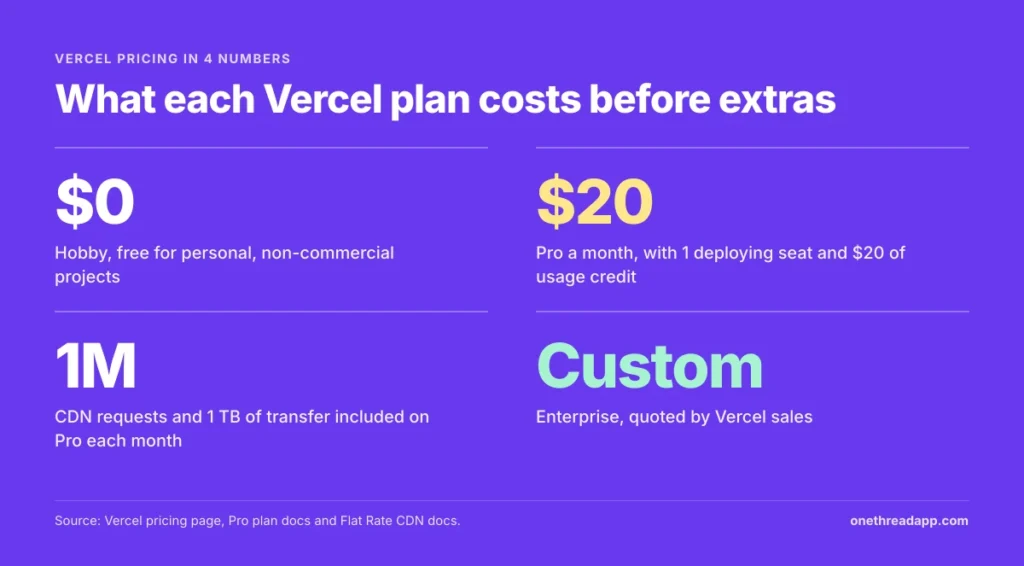
Vercel costs $0 a month on Hobby, $20 a month on Pro and a custom price on Enterprise. Pro adds $20 a month for each extra seat that can deploy code.
| Plan | Price a month | Who it’s for | Included usage | Seats |
|---|---|---|---|---|
| Hobby | $0 | Personal, non-commercial projects | 1M CDN requests, 100 GB transfer | 1 developer |
| Pro | $20 | Freelancers, teams and businesses | $20 credit, 1M CDN requests, 1 TB transfer | 1 deploying seat, then $20 each |
| Enterprise | Custom quote | Large teams with security needs | Custom | Custom |
Vercel bills Pro each month, and the pricing page shows no annual discount.
Sources: Vercel pricing page, Pro plan docs, Hobby plan docs, Flat Rate CDN docs, iad1 regional pricing, Enterprise plan docs.
How Does Vercel Pricing Work?
Vercel’s pricing model mixes a seat fee with metered usage. On Pro, the $20 platform fee buys one deploying seat and $20 of credit. That credit pays for compute, storage and other meters first. Past it, Vercel bills on-demand usage at listed rates.
The $20 Usage Credit Pays First
The usage credit applies from the first unit you use. It covers managed resources such as Active CPU, function calls, image work and Vercel Blob storage. Vercel notifies you when you reach 75% of it.
But the monthly credit doesn’t roll over. It expires at the end of each month and resets on the first day of the next. A quiet month won’t pay for a busy one.
Seats and add-ons sit outside it. They’re fixed charges on top of your usage.
Flat Rate CDN Caps Traffic Costs
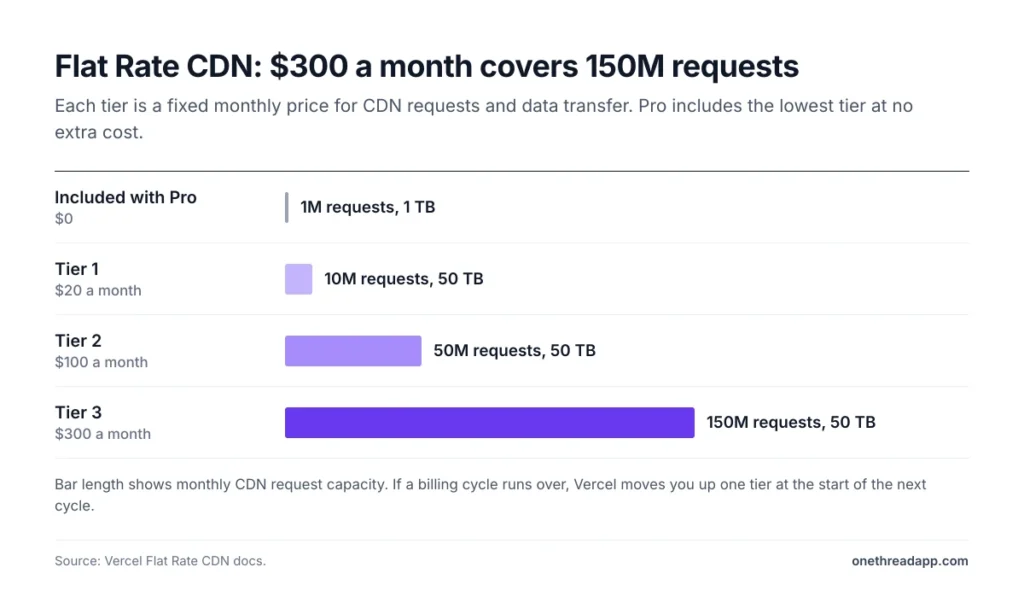
Flat Rate CDN is a fixed monthly price for CDN traffic on Pro. Pro includes the lowest tier at no extra cost: 1 million CDN requests and 1 TB of transfer a month. Paid tiers cost $20, $100 and $300 a month for 10M, 50M and 150M requests, each with 50 TB of transfer.
A one-day spike doesn’t change your bill. If a whole billing cycle runs over, Vercel moves you up one tier at the start of the next cycle.
What Does the Vercel Hobby Plan Include?
The Vercel Hobby plan is a free tier with no time limit. It grants 1 million CDN requests, 100 GB of data transfer, 4 hours of Active CPU and 1 million function calls a month. You also get 5,000 image transformations, 200 projects and 100 deployments a day.
Here’s the catch. Hobby is for personal, non-commercial use only. You can’t buy extra usage, either. Once you pass a limit, you usually wait 30 days before that feature works again.
Say you ship a portfolio and a weekend app. Hobby covers both with room to spare, and it costs nothing to keep them online. But the day a client pays for that app, you need Pro. Vercel’s fair use guidelines spell that rule out in plain words.
Pricing: $0, with no time limit.
Best For
- Personal sites, portfolios and side projects that earn no money.
Pros
- Free CI/CD, a global CDN and DDoS protection on every project.
- 1 million function calls and 100 GB of transfer each month.
- A preview deployment for every Git push.
Cons
- No commercial use is allowed.
- Hard caps, with a wait of up to 30 days after you hit one.
- One hour of runtime logs and one Hobby team per account.
What Does the Vercel Pro Plan Include?
The Vercel Pro plan costs $20 a month. That platform fee includes one deploying seat and $20 of credit. Each extra Owner or Member seat costs $20 a month, while viewer seats are free and unlimited.

Viewers can check analytics, open previews and leave comments, but they can’t deploy. So a client can follow the work for free.
Pro lifts most Hobby caps. You get unlimited projects, 6,000 deployments a day, one day of runtime logs and email support. Paid Pro teams also get one free domain for the first year. A 14-day trial with a $20 credit lets you test it first.
Spend never stops by itself on Pro. Vercel keeps your site live past 100% usage and bills the extra on demand.
Pricing: $20 a month, plus $20 for each extra deploying seat.
Best For
- Freelancers and businesses that ship commercial sites.
- Small teams that need previews, roles and one shared bill.
Pros
- Unlimited free viewer seats for clients and reviewers.
- A $20 monthly credit plus the included CDN tier.
- Spend alerts, with an option to pause projects at your limit.
Cons
- Paid seats add $20 a month each.
- The credit expires at the end of each month.
- Single sign-on and other security extras cost more.
What Does Vercel Enterprise Include?
Vercel Enterprise is a custom-priced plan for large teams. Vercel doesn’t publish a price, so you get a quote from sales. It includes everything in Pro, plus a 99.99% uptime SLA, SCIM and Directory Sync, and managed WAF rulesets.
Enterprise also adds multi-region compute with failover and isolated build machines. You get a dedicated success manager, custom invoicing and 12 custom environments, up from 1 on Pro. Function concurrency scales up to 100,000.
Say your security team wants SCIM user sync and a signed uptime SLA. Those sit on Enterprise only, so the plan choice is made for you. Start the sales talk early, because a quote takes longer than a credit card form. Ask for the price of your seats, your traffic and any add-ons in writing.
Pricing: Custom quote from Vercel sales.
Best For
- Large companies that need SLAs, SCIM and audit logs.
- Teams that face formal security reviews before launch.
Pros
- A 99.99% uptime SLA and support response times.
- SCIM, Directory Sync and access groups for user control.
- A dedicated success manager and professional services.
Cons
- No public price, which makes early budgets hard to plan.
- A sales process before you can sign the contract.
- Secure Compute still costs extra on top.
Which Vercel Usage Charges Raise the Bill?
Vercel usage charges start once the $20 credit runs out. Each meter has its own rate, and rates change by region. These are Pro rates for Washington, D.C. (iad1).
| Meter | Included on Hobby | On-demand rate on Pro (iad1) |
|---|---|---|
| CDN requests | 1M a month | $2 per 1M |
| Fast Data Transfer | 100 GB | $0.15 per GB |
| Active CPU | 4 hours | $0.128 per hour |
| Function invocations | 1M | $0.60 per 1M |
| Image transformations | 5,000 | $0.05 per 1,000 |
With the CDN tier turned on, it covers CDN requests and Fast Data Transfer instead. Other meters still bill.
Incremental Static Regeneration (ISR) writes cost ten times more than reads: $4 against $0.40 per million.
Example: an app uses 100 hours of Active CPU in a month. That’s 100 × $0.128 = $12.80, which the $20 credit covers, with $7.20 left for other meters.
What Do Vercel Pro Add-Ons Cost?
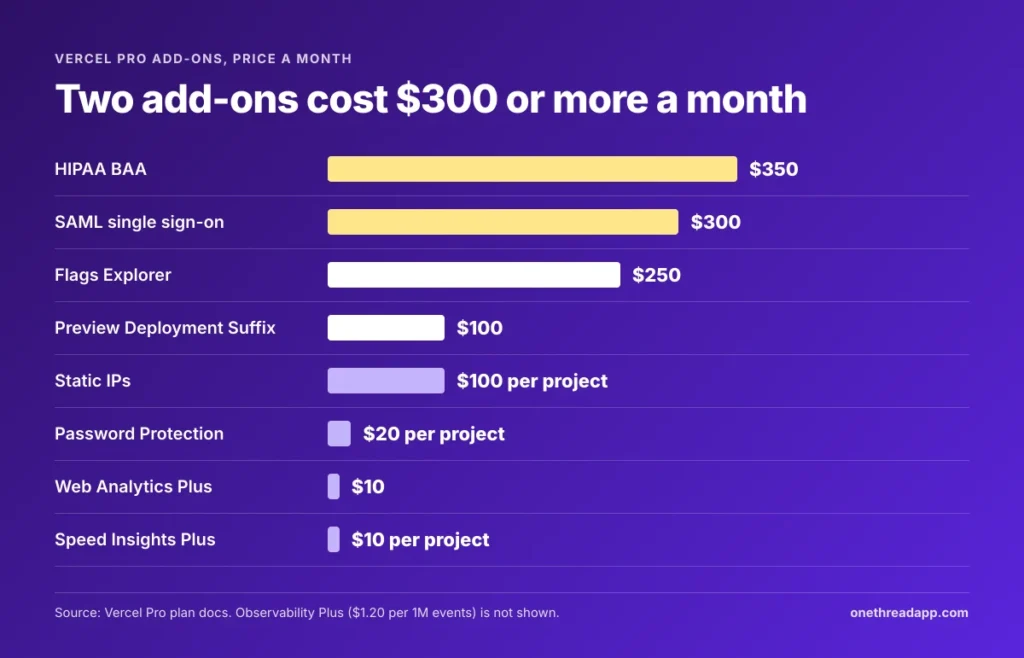
Vercel Pro add-ons are flat fees on top of seats and usage. The biggest ones cover security and compliance, and they’re the hidden costs most teams miss.
| Add-on | Price |
|---|---|
| SAML single sign-on | $300 a month |
| HIPAA BAA | $350 a month |
| Flags Explorer | $250 a month |
| Preview Deployment Suffix | $100 a month |
| Static IPs | $100 a month per project |
| Password Protection | $20 a month per project |
| Web Analytics Plus | $10 a month |
| Speed Insights Plus | $10 a month per project, plus $0.65 per 10,000 events |
| Observability Plus | $1.20 per 1 million events |
Here’s the thing. Single sign-on alone costs as much as 15 deploying seats.
Top Tip: Try free Vercel Authentication on your previews before you buy Password Protection. Hobby and Pro both include it, while Password Protection adds $20 a month per project.
What Will a Vercel Team Pay per Year?
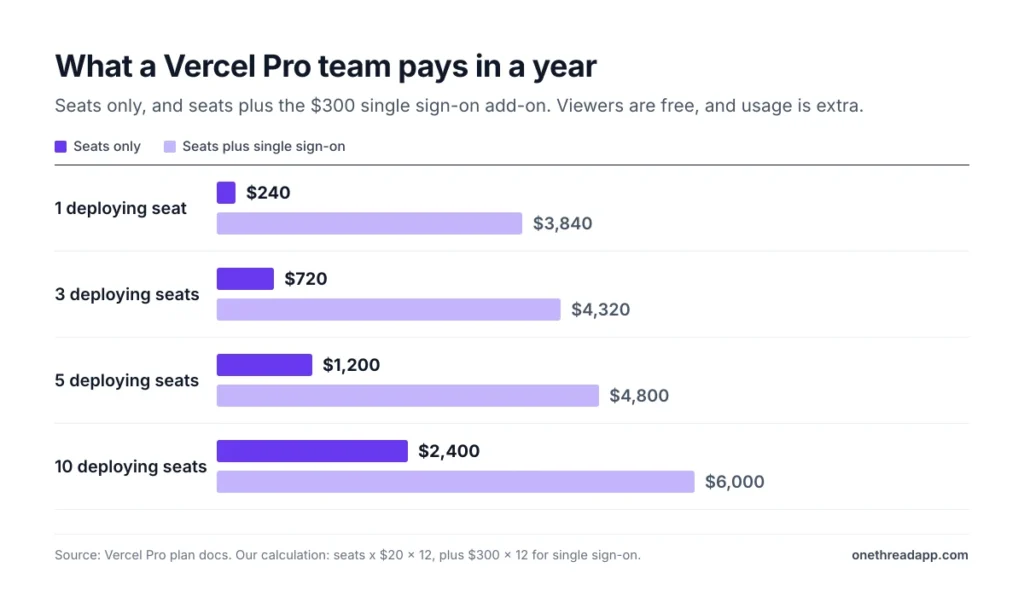
A Vercel Pro team pays $240 a year for each deploying seat, before usage and add-ons. Viewers add nothing.
Example: a team with 3 developers and 2 clients who only review previews pays for 3 seats. That’s 3 × $20 × 12 = $720 a year. The 2 clients join free.
| Deploying seats | Cost a month | Cost a year | Cost a year with single sign-on |
|---|---|---|---|
| 1 | $20 | $240 | $3,840 |
| 3 | $60 | $720 | $4,320 |
| 5 | $100 | $1,200 | $4,800 |
| 10 | $200 | $2,400 | $6,000 |
Traffic is the other line. A site that averages 5 million CDN requests a month moves to the $20 tier for 10M requests. That adds $240 a year. If your app also needs a hosted database, our Supabase pricing guide covers that side of the bill.
If Vercel is one line in a bigger client budget, our guide to cost estimation in project management covers the rest. A free project estimate calculator helps you total it.
How Can You Keep a Vercel Bill Under Control?
You keep a Vercel bill under control with spend management, caching and seat roles. Pro never stops your site by itself at 100% usage, so the limits are yours to set and check.
Five checks help:
- Spend amount: Vercel sets a $200 alert for new teams by default. Change it to your real monthly budget.
- Auto pause: Pause all projects when you reach your budget, or fire a webhook or an SMS alert instead.
- Caching: Cached responses cut function calls and duration charges on Pro. Each request still counts as a CDN request, though.
- Seat roles: Give clients and managers the Viewer role. They can comment on previews and check analytics for free.
- Flex CDN: Move side projects off your CDN tier capacity, so they don’t push you into a paid tier. Those projects must use Vercel DNS for their domains.
Hobby works the other way. It pauses at its limits, which guards your wallet but takes the site down until the wait ends.
One habit beats all five checks. Open the usage page in your dashboard once a week during your first month on Pro. You’ll see which meter grows with your traffic before it shows up on an invoice.
Which Vercel Pricing Plan Fits Your Team?
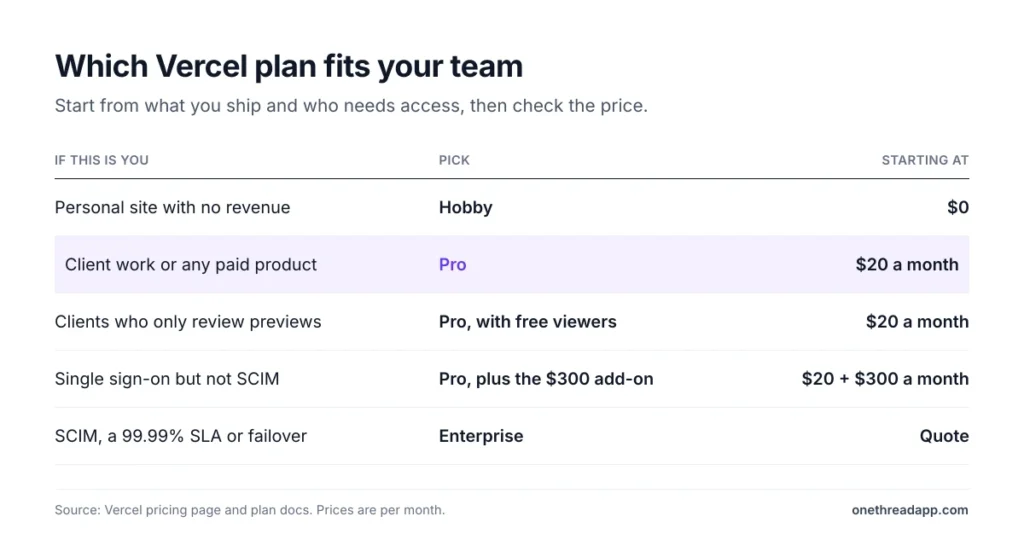
Most paying teams fit on Vercel Pro. Hobby fits only non-commercial work, and Enterprise fits when security or contract terms decide for you.
| Your situation | Plan to pick |
|---|---|
| Personal site with no revenue | Hobby |
| Client work or any paid product | Pro |
| Clients who only review previews | Pro, with free viewers |
| Single sign-on but not SCIM | Pro, plus the $300 add-on |
| SCIM, a 99.99% SLA or failover | Enterprise |
Our list of project management software for developers covers release planning, and the best project management software roundup compares more options. Onethread’s project and time tracking features keep releases and budgets in one place. For AI coding seats in the same budget, see Claude Code pricing.
What Should You Do Next With Vercel?
Vercel pricing looks like $20 a month, but the real number is seats times $20, plus usage past the credit, plus add-ons. Most small teams land on Pro, pay for the people who deploy and invite everyone else as viewers. Now you can price your whole team before the first invoice arrives, not after it lands.
This week, list who deploys code on your team and who only reviews it. Multiply the first group by $240, add any add-on you need, and set your Vercel spend amount to match that number.
FAQs
Is Vercel Expensive?
Vercel pricing is cheap for small sites and gets expensive with seats, traffic and add-ons. Hobby is free, and Pro starts at $20 a month with $20 of credit. Costs climb when you add deploying seats, pass the included CDN tier or buy single sign-on at $300 a month.
Is Vercel Free or Paid?
Vercel is both. The Hobby plan is free for personal, non-commercial projects, while commercial work needs Pro or Enterprise. You can test Pro with a 14-day trial that includes a $20 credit, one per user account. Without a card on file, the team returns to Hobby when the trial ends.
What Is Vercel Mainly Used For?
Vercel is mainly used to deploy and host web apps and frontends. Every plan includes automatic CI/CD from Git, a global CDN, Fluid compute for server functions and DDoS protection. Teams push code, get a preview for each change, then send it to production.
Does Vercel Offer an Annual Discount?
No, Vercel doesn’t publish an annual discount for Pro. The Pro docs describe monthly billing for seats, add-ons and usage. Enterprise customers can get custom invoicing, so ask sales about a yearly contract. Vercel pricing is in US dollars, with tax added based on your billing address.
How Much Does v0 by Vercel Cost?
v0 has its own pricing, separate from Vercel hosting. Free costs $0, Plus costs $30 per user a month and Business costs $100 per user a month. Both paid plans include $30 of monthly credit per user, plus $2 of free daily credit when you log in.