Every team runs projects, even the ones that never use the word.
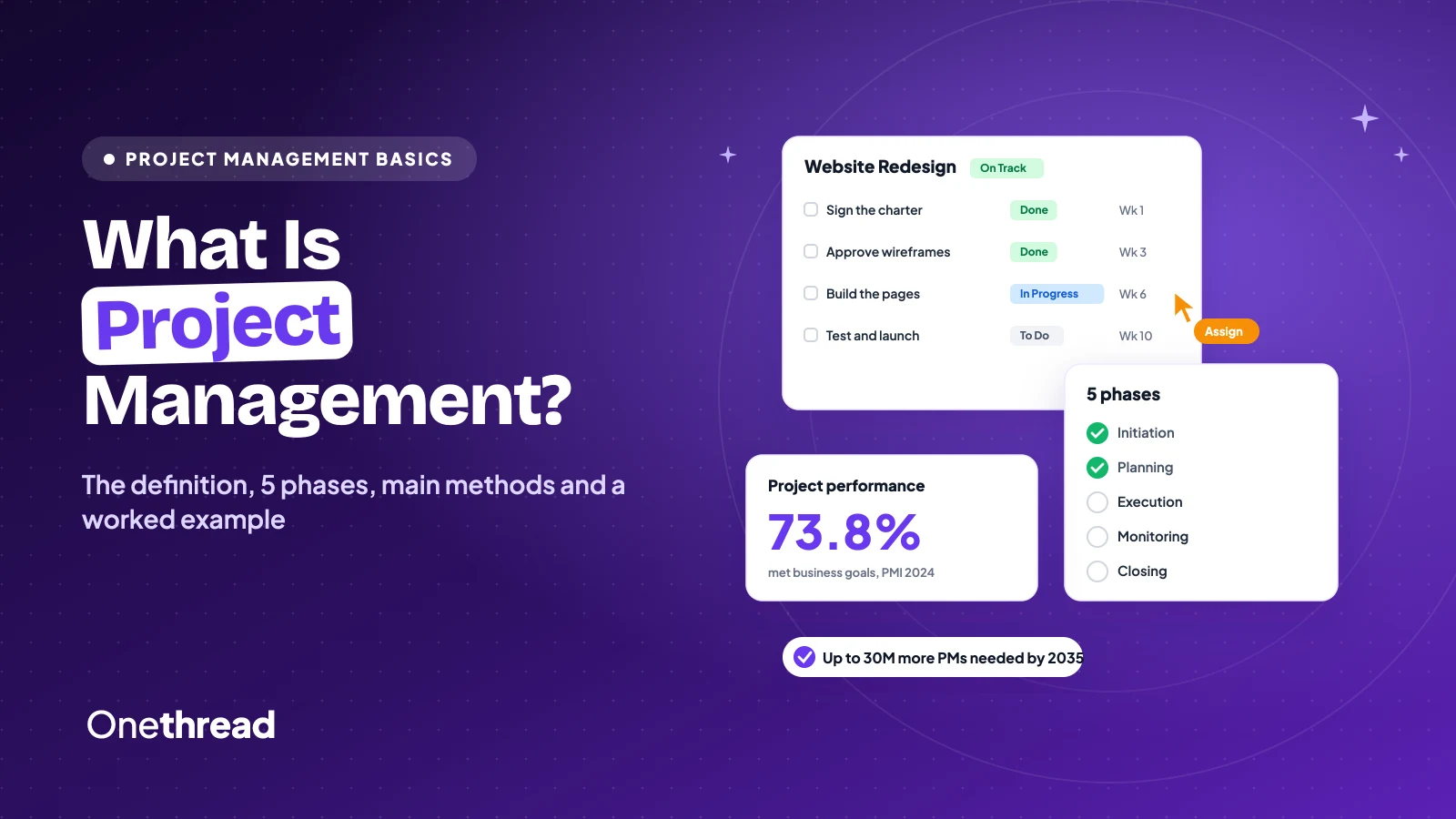
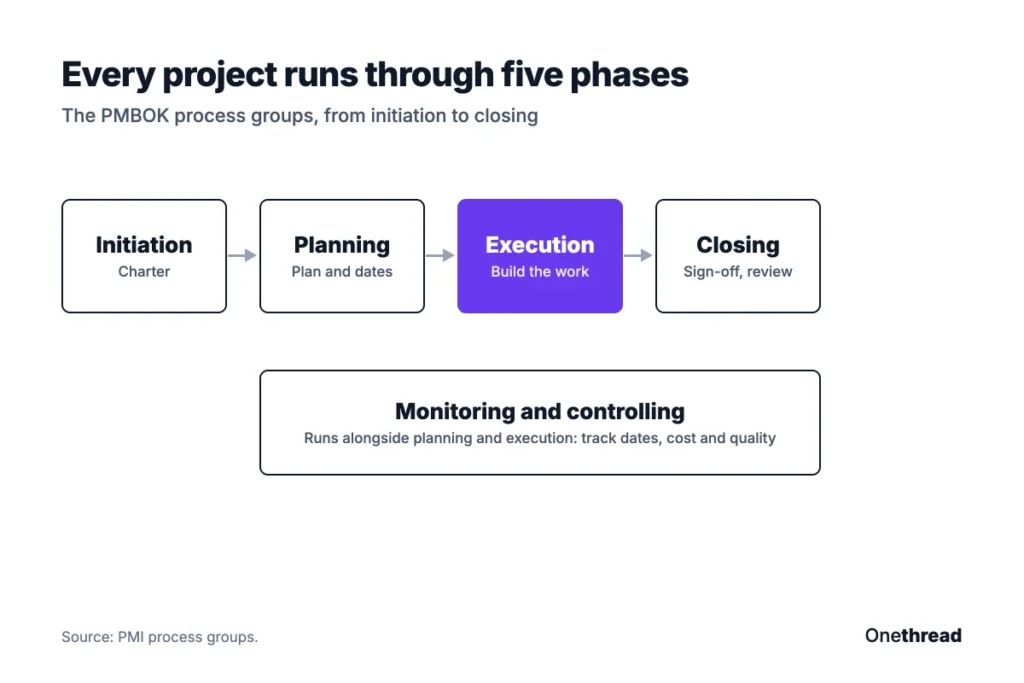
Project management is the work of planning, organizing and steering a one-time effort to a set result. The goal is to finish on time, on budget and to the agreed standard. It runs in five phases: initiation, planning, execution, monitoring and closing.
You do not need a title or a certificate to use it. You need a clear goal, a plan, an owner for each task and a habit of checking progress.
We base this overview on PMI's definitions, the PMBOK Guide and US labor data.
You get the phases, the main methods, the project manager's role and a worked example.
Key Points
- Project management is planning, organizing and steering a temporary piece of work to a set result, on time and within budget. PMI defines a project as a temporary endeavor that creates a unique product, service or result.
- Run every project through five phases: initiation, planning, execution, monitoring and controlling, and closing.
- Pick a method that fits the work: Waterfall for fixed scope, Agile or Scrum for changing scope, and Kanban for a steady flow of requests.
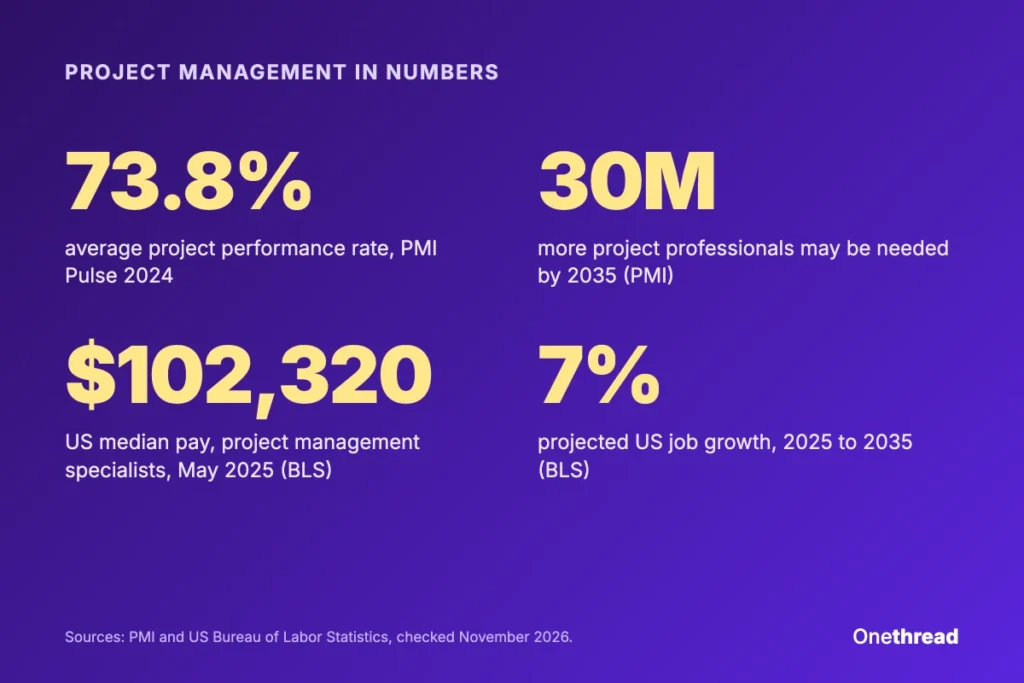
- Treat it as a skill and a career: US project management specialists earn a median $102,320 a year, and PMI expects up to 30 million more project professionals to be needed by 2035.
What Is Project Management?
Here is a short overview of project management. It is the practice of using knowledge, skills, tools and techniques to meet a project's goals. That is close to PMI's long-standing wording, and it covers both big programs and a two-week website change.
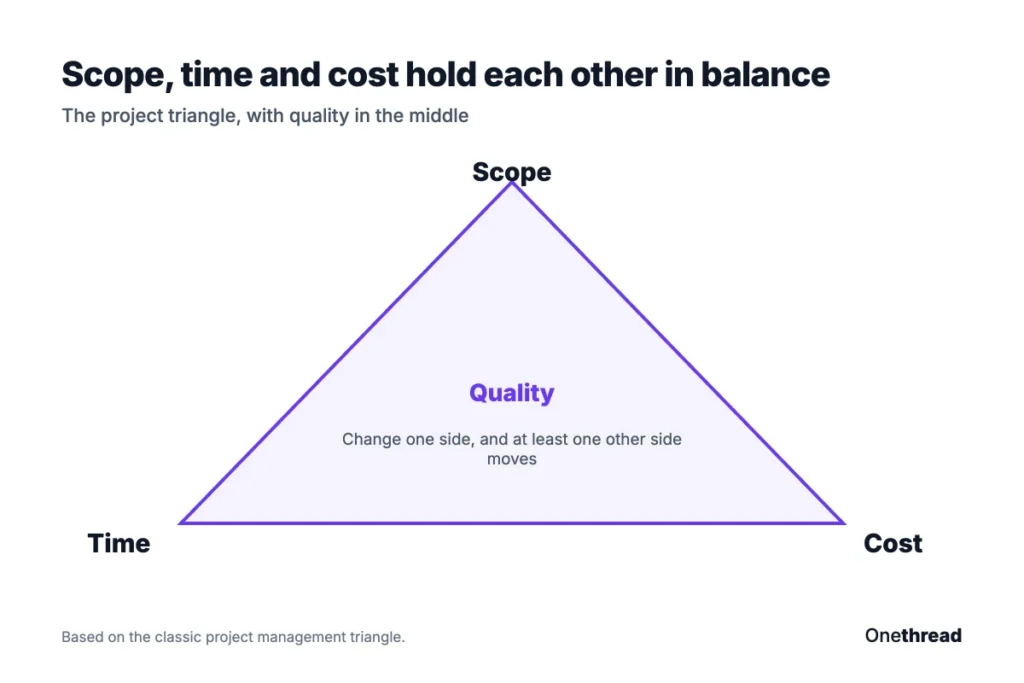
In plain terms, you decide what "done" means, plan the work, assign it, track it and close it out. The scope, the schedule and the budget hold each other in balance. Change one, and at least one of the others moves.
A project ends when its goal is met, and the team moves on to other work. Payroll, customer support and monthly reporting never end, so they are operations, not projects.
Project management also covers the people side. Someone has to agree on goals with stakeholders, settle trade-offs and keep the team moving when plans change.
Small teams often run projects in a spreadsheet or a chat thread. That works until two projects need the same people. At that point, a shared plan pays for itself.
The idea is not new, and it is not tied to one industry. Large building and defense programs used formal scheduling methods decades ago. Today the same ideas run marketing launches, office moves and app releases.
What Is a Project in Project Management?
A project is "a temporary endeavor undertaken to create a unique product, service, or result," according to PMI. Two words carry the meaning: temporary and unique.
Temporary means a project has a start and an end date. Unique means the output is new in some way, even if the steps look familiar. Launching a website, moving an office and running a product recall are all projects.
Every project shares a few traits:
- A clear goal that tells the team when the work is done.
- A budget and a deadline that limit how much work fits.
- A team pulled together for the job, often from several departments.
- Some risk, because the work has not been done in exactly this way before.
Projects also differ from programs and portfolios. Each one sits at a different level of the company. A program groups related projects that share a goal. A portfolio is the full set of projects and programs a company chooses to fund.
Our guide to what is business management shows where project work sits inside the wider running of a company.
A quick test helps. Will the work stop once a goal is met? Then treat it as a project, with a plan, an owner and an end date.
Why Is Project Management Important?
Project management matters because it turns goals into finished work you can measure. Without it, scope grows, dates slip and nobody owns the gaps.
The numbers back this up, and they come from a large yearly survey. PMI's 2024 Pulse of the Profession reports an average project performance rate of 73.8%, which means about one project in four misses its business goals. Our older guide on why projects fail covers the usual causes, such as unclear goals, weak planning and poor communication.
Good project management helps teams in four clear ways:
- Clear goals and scope, so everyone builds the same thing.
- Realistic plans, so dates and budgets hold up under normal changes.
- Early warning on risks, so problems are fixed while they are still small and cheap.
- Clear ownership, so every task has one person who answers for it and no work falls between teams.
Demand for the skill keeps growing. PMI's 2025 talent report says the world may need up to 30 million more project professionals by 2035. About 40 million people do this work today.
Small firms benefit too. A five-person agency that ships on time spends less time on rework and has more hours for new clients.
What Are the 5 Phases of Project Management?
Project management runs in five phases: initiation, planning, execution, monitoring and controlling, and closing. PMI calls them process groups, and they come from the PMBOK Guide.
The phases overlap in real projects. Monitoring runs alongside execution, and planning often repeats when scope changes.
Initiation
Initiation answers whether the project is worth doing. The sponsor states the goal, the expected value and the rough budget. The output is a short project charter that names the sponsor, the project manager and the success measures.
Keep the charter to one or two pages. It is a decision record, not a plan. If no one will sign it, the project should not start.
A quick stakeholder list belongs here too. Write down who funds the work, who uses the result and who can block it.
Planning
Planning turns the goal into tasks, dates and costs. A good project plan breaks the work into deliverables, assigns owners, sets the schedule and lists the main risks.
Most teams use a work breakdown structure to split the scope into small pieces. Then they order the tasks, estimate effort and build a timeline or Gantt chart.
Planning also sets the rules: how often the team reports, who approves changes and where files live. Ten minutes on those rules saves hours of confusion later.
Execution
Execution is where the team builds the deliverables. The project manager assigns work, removes blockers and keeps stakeholders informed.
This phase uses most of the budget and most of the hours. It also brings the most change, so the plan needs a clear way to absorb new requests.
Daily or weekly check-ins keep execution on track. Each person says what they finished, what is next and what blocks them. Keep these short, and move long talks to a separate call.
Monitoring and Controlling
Monitoring and controlling compares real progress with the plan and fixes the gaps. The project manager tracks dates, costs and quality, and reports on milestones as they are reached.
A milestone is a checkpoint with zero duration, such as "design approved." Our guide on what is a project milestone shows how to set them.
When a gap appears, the team decides whether to add people, cut scope or move a date. That decision is recorded so everyone knows what changed and why.
Closing
Closing confirms the work is done and formally ends the project. The sponsor signs off the deliverables, the team hands over files and support, and contracts are closed.
A short review captures what went well and what to change next time. Write down three lessons and one owner for each, or they will be forgotten by the next kickoff.
Closing also releases the team, so people can move to new work without loose ends. Archive the plan and files where the next team can find them.
What Are the Core Elements of Project Management?
The core elements of project management are scope, time and cost, held together by quality. Most teams also manage risk, resources and stakeholders.
| Element | What you manage | Typical tool |
|---|---|---|
| Scope | What the project will and will not deliver | Scope statement, work breakdown structure |
| Time | Task order, durations and deadlines | Timeline, Gantt chart, critical path |
| Cost | Budget, spending and forecasts | Cost estimate, budget tracker |
| Quality | Standards the output must meet | Acceptance criteria, reviews |
| Risk | Events that could hurt the project | Risk register |
| Resources | People, tools and materials | Resource plan, workload view |
| Stakeholders | People who fund, use or affect the work | Stakeholder map, status reports |
Scope, time and cost form the project triangle. If a client adds features, you need more time, more money or both. If the deadline moves up, you cut scope or add people.
The PMBOK Guide Eighth Edition, released in November 2025, groups this work into seven performance domains: governance, scope, schedule, finance, stakeholders, resources and risk.
What Are the Main Project Management Methodologies?
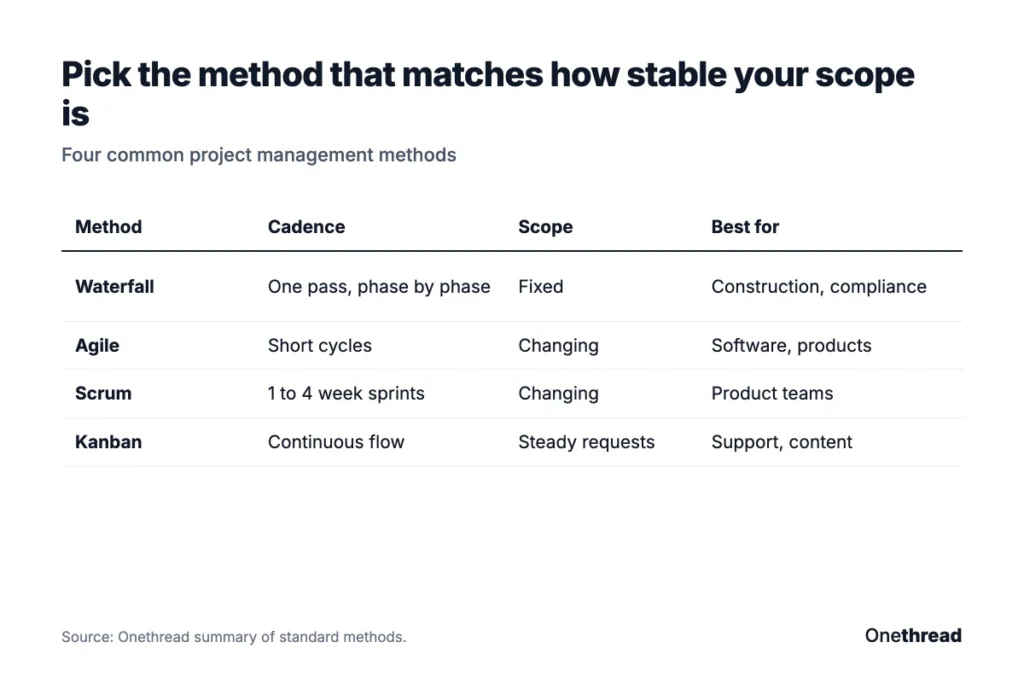
A project management methodology is a set of rules for how the team plans and delivers work. The right one depends on how stable your scope is.
| Methodology | How it works | Best for |
|---|---|---|
| Waterfall | Finish each phase before the next one starts | Fixed scope, such as construction or compliance work |
| Agile | Deliver in short cycles and adjust after each one | Software and products where needs change |
| Scrum | Agile in fixed sprints with set roles and reviews | Product teams shipping every one to four weeks |
| Kanban | Visual board that limits work in progress | Steady streams of requests, such as support or content |
| Lean | Remove waste and keep only steps that add value | Process improvement and operations-heavy projects |
| Hybrid | Waterfall planning with Agile delivery | Client projects with a fixed budget but changing details |
Some teams also use scheduling techniques on top of a method. The critical path method finds the longest chain of linked tasks, which sets the earliest finish date. Our older guide to project planning techniques such as CPM walks through how it works.
There is no single best method. Many teams start with a simple Kanban board and add structure only when the work needs it.
What Does a Project Manager Do?
A project manager owns the plan and the result. They agree on goals with stakeholders, build the schedule, assign work, track progress and fix problems before they grow.
The day-to-day work looks like this in most teams:
- Running kickoff, status and review meetings.
- Updating the plan when scope, dates or people change.
- Reporting progress and risks to sponsors and clients.
- Settling conflicts over priorities and workload.
Communication takes up much of the job. Project managers write status updates, run reviews and create engaging presentations and reports that explain complex plans in a few slides.
The core project management skills are planning, communication, risk thinking, budgeting and leadership. Tool skills matter too, because most teams now plan in software rather than on paper.
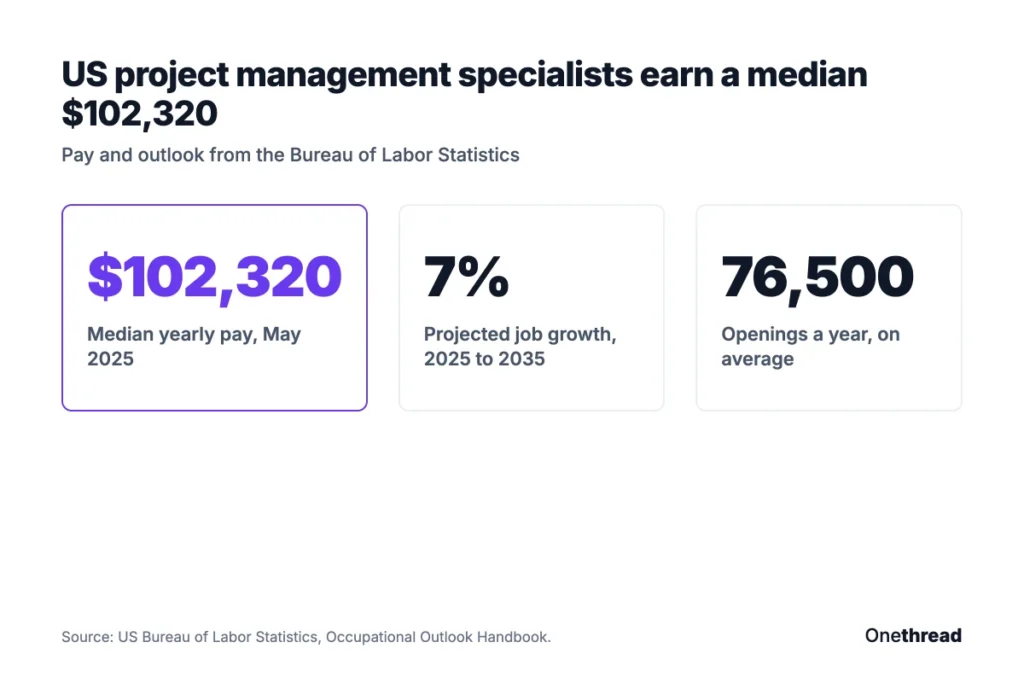
The job pays well in the US. The Bureau of Labor Statistics lists a median pay of $102,320 a year for project management specialists. That figure is from May 2025. It projects 7% job growth from 2025 to 2035, with about 76,500 openings a year.
Project managers work in almost every field, from IT and construction to marketing and health care. The title changes, but the core loop of plan, track and close stays the same.
How Do You Become a Project Manager?
You can become a project manager by leading small projects first, learning a method, and adding a certification once you have experience. Many project managers start in another role, such as design, sales or engineering, and take on projects over time.
The best-known certification is the PMP from the Project Management Institute, and many job posts ask for it. The exam costs $405 for PMI members and $555 for non-members, according to PMI. You need 35 hours of project management education.
You also need project experience. With a four-year degree, that is 36 months. With a high school diploma or associate degree, it is 60 months.
New starters can take the CAPM instead, which PMI designed as an entry-level credential. It needs a high school diploma and 23 hours of project management education, with no work experience. Our list of PMI certifications explains the full PMI family.
Hands-on work counts as much as a certificate. In small firms, it often counts more.
Offer to run a small internal project, such as a team offsite or a new tool rollout. Use it to practice the five phases from start to finish, and keep the charter and review notes as proof of your work.
What Tools Help You Manage Projects?
Project management tools keep the plan, the tasks and the updates in one place. The basics are a task list, a timeline or Gantt chart, a board view and a way to share files and comments.
Spreadsheets work for one small project. Once you run several projects with shared people, a dedicated tool saves real time each week. Every update shows up for the whole team, and no one hunts for the latest file.
Look for four things when you choose. You want a clear task list and a timeline. You also want simple sharing with clients and reports that show what is late.
Onethread is one example, built for small teams and agencies. It includes task management, project planning with phases and milestones, Gantt charts, a calendar view, timesheets, sprints and dashboards. The Basic plan is free for the first 10 users.
Other popular choices include Asana, Trello, monday.com, Jira and ClickUp. Each one leans toward a different method. Our comparison of the best project management software sets them side by side by price and fit.
Top Tip: pick the tool after you choose your method. A Kanban team needs a good board, while a Waterfall team needs a strong Gantt chart.
What Does Project Management Look Like in Practice?
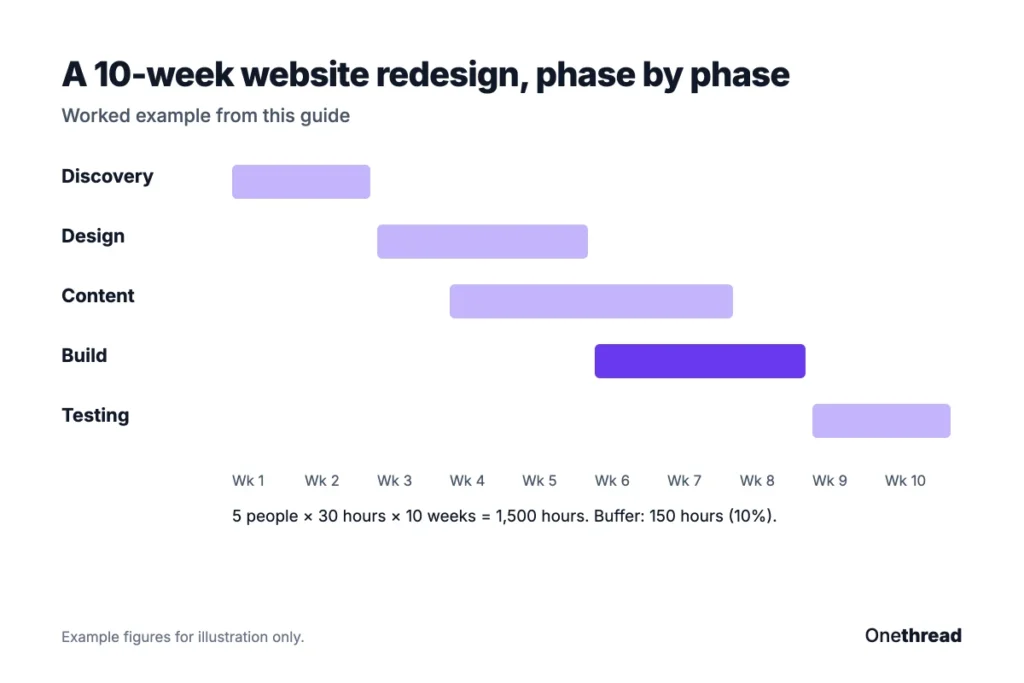
A worked example shows how the phases, elements and roles fit together. Picture a five-person team that needs to redesign a company website in 10 weeks, with one project manager leading it.
Example: the team plans 10 weeks of work for five people at 30 project hours a week each. That gives 5 × 30 × 10 = 1,500 hours. At an internal rate of $60 an hour, the labor budget is 1,500 × $60 = $90,000. The project manager holds back 10% of the hours, or 150 hours, as a buffer for changes.
That buffer sits in the plan as its own line, so everyone can see it shrink.
Initiation produces a one-page charter with the goal: a faster site with a new design, live by week 10. The marketing lead signs it as sponsor. Planning splits the work into discovery, design, content, build and testing, each with an owner and a milestone.
During execution, the client asks for a new pricing page in week 6. The project manager checks the buffer, sees 150 hours left and approves the change with a clear note on what it costs.
Closing comes after launch. The team runs a 30-minute review and records three lessons for the next site project. In this example, the buffer is what kept the late request from pushing the launch date.
More Guides on Project Management Basics
- best books on management
- best project management certification
- change management tools
- conflict in project management
- cost estimation in project management
- critical chain management
- critical path method
- eisenhower matrix for project management
- how to be an organized manager
- how to become a project manager
- how to manage a project
- importance of project management
- marketing project manager skills
- okrs
- online project management courses
- organizational goals
- perfect project plan
- project delays
- project dependencies
- project life cycle 5 phases
- project management and people management
- project management challenges
- project management framework
- project management plan
- project management quotes
- project management tools and techniques
- project manager roles responsibilities
- project scope management
- project time management
- requirements management tools
- risk management software
- smart goals
- smart model
- what can you learn from project management
- why do projects fail
- work breakdown structure
What Should You Do Next?
Project management is a simple loop: agree on the goal, plan the work, track it and close it out. Treat your next piece of work as a project with a start, an end and an owner. Then the five phases tell you what to do at each step.
Pick one small project you own this month and write a one-page charter with the goal, the deadline and the owner. Then list the tasks, set three milestones and review progress every week until you close it. Small wins build the habit.
FAQs
What Is Project Management in Simple Terms?
Project management, in simple terms, is getting a one-time piece of work done on time and within budget. You agree on the goal and split it into tasks. Each task gets an owner and a date. Then you track progress and close the project once the result is approved.
What Are the 3 Pillars of Project Management?
The three pillars of project management are scope, time and cost. Together they form the project triangle, with quality in the middle. If one changes, at least one other must change too. Adding scope, for example, needs more time, more budget or both.
Is Project Management a Good Career?
Yes, project management is a strong career for people who like planning and working with others. US project management specialists earn a median $102,320 a year. PMI also expects the world to need up to 30 million more project professionals by 2035.
What Is the Difference Between Project Management and Operations Management?
Project management handles temporary work with a set end, such as a product launch. Operations management runs the ongoing work that keeps a business going, such as payroll or customer support. Many managers do both, which is why clear project boundaries help.
Do You Need Software for Project Management?
You do not need software for one small project, since a spreadsheet and a calendar can work. Software starts to pay off once you run several projects or share people across teams. It keeps tasks, dates and updates in one place.