Codex pricing isn’t one price. It’s a ChatGPT plan, a credit balance and a usage meter.
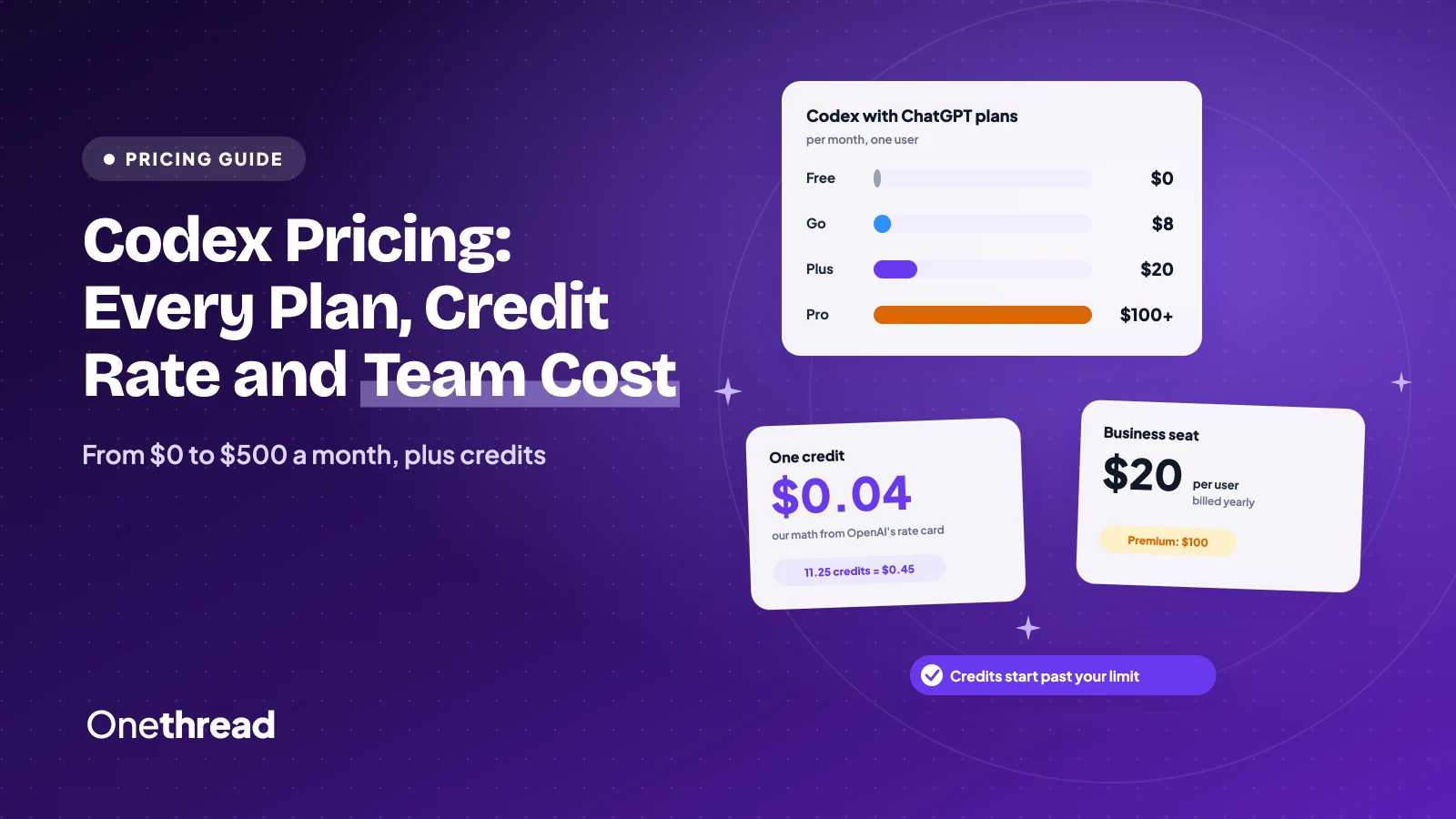
Codex comes with ChatGPT: Free costs $0, Go $8, Plus $20, and Pro $100, $200 or $500 a month. Business costs $20 per user a month billed yearly. An API key bills per token instead.
Hit your limit and credits take over. Several guides you’ll find still quote retired GPT-5 prices.
We read OpenAI’s pricing pages and 10 top-ranking guides, then priced a 10-developer team for a year.
Here’s what each plan costs, and where your bill grows.
Key Points
- Codex comes with ChatGPT: Free costs $0, Go $8, Plus $20, and Pro $100, $200 or $500 a month. Business costs $20 per user a month billed yearly, or $25 billed monthly. Enterprise is a quote, and an API key bills per token with no cloud features.
- Past your included usage, you buy credits. OpenAI doesn’t publish a dollar price per credit. Our math from its rate card and API prices gives $0.04 a credit, so a task that reads 150,000 tokens and writes 15,000 on GPT-6.1 Sol costs about $0.45.
- A 10-developer team pays $2,400 a year on Business Standard billed yearly and $12,000 on Premium seats. Premium costs 5x Standard for 5x the usage, so mix the seat types instead of upgrading everyone.
- Start on Plus or Business Standard, check your allowance with the /status command for a week, and upgrade only the developers who hit the limit.
How Much Does Codex Cost per Month?
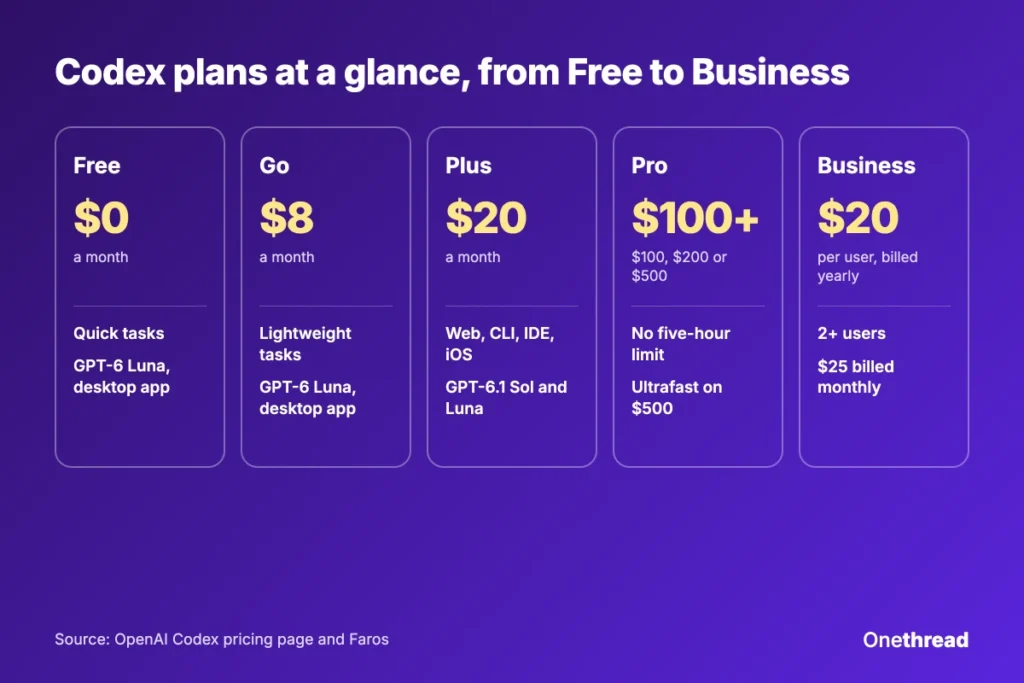
Codex costs $0 on the Free plan, $8 a month on Go and $20 on Plus. Pro runs $100, $200 or $500 a month. Business seats cost $20 per user a month billed yearly, or $25 billed monthly. Enterprise is a quote, and an API key bills per token.
| Plan | Price | What Codex access means |
|---|---|---|
| Free | $0 | Quick coding tasks with GPT-6 Luna in the desktop app, subject to rollout |
| Go | $8 a month | Lightweight coding tasks, same GPT-6 Luna access |
| Plus | $20 a month | Codex on web, CLI, IDE and iOS, with GPT-6.1 Sol and GPT-6 Luna |
| Pro | $100, $200 or $500 a month | No five-hour limit, and Ultrafast mode on the $500 tier |
| Business | $20 per user a month billed yearly, $25 billed monthly | Plus-level usage estimates per seat, for 2 or more users |
| Enterprise and Edu | Contact sales | Credit-based plans with no fixed rate limits |
| API key | Pay per token | CLI, SDK or IDE only, with no cloud features |
OpenAI includes Codex in every ChatGPT plan, so there’s no separate Codex subscription to buy. This guide covers OpenAI’s Codex coding agent. Go, Plus and Pro bill monthly with no annual discount, and Business is the only plan that rewards yearly billing.
Prices change often, so check the plan page on the day you buy.
Sources: OpenAI’s Codex pricing page, Faros’s Codex pricing guide.
What Does Codex Include on the Free and Go Plans?
Codex works on both Free and Go, but only at trial size. Free costs $0 and covers quick coding tasks. Go costs $8 a month and covers lightweight ones. Both list the same model: GPT-6 Luna at Standard speed in the desktop app, subject to rollout.
Say you want to see whether Codex can fix one failing test in your repo. Either plan handles that. Neither carries a week of daily work.
Faros’s guide adds that neither plan includes Codex Cloud, which runs tasks in the background. OpenAI’s usage table doesn’t list message counts for Free or Go either, so you can’t plan around a number.
OpenAI doesn’t publish how the Go allowance compares with Free, so treat the $8 as a small step up, not a promise. If you want the CLI, IDE and web apps, Plus at $20 is the plan to test.
Pricing: $0 for Free, $8 a month for Go.
Best For
- Developers trying Codex before they pay
- Occasional small fixes and questions about a codebase
Pros
- Costs nothing to start on Free
- Uses GPT-6 Luna, the cheapest model for credits
- Upgrades to Plus without changing accounts
Cons
- No Codex Cloud on either plan, per Faros
- No published usage numbers for planning
- Access depends on rollout
What Does Codex Include on the Plus Plan?
Plus costs $20 a month and is where Codex becomes a daily tool. It adds Codex on the web, in the CLI, in your IDE and on iOS, with GPT-6.1 Sol and GPT-6 Luna. When the allowance runs out, you can buy credits instead of waiting.
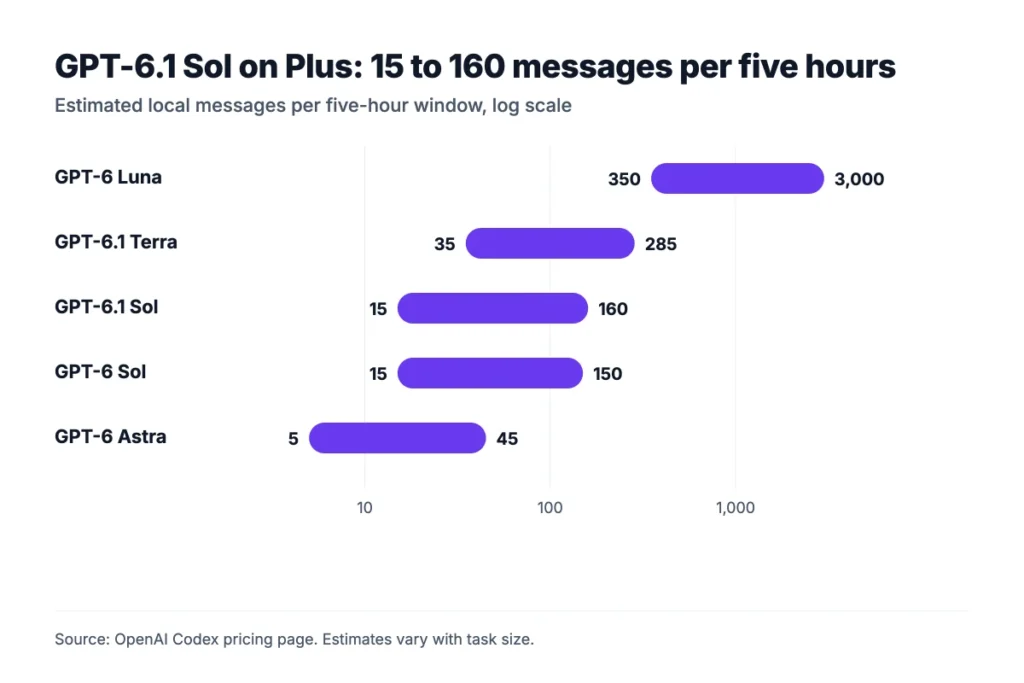
OpenAI estimates how many local messages Plus allows per five-hour window. The ranges are wide because task size drives the count:
- GPT-6 Luna: 350 to 3,000 messages
- GPT-6.1 Terra: 35 to 285 messages
- GPT-6.1 Sol: 15 to 160 messages
- GPT-6 Sol: 15 to 150 messages
- GPT-6 Astra: 5 to 45 messages
Local messages and cloud tasks share one allowance, and weekly limits can apply on top. OpenAI doesn’t publish the weekly numbers.
Example: At GPT-6.1 Sol’s low end, 15 messages in five hours is 15 ÷ 5 = 3 an hour. At the high end, 160 ÷ 5 = 32 an hour.
Plus includes limited GPT-6 Astra usage, and you buy credits for more. For the wider ChatGPT lineup, see our ChatGPT pricing guide.
Pricing: $20 a month, billed monthly.
Best For
- Developers who use Codex a few days a week
Pros
- Codex on web, CLI, IDE and iOS
- Credits extend the allowance without a plan change
- The same estimates apply to a Business Standard seat
Cons
- Five-hour windows and weekly limits both apply
- GPT-6 Astra access is limited
- The 15 to 160 message range makes planning hard
What Does Codex Include on the Pro Plans?
Pro starts at $100 a month and comes in three steps: $100, $200 and $500. None of them has a five-hour limit, though weekly limits still apply. Only the $500 plan adds Ultrafast mode. The $100 and $200 plans include GPT-6 Astra in the existing allowance.
OpenAI doesn’t publish how much more usage each tier allows. At launch, TechCrunch reported the $100 tier as 5x Plus Codex usage and the $200 tier as 20x.
Allowances have moved since. OpenAI doubled them on October 29 after it canceled a planned cut. In OpenAI’s words, “The reduction announced in our September 29 email is canceled.”
Pro also lists monthly API credits. They don’t pay for Codex usage on an API key, per Faros.
Top Tip: Don’t buy a Pro tier on a multiple you read in a guide. Check your own usage dashboard first, because the multiples are not on OpenAI’s pricing page.
Pricing: $100, $200 or $500 a month, billed monthly.
Best For
- Developers who hit the Plus limit most days
Pros
- No five-hour limit on any Pro tier
- Three price steps to match your usage
- GPT-6 Astra included in the $100 and $200 allowance
Cons
- No published usage multiples
- Weekly limits still apply
- Ultrafast mode only on the $500 tier
What Does Codex Include on the Business and Enterprise Plans?
Business Standard costs $20 per user a month billed yearly, or $25 billed monthly, with a minimum of 2 users. Premium seats cost $100 billed yearly or $125 billed monthly. Enterprise and Edu are quotes, with credit-based plans and no fixed rate limits.
Standard seats show the same usage estimates as Plus, so an annual Business seat costs the same $20. It adds a dedicated workspace with SAML single sign-on and multi-factor authentication. OpenAI doesn’t train on your data by default.
Premium seats give 5x the usage of Standard, with no five-hour limit and a weekly reset. When a workspace hits its limit, the owner can add shared workspace credits. You can mix both seat types in one workspace.
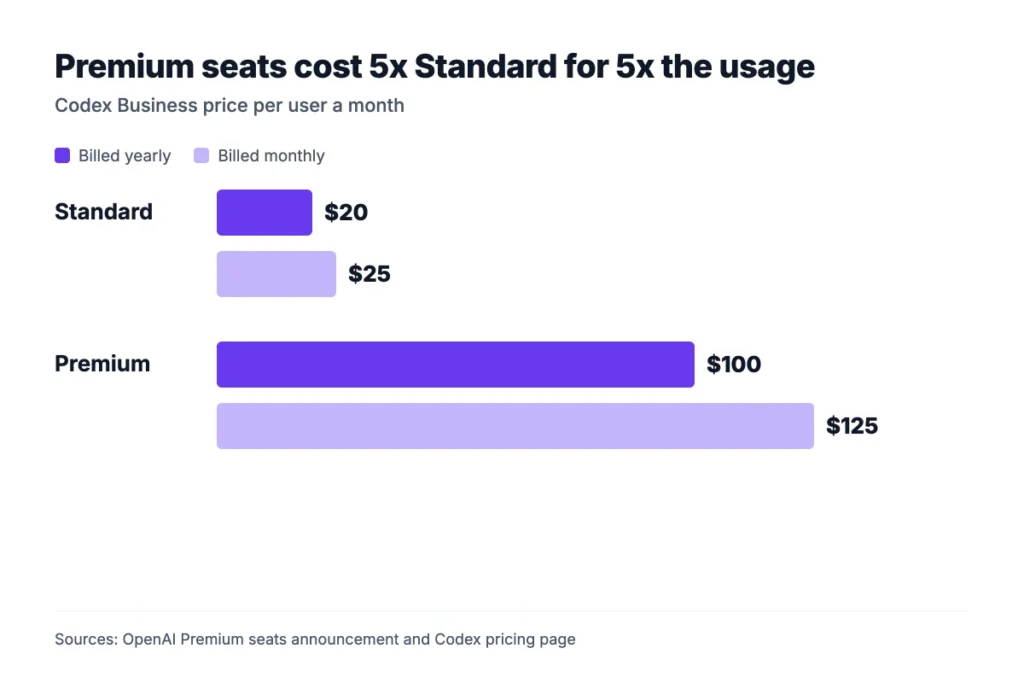
Example: Premium costs 5 × $20 = $100 per user a month on yearly billing, the same 5x as its usage. You pay in proportion, so the benefit is no five-hour limit, not a volume discount.
Enterprise and Edu plans add priority processing, SCIM, role-based access, a Compliance API and data residency controls, according to Morph’s guide.
Sources: OpenAI’s Premium seats announcement, OpenAI’s Codex pricing page, Morph’s Codex pricing guide.
Pricing: $20 per user a month billed yearly, or $25 billed monthly, for Standard. Premium costs $100 yearly or $125 monthly. Enterprise and Edu are quotes.
Best For
- Teams of 2 or more developers who need admin controls
- Mixed teams with a few heavy Codex users
Pros
- The $20 annual seat matches the Plus price
- Standard and Premium seats mix in one workspace
- Workspace credits cover spikes
Cons
- The $20 price needs annual billing and 2 or more users
- Enterprise has no public price
- Premium costs 5x Standard
How Do Codex Credits Work?
Codex credits pay for usage once your plan’s allowance runs out. Each task burns credits by model and by token type: input, cached input and output. Codex doesn’t charge for cache writes.
Here are OpenAI’s rates at Standard speed, in credits per 1 million tokens.
| Model | Input | Cached input | Output |
|---|---|---|---|
| GPT-6 Astra | 250 | 25 | 1,250 |
| GPT-6.1 Sol | 50 | 2.5 | 250 |
| GPT-6.1 Terra | 25 | 1.25 | 125 |
| GPT-6 Sol | 50 | 5 | 250 |
| GPT-6 Luna | 2.5 | 0.25 | 12.5 |
OpenAI doesn’t list a dollar price per credit. Purchase prices and discounts depend on your plan or agreement. We divided each credit rate into the matching API price and got $0.04 a credit for every model in the table. Treat that as an API-equivalent value, not a quote.
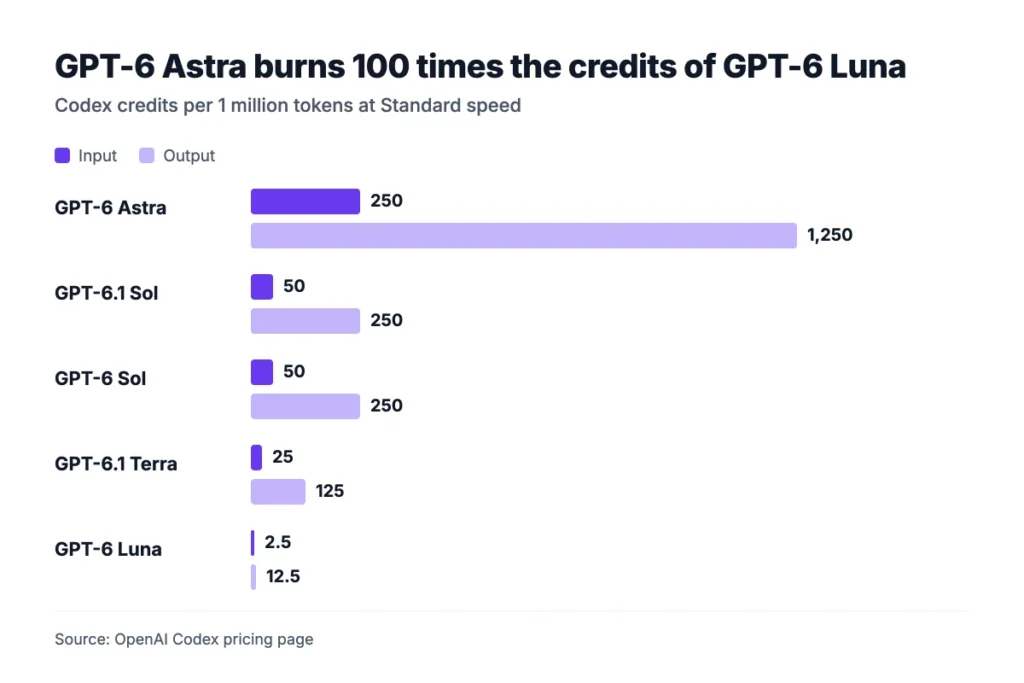
Example: A task reads 150,000 tokens and writes 15,000 on GPT-6.1 Sol. Input costs 0.15 × 50 = 7.5 credits and output costs 0.015 × 250 = 3.75 credits. The total is 11.25 credits, or 11.25 × $0.04 = $0.45. On GPT-6 Astra, the same task costs 56.25 credits, or $2.25.
Personal-plan credits stay valid for 12 months, per Faros. They are ChatGPT credits, not API credits.
Top Tip: Switch routine edits to a cheaper model. OpenAI says a lower-cost model makes your allowance last longer, and GPT-6 Luna costs 5% of GPT-6.1 Sol’s input rate.
What Happens When You Hit Codex Usage Limits?
Active turns can finish, then Codex stops until your allowance resets or you add credits. Plus and Pro users can buy credits, and Business workspaces buy workspace credits. API-key users keep working and pay standard API rates.
OpenAI doesn’t publish exact reset times. Plus and Business Standard run on five-hour windows. Pro and Premium seats don’t, though weekly limits can still apply. The usage dashboard and the /status command in the CLI show where you stand.
Four habits make an allowance last longer, all from OpenAI’s own guidance:
- Keep prompts focused: Name the files and the output you need.
- Limit source material: Attach less context per task.
- Trim AGENTS.md: A small file loads cheaply on every task.
- Disable unused MCP servers: Idle servers still add context.
Image generation draws on the same limits, and OpenAI says it uses them 3 to 5 times faster than a similar turn without it. Code review counts toward the limit only when it runs through GitHub.
Example: You run 20 tasks a day like the 11.25-credit task above. That’s 225 credits, or 225 × $0.04 = $9 a day at our rate. Price that against a Pro tier before you buy credits all month.
Sources: OpenAI’s Codex pricing page, FAQ section.
How Much Does Codex Cost With an API Key?
An API key bills per token at standard API rates instead of drawing on a plan allowance. It works with the CLI, SDK and IDE only, so Codex Cloud isn’t available. Faros lists these rates per 1 million tokens for the GPT-6 models.
| Model | Input | Cached input | Output |
|---|---|---|---|
| GPT-6 Astra | $10.00 | $1.00 | $50.00 |
| GPT-6.1 Sol | $2.00 | $0.10 | $10.00 |
| GPT-6.1 Terra | $1.00 | $0.05 | $5.00 |
| GPT-6 Luna | $0.10 | $0.01 | $0.50 |
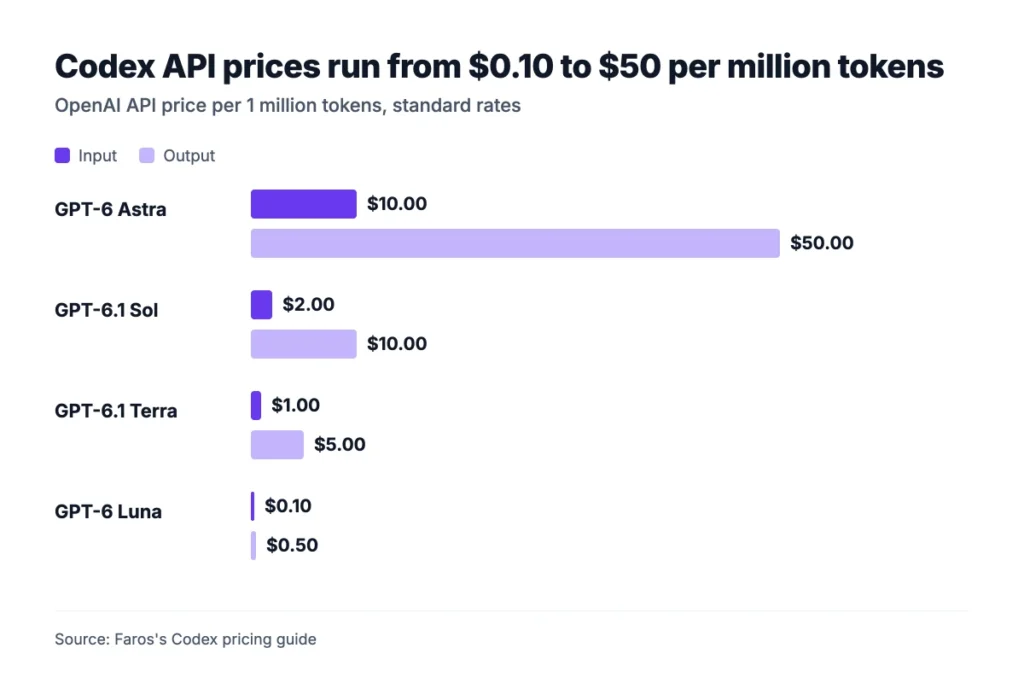
Two API-only charges can surprise you. For GPT-6.1 Sol requests over 272,000 input tokens, the whole request bills at 2x the input and cache rates and 1.5x the output rate. Supported regional processing adds a 10% premium. OpenAI says subscription usage of GPT-6.1 Sol has no long-context surcharge.
Example: The 150,000-token, 15,000-token task costs 0.15 × $2.00 + 0.015 × $10.00 = $0.45 on the API. A $20 Plus plan equals about $20 ÷ $0.45 = 44 such tasks at API rates, and a $100 Pro plan about 222.
Run that math with your own token counts. If your tasks are rare or scripted, an API key can cost less than a plan.
Top Tip: Use an API key for CI jobs and scripts, and a ChatGPT plan for hands-on work. The key skips plan limits, but it also skips Codex Cloud.
Sources: Faros’s Codex pricing guide, OpenAI’s Codex pricing page.
What Do Fast Mode, Voice and Image Generation Add to the Bill?
Fast mode costs 2.5 times the included usage of Standard speed, or 2 times the credits. Ultrafast costs 8 times the included usage, or 6 times the credits. Ultrafast covers GPT-6 Astra and GPT-6.1 Sol, and the $500 Pro plan and eligible Enterprise and Edu plans.
| Speed mode | Included subscription usage | Purchased credits |
|---|---|---|
| Fast | 2.5x | 2x |
| Ultrafast | 8x | 6x |
Example: The 11.25-credit task above costs 11.25 × 2 = 22.5 credits in Fast mode, or $0.90. In Ultrafast it costs 11.25 × 6 = 67.5 credits, or $2.70.
Voice in the desktop app costs $0.05 a minute from your Codex usage budget. On credit-based Business, Edu and Enterprise workspaces, it costs 1.25 credits a minute. Plus and Pro users pay the same credit rate when they spend extra credits.
Sites, OpenAI’s hosting feature, is included with eligible plans during its public beta.
Sources: OpenAI’s Codex pricing page.
What Does a 10-Developer Team Pay for Codex per Year?
A 10-developer team pays $2,400 a year on Business Standard billed yearly, $3,000 billed monthly and $12,000 on Premium seats. Pro tiers cost $12,000 and $24,000 a year for 10 developers. Mixing seat types cuts the bill most.
| Option, 10 developers | Price per user a month | One year | Best for (our view) |
|---|---|---|---|
| Business Standard, billed yearly | $20 | $2,400 | Light to moderate use |
| Business Standard, billed monthly | $25 | $3,000 | Teams that won’t commit |
| 7 Standard and 3 Premium, billed yearly | $20 and $100 | $5,280 | A few heavy users |
| Business Premium, billed yearly | $100 | $12,000 | Everyone codes with Codex daily |
| Pro $100 per developer | $100 | $12,000 | Individuals without admin controls |
| Pro $200 per developer | $200 | $24,000 | Power users |
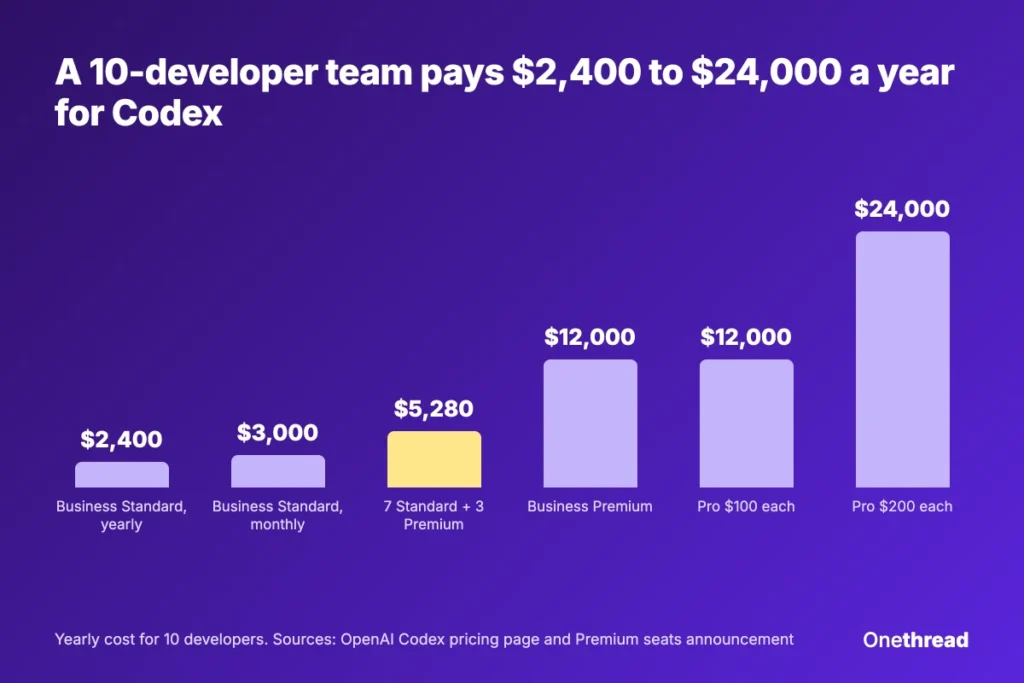
Example: Seven Standard seats cost 7 × $20 = $140 a month. Three Premium seats cost 3 × $100 = $300. The mix costs $440 × 12 = $5,280 a year, which is $6,720 less than 10 Premium seats.
OpenAI’s help center puts the average at about $100 to $200 per developer per month, with wide variation. For 10 developers, that’s $12,000 to $24,000 a year.
Top Tip: Put only the developers who hit the five-hour limit on Premium seats. Everyone else stays on Standard.
Treat the Codex line as one budget item. A project management tool such as Onethread can hold it next to the rest of the project budget. Our project estimate calculator helps you size it. Our guide to project management software for developers covers the wider toolset.
How Does Codex Pricing Compare With Claude Code?
Codex and Claude Code list the same prices at the $20 entry tier, the $100 tier and the team seat tiers. Claude Pro costs $20 a month, or $17 billed yearly. Max starts at $100, and Team seats cost $20 or $25 for Standard and $100 or $125 for Premium.
| Tier | Codex, ChatGPT plan | Claude Code, Claude plan |
|---|---|---|
| Entry paid plan | Plus, $20 a month | Pro, $20 a month, or $17 billed yearly |
| 5x tier | Pro, $100 a month | Max, $100 a month, 5x Pro usage |
| Team standard seat | Business, $20 billed yearly, $25 monthly | Team Standard, $20 billed yearly, $25 monthly |
| Team premium seat | Premium, $100 billed yearly, $125 monthly | Team Premium, $100 billed yearly, $125 monthly, 5x Standard |
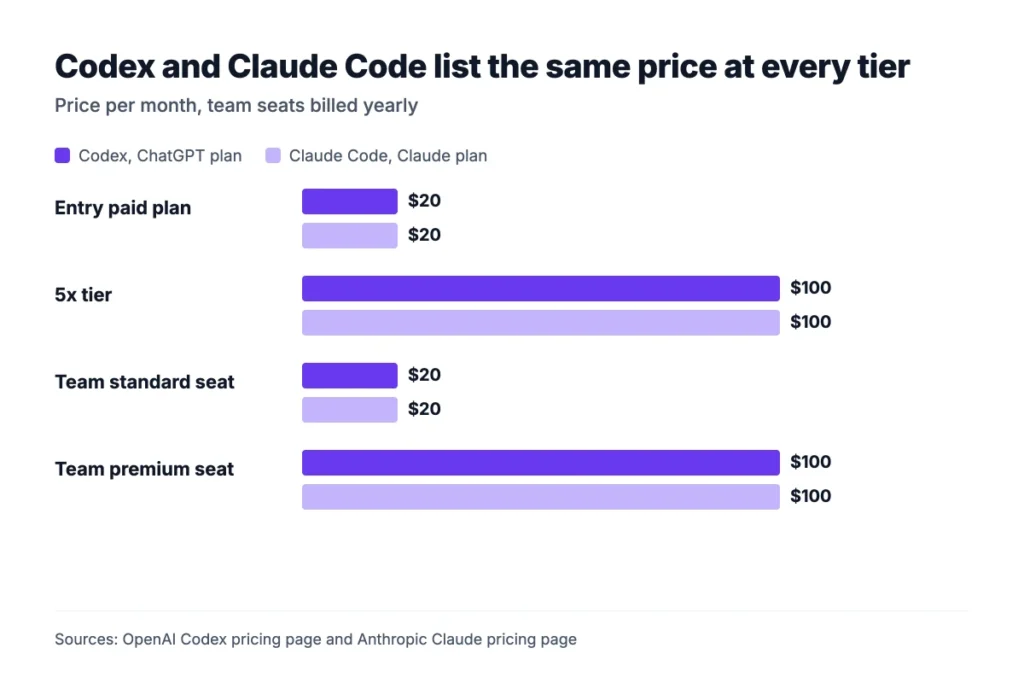
The price lists match, so the difference lies in the allowance and the model. OpenAI claims “Codex delivers more coding capacity per dollar across paid tiers.” We couldn’t verify that, and neither vendor publishes a like-for-like usage count.
Test both on one real task from your repo, and compare the allowance each one leaves you. For Anthropic’s side in detail, read our Claude Code pricing guide.
Sources: OpenAI’s Codex pricing page and Anthropic’s Claude pricing page.
What Changed in Codex Pricing This Year?
Codex pricing changed six times in about seven months, and most guides miss the last three changes. This timeline comes from OpenAI’s pages and news coverage we checked:
- April 2: Codex moved from per-message to token-based credit pricing for Plus, Pro and Business.
- April 9: OpenAI added the $100 Pro tier, reported at 5x Plus Codex usage.
- August 10: OpenAI announced Premium seats for Business, and they went live on August 25.
- September 29: The $500 Pro tier arrived, alongside a planned cut to Pro 200 allowances.
- October 14: GPT-5.5 left Codex for ChatGPT sign-in users.
- October 29: OpenAI canceled the Pro 200 cut and doubled allowances.
Two lessons come out of this list. Allowance changes arrive without a price change, so the same $200 buys a different amount of usage than it did in the spring. And a guide that quotes the April multiples describes a plan OpenAI has since changed twice. We treat every multiple as a launch-era figure.
Before you buy, check how old any guide is, ours included, and compare it with OpenAI’s plan page.
Sources: OpenAI’s Codex rate card, TechCrunch, OpenAI’s Premium seats announcement, Justin McKelvey’s Codex pricing guide, Mixed’s report on the Pro 200 reversal.
Which Codex Plan Should You Pick?
Pick Free or Go to test Codex and Plus for a few days of use a week. Move to a Pro or Premium seat when you hit the five-hour limit daily. Business Standard suits 2 or more developers who need single sign-on, and an API key suits scripts.
| If you… | Pick | Price |
|---|---|---|
| Want to try Codex on a small fix | Free or Go | $0 or $8 a month |
| Use Codex a few days a week | Plus | $20 a month |
| Hit the Plus limit most days | Pro or a Premium seat | $100 a month |
| Have 2 or more developers who need shared admin controls | Business Standard | $20 per user a month billed yearly |
| Run Codex in CI or scripts | API key | Per token |
| Need priority processing or data residency | Enterprise | Contact sales |
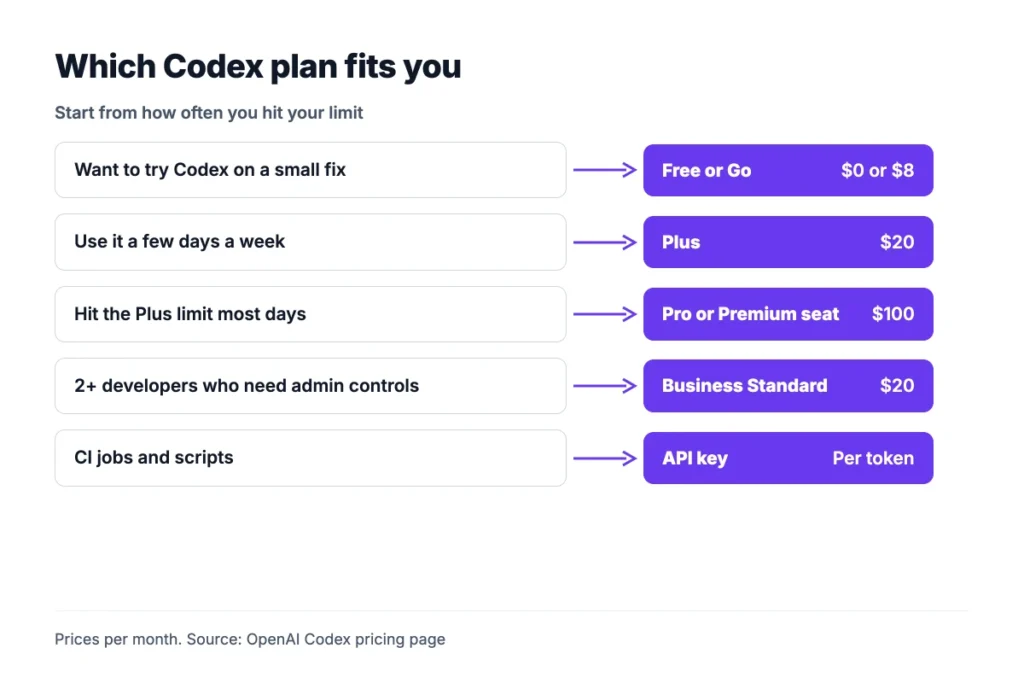
Start from usage, not features. Run /status at the end of your busiest day and note what’s left of the allowance. If it’s close to empty twice in a week, move up one tier. If you never come close, you’re already paying for the right plan.
If Codex is one line in a bigger tooling budget, a good project tool keeps it visible. We compare the options in our guide to the best project management software.
What Should You Do Next With Codex Pricing?
Codex pricing comes down to three numbers: your seat price, your usage and your credit burn. The list prices are easy to read. The allowance and the credit rate decide what you actually pay. We’ve given you the math to price both before you buy, so run it on your own token counts.
This week, run /status on your busiest day and write down what’s left of your allowance. Then price that usage against Plus and the next tier up with the $0.04 credit math above. If your usage fits Plus, stay there.
FAQs
Is Codex Completely Free?
No. The Free plan at $0 covers quick coding tasks with GPT-6 Luna in the desktop app, subject to rollout. Regular use needs Plus at $20 a month, or a Pro or Business plan. Past your allowance, Codex pricing moves to credits or API rates.
Is Codex Free With ChatGPT Plus?
Codex access is included in the $20 Plus price, so you pay nothing extra to use it. Usage is capped by five-hour windows and weekly limits. When you pass them, you buy credits or wait. GPT-6 Astra is only included in limited amounts on Plus.
Does ChatGPT Pro Include Unlimited Codex Usage?
No. Pro offers higher Codex allowances at $100, $200 or $500 a month, and weekly limits still apply. Pro plans have no five-hour limit. How far an allowance goes depends on the model, the task size and the speed mode you pick.
Does the Codex CLI Cost Extra?
No. The Codex CLI draws on your ChatGPT plan’s allowance when you sign in with ChatGPT. With an API key, it bills at standard API rates per token instead. Either way, Codex pricing includes no separate CLI fee, so you only pay for the plan or the tokens.
Are Codex Credits the Same as OpenAI API Credits?
No. ChatGPT credits extend Codex usage after your included allowance runs out. API credits belong to the separate API billing system. The promotional API credits that come with eligible Pro and Business plans don’t cover Codex usage through an API key, per Faros.
Is There a Codex Discount for Nonprofits?
Yes, for teams. OpenAI’s ChatGPT pricing page lists up to a 75% discount on ChatGPT Business or Enterprise for nonprofits. It lists no discount for individual Free, Go, Plus or Pro plans. Ask OpenAI sales to confirm the exact rate for your organization.